Moon Sweepers
DragDrop Games · Simulation, Indie, Automation
Overview
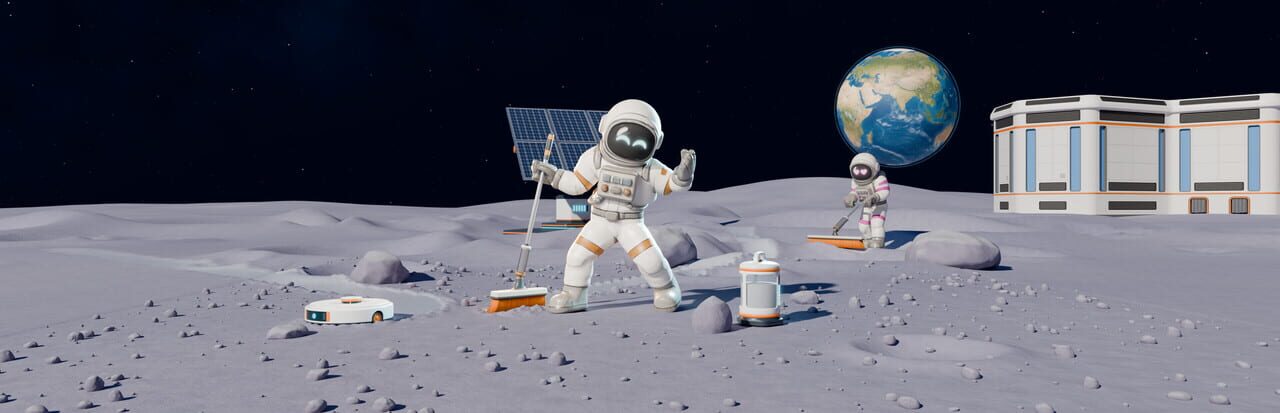
An entire Moon to clean. One toothbrush to start. Team up with up to 16 players, collect and sell lunar dust, upgrade your tools, and unlock cleaning vehicles. Turn a ridiculous job into a thriving operation, if your friends actually help.
Read moreShow less
The Moon is covered in dust. The Lunar Surface Department (LSD) has sent you and your crew to clean it up. Unfortunately, the budget only covered a toothbrush.
Collect lunar dust, sell and use the earnings to buy better tools and upgrade your equipment. Turn an underfunded cleanup mission into a growing operation, one painfully small brushstroke at a time.
Team up in online co-op lobbies of up to 16 players. Spread out to cover more ground or tackle the same area together. There’s enough dust to keep everyone busy. Whether everyone actually works is another matter.
Fill your storage with lunar dust, deliver it to a depot and launch shipments to get paid. Spend your earnings on new cleaning tools and increased carrying capacity so you can take on bigger jobs between deliveries.
Watch dusty terrain turn clean with every pass. Track your progress across the lunar surface, place depots near your work and put cleaning vehicles to use as your operation grows.
Stop being lazy, you’ve got whole Moon to clean. Better get started.
From the game's Steam store page.
THE GAMEQ VERDICT3,899 reviews analyzed
What players are actually saying
1. Summary
Moon Sweepers starts you on the moon with a toothbrush and asks you to clean all of it, and a lot of reviewers find that premise funny and absorbing. They praise the early climb from hand tools to ride-on sweepers and vacuum trucks, and they call the sweeping itself relaxing and satisfying. Playing with friends is the other big draw (reviewers mention lobbies of up to 16), and some groups describe losing whole nights to it. At under $10, many reviewers say the price was fair for the hours they got.
Both sides of the vote run into the same problem. Players say they have bought every upgrade and vehicle while the moon sits at or below 1% clean, and from there the game becomes a matter of placing more J.O.O.N.A.S. robots and leaving the PC running. 45% of the negative reviews make this complaint, and about 11% of the positive ones raise it too. Players add a clunky build system, a hard cap on how fast dust can be sold, and frame rates that collapse once hundreds of robots are out. Reviewers on both sides tend to like the core and call the game unfinished. Where they part ways is whether it is worth paying for in that state.
2. What keeps coming up
What players praise
A relaxing, satisfying sweeping loopHigh
Reviewers call the game chill, cozy, zen, therapeutic and "brain off", and many describe pairing it with a podcast, audiobook or a show on a second screen. Watching the hexagonal sectors turn clean, line by line, is described as oddly addictive, and the size of the task is part of the joke: "the only game ever where i can be .084% done and still feel like im making good progress". Fans of PowerWash Simulator often bring it up as a close match. The soundtrack and calm presentation get smaller but consistent mentions. Some negative reviews also say the sweeping itself feels good; their objections start later in the game.
Great fun with friendsHigh
Couples, siblings, parents with kids and groups of friends describe marathon sessions, flinging each other into low orbit with vehicles, racing to clean sectors and playing the in-base chess and air hockey. One group summed it up as "Suddenly it's 6 am and you've each got a vehicle." Many reviewers recommend the game specifically as a group activity and warn that it drags solo. In launch week the main co-op complaint was that the team shared one wallet while each player had to buy their own tool and vehicle upgrades. Later reviews report that a patch made upgrades shared, and a few say only the host sees the ending cutscene.
Good value for the priceMedium
The price (around $7 to $10 depending on region and launch discount) comes up a lot, mostly as a reason to forgive the thin late game. Positive reviews often do the math, such as 20 to 40 hours for under $10, and some say they would have paid more. Negative reviews use the same number the other way: a few call it worth $2 to $5, and others say a cheap price does not excuse a game that feels unfinished.
A strong first stretchMedium
Reviewers on both sides agree that the first five to ten hours work. Going from a toothbrush to brooms, then to ride-on sweepers and the vacuum rover, gives regular jumps in power, and the first surprise for many is finding out the moon is a full sphere you can drive around. Some reviewers grade the game in stages: a good early game, an acceptable mid game and a weak end. A minority found the opening toothbrush phase too slow, and some skipped it by hunting flags for cash.
A small team that patched fastMedium
Launch-week reviews often credit what they describe as a two-person team for quick fixes. Players report patches within days for broken splitters and mergers, conveyors that swallowed dust without paying, J.O.O.N.A.S. robots that stopped working away from the player, shared co-op upgrades, a move-building option and performance problems. One player wrote, "Woke up to an update fixing all of these and many more." A handful of reviews were edited from negative to positive after these patches, and some players mention a planned December update as the reason they are holding off on finishing.
Humor and presentationLow
The opening employment contract and the manual get specific praise for their dry corporate satire ("The employment contract you sign at the start tells you exactly what to expect from the game."), along with the base interior, the posters and the clean art style. A few found the satire too bleak, and one solo player called the gray surface visually boring.
Low-gravity physics and side toysLow
Mostly in co-op reviews, players mention vehicle stunts that pay out small cash rewards, moon-gravity jumps, chess, air hockey and the whiteboards as charming extras. A few note the stunt payouts are too small to matter.
Where players are split
The light factory and automation layerMedium
Turning dust into sand and moon stone with pressure chambers, stone presses, belts and solar panels divides players. Some love it as "babies first automation game", a gentle introduction to factory building for people put off by Satisfactory or Factorio. Players who know those games often call it shallow: two processing buildings, no machine or belt upgrades and one layout repeated at every base. Others point out that the factory stops mattering once money stops mattering, and several say they tore their production lines down and fed raw dust straight to the stations because the lines added lag and little else.
The size of the moon, especially soloMedium
For some players the enormous moon is the point. They play an hour at a time like a zen garden and are happy if it never ends. Others, especially solo players, say the scale stops being funny once the tools stop growing, because finishing then means days of the game running in the background. Groups get much further, and several solo reviewers recommend the game only to people with friends to play it with. A handful of players were proud to have cleaned the whole moon alone, and some reported 30 to 100 hours on the clock, much of it idle.
Flags and survey sitesLow
Reviewers count 195 national flags and 26 survey sites (lunar landing sites) scattered across the surface, and hunting them is a well-liked side activity whose cash speeds up the early game. Late in the game the rewards stop meaning anything, and there is no radar, so the last few are hard to find: "finding the last few flags without any radar or hint system is brutal." Players also point out that no achievements are tied to collecting them all.
The endingLow
Players who finished the moon often call the ending surprising or funny and say it made the slog worth it. Others found a short cutscene a thin reward for dozens of hours, and some co-op players say only the host saw it.
What frustrates players
Progression runs out long before the moon doesHigh
Negative reviews raise this more than any other problem. Dozens of reviewers say they had bought every tool, vehicle, upgrade and building at or below 1% of the moon cleaned: "After only a few hours, I had already unlocked 100% of the available upgrades and structures, while having cleaned only around 1% of the Moon." From then on, the late game means saving $20,000 at a time for another J.O.O.N.A.S. robot, building the same small factory at the next station and waiting, often overnight or for days. Money piles up into the millions with nothing to spend it on. One player who finished put it this way: "Unlock all the upgrades in 4 hours, Leave computer running for 90 hours so the robots can clean the moon for you." Dozens of reviewers, positive ones among them, say the game should have launched as early access, and several plan to come back after the planned December update. A small but vocal group argues that a huge, slow task is the point and that complainers expected the wrong genre.
Late-game performance and robot pathingMedium
Finishing takes hundreds of J.O.O.N.A.S. robots, and players report that the game struggles to run them. Reviews describe frame rates falling to the teens or single digits, stutter on high-end cards, RAM usage near 30 GB and a host's PC working flat out: "By the end the frame rate was cleaning harder than I was." The robots draw separate complaints. They leave sectors partly cleaned, wander to random spots, freeze near the player or bunch up on terrain. Some players say a few sectors stayed stuck at 98 to 99% with no visible dust, so they could not reach 100% at all. In launch week, robots also stopped working when the player was far away; later reviews say a patch fixed this, though a few say it still happened to them.
A clumsy build systemMedium
Players describe aggressive snapping with no grid option, belts that will not line up, stairs and walls with mismatched heights, roofs that need all four walls, and splitters and mergers that cannot be raised: "Litterally everything intersects with everything all of the time." With no blueprints or copy tool, the same buildings and solar panels have to be placed one at a time at every base. Buildings do not show which side is input and which is output, and before the move tool arrived, a misplaced building could only be sold back at a 25% loss. Deleting a belt dumps every capsule on the ground, and they then have to be picked up one by one. A minority of players say the system was fine for them.
A hard cap on how fast dust can be soldMedium
The four stations have a fixed number of deposit ports, belts have one speed, and the processing buildings cannot be upgraded, so players who push the automation find that extra robots stop adding speed past a few hundred: "You can build hundreds of robot cleaners, but most will be idle while they wait for an open collector." They ask for faster belts, buildable sell points, bigger capsules and storage silos. Some found workarounds, such as placing unconnected capsule catchers as extra sinks or using Nexus mods.
Upgrades that are not worth buyingMedium
Upgrading a brush usually costs about as much as the next, better tool, so incremental-game fans find the sensible move is to skip upgrades and early vehicles entirely: "Well that was dumb, I should have just saved a little more for the next one." Players list upgrades they see as pointless, such as faster depositing when depositing is already instant, a six-slot tool belt when only two slots are useful, and vehicle suction upgrades with no visible effect. Hand tools become obsolete as soon as the first vehicle arrives.
Suspicion that the game was made with AIMedium
About 15% of negative reviews say the game looks or plays as if it was AI-generated or "vibe-coded". They point to odd upgrade descriptions and numbers, three different names for the hex sectors, a distorted player model and systems that look untested, and some say the AI use goes beyond the translation the Steam page discloses. A few say they refunded or would not have bought it had they known. Some positive reviewers reject the claim or say it makes no difference to their fun, and one notes the game ships in 19 languages.
Crashes and game-breaking bugsMedium
Crashes come up most in launch week, including some on AMD graphics cards, a memory leak reported on Linux and a few full PC shutdowns. Those reports thin out in later weeks. Other bugs persist across the two weeks: capsules stuck in a machine's input that can only be cleared by rebuilding it, production lines that stop with "could not pack a capsule", stray dust capsules landing on sand belts, and the player being launched into the air after touching a capsule or a building edge. A small number of reviews report lost saves, bugged achievements (several cite the 10,000-deposit and money achievements) and a game that forgot a player owned their fully upgraded vehicle.
Griefers in public lobbiesLow
Players who left their world public describe strangers joining, deleting factories, spending the shared money (sometimes into debt) and leaving. One player summed up the pattern as "someone joins, deletes all of your production and conveyor belts, then logs out." There are no build permissions, logs or rollback, so the advice in these reviews is to play solo or with friends only. For a few negative reviewers, this was the main reason for the thumbs down.
Night-time powerLow
Solar panels are the only power source, the lunar night is long and gives no countdown, and the panels store too little to carry factories through it. Players ask for batteries, power lines or another generator.
Comfort and control optionsLow
Motion sickness from the camera following every tool swing shows up mostly in reviews written in the first hour or two ("Couldn't even lock the camera. Made me sick."), and a couple of those players say they refunded or are thinking about it. Others report hard-coded keys with no rebinding, a problem for left-handed players and alternate keyboard layouts. Players also mention a vehicle camera that keeps snapping back behind the car, no first-person or zoom option while driving, hold-to-sweep with no toggle (one reviewer with tendonitis raised this) and unfinished controller support.
3. The player conversation
The tone is warmer than the thumbs-down share suggests. Many negative reviews say they had fun or want the game to succeed, and some positive ones carry the same "needs more content" caveat. Few reviews argue the core loop is bad; the argument is over whether a fun ten hours followed by days of idling deserves a recommendation at this price. A loud minority on each side goes further: some call the game AI-made "slop", while some fans scold the negative reviewers for expecting depth from a cheap game about sweeping dust.
Who raises what follows the game's arc. Motion sickness and missing key rebinding cluster in reviews written in the first hour or two, as does pure delight at the premise. Players in the mid game write about the build system, belts and the first sight of the upgrade ceiling. Players deep into the late game write the long, detailed reviews about throughput caps, robot pathing, frame rates with hundreds of bots and sectors stuck at 99%. Co-op players talk about shared money, griefing and hosting; solo players talk about scale.
Launch-week reviews were 82% positive, and more of them dealt with bugs and quick patches. The share fell to 79% the following week and to 76% in the first days of November. As more players reached the late game, complaints about the empty endgame and late-game performance became more common, while reports of crashes and praise for fast patches both faded.
4. What the developers could do
- Extend progression past the first percent. 45% of negative reviews say progression runs out early, dozens of them at about 1% of the moon cleaned, and players ask for higher-tier vehicles and machines, J.O.O.N.A.S. upgrades and further processing steps to spend their millions on.
- Lift the throughput cap. Players with hundreds of robots say the limit is the fixed deposit ports, single-speed belts and unupgradable processing buildings, so faster belts, buildable sell points, larger capsules and storage silos are the fixes they ask for.
- Optimize the late game and fix J.O.O.N.A.S. pathing. Finishing the moon requires the robot counts that drop frame rates into single digits, and players describe robots leaving sectors half-cleaned or stuck at 98 to 99%, which blocks 100% completion.
- Rework the build tools. Reviewers want grid snapping they can control, blueprints or copy-paste for repeated layouts, input and output markers on buildings, and a bulk pickup for the capsules that spill when a belt is deleted.
- Rebalance tool and vehicle upgrades. Players say they skip upgrades because the next tool costs about the same and does more, so upgrades need to be worth buying and intermediate tiers need a reason to exist.
- Fix the production-stopping bugs. "Could not pack a capsule", capsules stuck in machine inputs, stray capsules on sand belts and the remaining crash reports come up in negative reviews from players partway through the game.
- Add host permissions for public lobbies. Griefers deleting factories and draining shared money led some players to stop hosting public worlds, and they ask for build, delete and spend permissions plus kick or rollback options.
- Add comfort and control options. A camera lock or reduced sway, a toggle for vehicle camera auto-centering, key rebinding and a toggle for sweeping would address the motion sickness and accessibility complaints that turn some players away in their first hour.