Probably Stolen
Questing Goose Studio · Simulation, Management
Overview
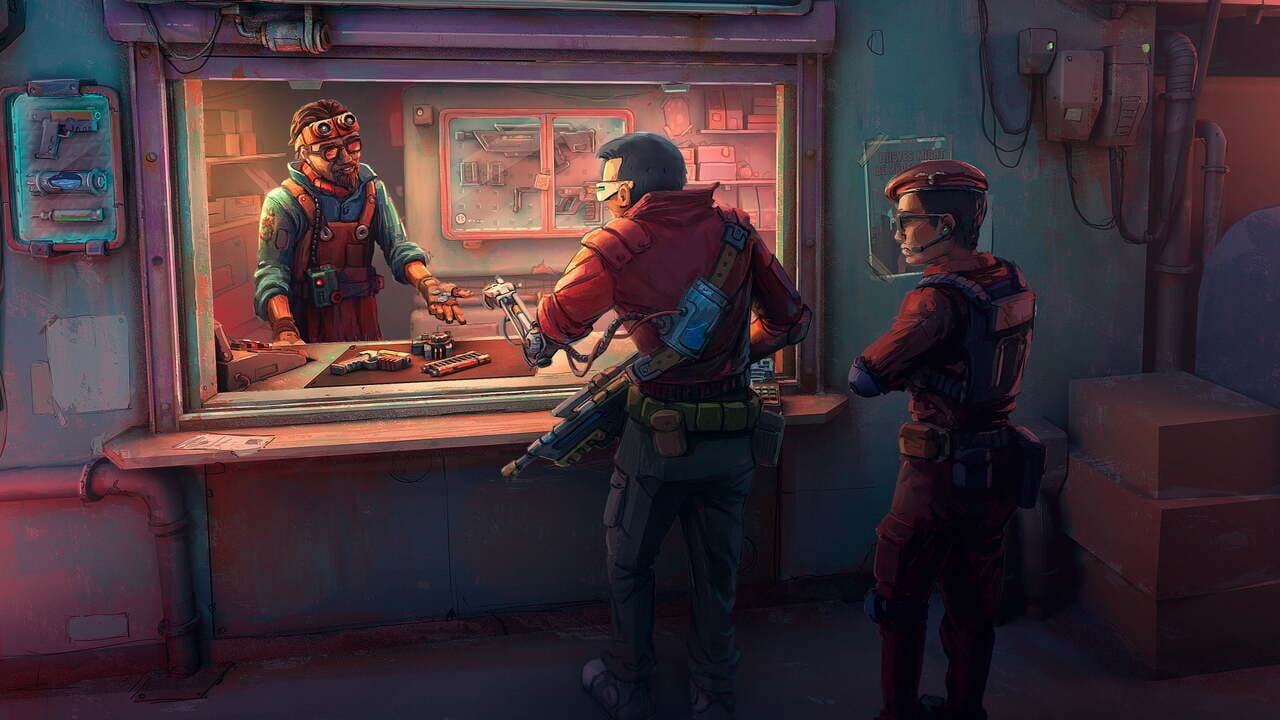
Probably Stolen is a cyberpunk shopkeeping simulator set in a dystopian space station. Craft, trade, and smuggle goods of questionable origin, navigate faction loyalties, and decide how far you’re willing to go to stay afloat. Earn enough to buy out your shop before rising rent forces your hand.
Read moreShow less
In a towering space station split by wealth and corruption, your business runs on merchandise with flexible origins. You’re a former scavenger who secured a storefront thanks to a generous loan and questionable timing. Now rent is rising, factions are watching, and most of your best margins live in legal gray zones.
You never really know who’s on the other side of the counter. Today’s customer could be a security fisher for evidence, a revolutionary seeking leverage, or a fallen elite testing your usefulness. Every sale is a gamble. Approve it, refuse it, report it, or look away; someone is always taking notes. Reputation buys access and protection, but it also paints a target on your back. On this station, every client is a potential profit and a potential trouble.
Start as a gunsmith, chemist, water merchant, fence, farmer, or from absolute rock bottom. Every product line has its own profit curve and its own way of ruining you, weapons bring inspections, chemicals bring addiction, water brings liability, contraband brings raids. Some trades need heavy machinery and permits, others just a good hiding spot and a straight face. The better the margins, the worse the consequences when something goes wrong. You’re not choosing a theme for your shop, you’re choosing which kind of trouble you’re willing to monetize.
Every item you stock carries its own risks. Cigarette packs need visual inspection before resale. Water must be tested and filtered. Weapons require permits and modifications. Profitable chemicals rely on closely guarded recipes. Rare items need proper appraisal to avoid overpaying. You can cut the product’s quality, relabel counterfeit products as genuine, or fence discounted, stolen goods if you believe Security won’t reach you. But beware, there’s always the mob justice. Suppliers overstate value, customers push their luck, and contraband often comes with issues you only notice after the deal is done. Your margins depend on how well you assess what’s in front of you. Misjudge the item or the person selling it, and you absorb the cost.
Keep the rent paid and you can start thinking bigger. Expand your operation, run multiple businesses, and unlock new merchandise and production opportunities. But rent keeps rising, and confiscated stock or a bad deal can leave you struggling to make the next payment. Every purchase needs to earn its keep
A sentient AI chip went rogue and took its hosts with it. Augs look like everyone else ... until they don't. Stay alert, pick up on the signs. Every faction agrees on the policy, and you have the gun to enforce it. But missing the signs, or misreading them, carries its own price
Run your store in a dystopian station
Balance supply and demand by attracting the right customers
Authenticate rare goods and sell them for a profit
Haggle for the best deals, but remember that every bargain comes with a trade-off
Master additional jobs: water merchant, hydroponic farmer, organ dealer, and more
Manage machines and production chains to craft valuable artifacts
Unlock advanced licenses to access the underground market
Navigate cutthroat politics and build connections with the right factions to get the exclusive deals
Profit from the arrogant elite by selling them counterfeit goods
Manage and expand your inventory
Hide stolen goods and contraband from the authorities (or bribe your way out if you get caught)
From the game's Steam store page.
THE GAMEQ VERDICT4,708 reviews analyzed
What players are actually saying
1. Summary
Probably Stolen is a pixel-art shop sim on a grimy space station where you buy, sell, appraise and relabel goods to make the weekly rent, and 96% of the English reviews recommend it. A lot of that praise is about how hard it is to stop playing: 16% of reviews call it addictive or a "one more day" game, or mention looking up at 3 AM. Players also keep listing side trades they didn't expect from a shop counter. Water purification, rat and fish farming, chemistry, 3D-printed guns, wine, appraisals and contraband are all optional and feed into each other, and the crime stories (drugged water, relabeled tap water, guns sold and then reported) show how much players enjoy bending the rules. About 7% of reviews compare it to Papers, Please, and those who spell out the difference point to the missing timer and the slower, calmer pace.
The criticism is narrow and fairly consistent. Once you have learned the systems and seen the scripted characters, the days start to repeat, and buying the shop ends the run with little story payoff. Several players feel the 1.0 release still reads like early access, with professions marked as coming later. Below that come inventory and UI friction, the randomness of which customers walk in, a save system that only saves between days, and a handful of bugs, including an update rollback that broke some saves and mods. A number of the negative reviews still say the first hours were fun. This verdict reads English reviews; Steam's all-language rating is Mostly Positive (74%).
2. What keeps coming up
What players praise
The "one more day" loop is hard to put downHigh
16% of the reviews describe the game as addictive, call it "crack" or a "one more day" game, or report playing until 2, 3 or 4 AM. Some reviews are nothing more than a playtime confession: 12 or 15 hours in a first sitting, a whole weekend gone. One player called it "The game that ruined indie sims for me (in the best way possible)", because it held their attention well past the point where similar sims had lost them.
Each day is short and turn-based, there is always another upgrade or deal within reach, and the weekly rent gives a steady target. A couple of negative reviews see that pull as a problem and compare the game to doomscrolling or a Skinner box, and a couple of players who recommend it joke about uninstalling it to get their free time back.
Deep, optional trades that feed into each otherHigh
Reviews keep listing the side trades: purifying sewer water into "pure" grades, breeding rats and fish, growing crops, cooking drugs at the right temperature, 3D-printing gun parts, aging wine, appraising sandwiches and cybernetic hands. Players are surprised that a game set behind one counter goes this far, and some say they had barely scratched the surface after dozens of hours.
None of it is required, and players like that. One wrote that the game has "Lots of varied ways to make money and a wide variety of game mechanics, but critically for a game like this, they are all optional." The systems also connect (clean water grows plants, which feed the rats), and chemistry and water purification are the ones positive reviews most often call deep. Critics disagree. One negative review says that "while this game has many different systems all of them are very shallow and almost identical to each other," and another says drug making and water purification are "kept vague to hide their lack of complexity."
Papers, Please without the timerHigh
7% of the reviews compare the game to Papers, Please. The inspection side (spotting counterfeits, checking the wanted list, catching Augs) borrows that game's look and feel, and players who explain the difference point to the lack of a clock on customers. "There is no timer forcing you to rush through customers," one wrote, and another said it "doesn't play like a job." Players often call it cozy, chill or relaxing even with crime and rent pressure around it, and say they can play it in short sessions or let it run for hours.
Some came in expecting Papers, Please and left disappointed. They say the story is far lighter, the choices matter less, and the gameplay leans toward trading and inventory management rather than tense document checks.
Freedom to run an honest shop or a crooked oneMedium
The reviews are full of crime stories: lacing water with narcotics to bring customers back, relabeling tap water as glacier water, selling 3D-printed guns to the revolution and then reporting the buyer to security, hiding contraband before a surprise inspection. Reputation with Security, the black market, the revolution and the upper and lower levels shapes which risks you can take. Some reviewers got arrested at the end of a long run and started a new one anyway, laughing about it. Some critics feel the factions do not push back on each other enough. Several note you can max reputation with everyone at once, and that Security stops checking a shop it trusts.
Memorable characters and plenty of referencesMedium
Georgio, the junk-selling scavenger, is the character players name most, and Eleanor and Serpico come up too; Officer Lun gets a few mentions, mostly as the villain players love to hate. Players also like the Space Station 13 references and the cameos by streamers such as Ohnepixel and CaseOh (see the split section for those). One reviewer found "so much more world building and characterization than I was expecting."
Several players who recommend the game add that there are too few of these storylines and that they stop without a clear ending. One wrote that "there wasn't enough of these unique character stories overall."
Strong value for the priceMedium
Reviews that bring up the price mostly say the game is worth the money, some mentioning paying about $20 and getting 30, 50 or 100 hours from it. Several say they would happily buy DLC. A few critics disagree and would only pay $5 to $12 for what they saw as a few hours of content, and some advise waiting for a sale until more content arrives.
Art, music and atmosphereMedium
The pixel art, the dirty cyberpunk setting and the synthwave and lo-fi soundtrack get regular praise. Several players like that new tracks come on cassette tapes you buy from customers, and some say the soundtrack alone was worth it. A few found the music repetitive or the art plain, and some feel the setting is more generic sci-fi than cyberpunk.
Mod support and an active roadmapMedium
Reviews mention the public roadmap, frequent patches, developers who answer bug reports on Discord, and the ability to carry over demo saves. Day-one Steam Workshop support is a plus for players who bring it up. Several use mods for quick saves, real-time clocks and inventory fixes. The catch, raised in several reviews, is that the Workshop filled up fast with low-effort and untranslated mods; one player said "the Workshop is FILLED with AI slop."
Runs on almost anythingLow
A smaller group notes the game runs well on old laptops, Linux through Proton, and modest PCs.
Where players are split
Difficulty and balanceMedium
Some find normal difficulty too forgiving once a money-maker is set up: "The game is so incredibly generous with cash that the only way to lose is to do so on purpose." A few name water trading and appraisals as overpowered, and some say a run cannot really be lost once liquid assets pass a certain point. Others struggled to pay rent, got stuck with only sellers walking in, or found certain starts weak. One wrote "Some specialisations are just insanely bad, and some are crazy value," and gunsmithing is described as both the best and the worst start. Some experienced players recommend the harder starts (Rock Bottom, Red Ink) for a real challenge, and others like being able to tune the difficulty and perks.
Saving only between daysLow
The game saves when you sleep, at the boundary between days. Some players like this and say it keeps them honest: "with saves only at the start of the day, you can always squeeze another one before bed." Others hate losing a half-played day when they have to quit, and at least one negative review is about exactly this. Players also warn that only a few recent saves are kept by default, which matters for the softlock problem below.
Learning curve and unexplained systemsLow
Some players enjoy figuring things out and praise the tutorial and the mentor's notebook. Others feel thrown into dozens of options with no sense of which ones pay off, and chemistry in particular is called vague. Several players ask for an in-game wiki or clearer item descriptions.
Streamer cameosLow
Some players who mention CaseOh and Ohnepixel walking into the shop find it funny. Others say a real-world streamer pulled them out of the setting.
What frustrates players
Repetition and a thin late gameMedium
This is the main complaint, and it shows up in praise as well as criticism. Among the game-focused negative reviews, 38% use words like repetitive, boring, tedious, grind or shallow. The first hours keep introducing new mechanics, characters and events, and then the scripted stories run out and days blur together. One critic put it as "what you do in hour 20 is the same as hour 1 just with different merchandise." Another hit a point where "all the special events have dried up" while they kept paying off the mortgage.
Buying the shop ends the main goal with a stats screen, and players expected factions and relationships to lead somewhere: "the faction system doesn't tie into the endings." Several also say the profession you pick at the start barely matters, because "almost everything is available during every playthrough anyway," which cuts replay value. Positive reviews often carry the same caveat in milder form: great for one or two runs of 20 to 40 hours, then thin until more content arrives.
A 1.0 that feels like early accessMedium
The starting-profession screen lists options marked as in development (the Junker, organ trader and food vendor starts), the store page shows organ trading that is not yet in the game, customers ask for armor that cannot be bought, and some systems such as gunsmithing feel underbuilt. "It's a 0.9 at best," one reviewer wrote. Others point to typos and stiff dialogue. Some positive reviews accept this because the roadmap promises those starts, but for some critics it is the reason they voted no.
Inventory and UI frictionMedium
For a game built around inventory, players want better tools: sorting by category ("Useless sort function. It only sorts by size"), a way to swap items on the cursor, rotating stacks, tabs that snap or resize, keybinds for storage tabs, and less clutter when many containers are open. Small text comes up too, especially on the Steam Deck. Several reviews mention the button that sends the next customer in: players accidentally dismiss a seller or lose a complex trade, and one asked to "Please add a button to recall the previous customer." Others want to advance dialogue with the mouse instead of the space bar.
Customer randomness undercuts specializingLow
Players who build around one trade complain that the customers who walk in do not follow it. Some describe days of only sellers ("80% of people selling you stuff and only 20% buying"), buyers asking for goods the shop never stocks, and display windows that seem to be ignored. Others note the newspaper with price events arrives only after the display is set. One critic said "there's absolutely no way to know how many actual buyers and sellers you'll get in a day," and that story characters count against the daily customer limit.
Story softlocks around LouLow
A small but angry group lost long runs to one character, Lou, whose story could end a run based on a choice made days earlier, with no way to fight back and no save left to reload. One player reported "40 hours on one save just to get soft-locked into an inescapable game-over state." A later update reworked the character, and at least one reviewer switched to positive because it made "softlocks less possible", though a few later reviews still complained about her.
Bugs in specific systemsLow
Bug reports are scattered and mostly tied to particular mechanics: water purification not changing quality ("Water filtration and purification doesn't work"), supplier contacts that never show up or answer, items that vanish from the counter or from an upgraded smugglers bay, a false-report fine when reporting a contraband seller, and a few freezes or crashes. Some other reviews say they hit no bugs at all and praise how quickly patches arrived.
An update rollback that broke saves and modsLow
Players report the live game being rolled back to an earlier build, once in launch week and again in week two, when most of these complaints were written. Those who hit it describe lost saves and broken Workshop mods: "Pointless rollback breaks saves and most mods," and "Rolled back a major quality of life update with no explanation." One player said the rollback "broke my 30-hour save." Some reviewers noted it was fixed within hours or could be avoided through the beta branch.
Steam Deck, controller and Mac supportLow
Steam Deck players report that "Some text is unreadably small on the deck" and ask for UI scaling. Others ask for controller support, ultrawide support and a Mac version. Several Deck players still say it plays well.
3. The player conversation
Short reviews often read as confessions of lost sleep or crime-spree anecdotes (rat farms, drugged water, selling a gun and then reporting the buyer) rather than structured reviews. Negative reviews make up a small slice, and a number of them open by saying the first hours were fun before explaining why the game did not hold up.
Players who quit within the first hour or two mostly say it did not click: too slow, too much like work, or not the Papers, Please they expected. The repetition, endgame and early-access complaints come from players who finished a run, usually after 10 to 40 hours. The Lou softlock and save complaints come from players who lost long runs. Mod talk and balance debates come from the most invested players. A visible group arrived after many hours in the demo and playtests, under what some reviewers say was the game's old name, DeepSpace Emporium, and judges 1.0 as a big step up.
The game-focused positive share eased only slightly over time, from 97% in launch week to 96% in week two and 94% for reviews written from 2026-11-09. Later reviews talk more about repetition, the rollback and the late game as players finished first runs.
4. What the developers could do
- Add late-game goals and real endings. Repetition after the scripted stories end, and a shop purchase that closes the run with a stats screen, are the most common reasons players stopped or voted no; faction and character outcomes are what they asked for.
- Ship the announced starts and fill the visible gaps. The Junker, organ trader and food vendor starts marked as in development, plus armor that customers ask for, are why several players call 1.0 an early-access game.
- Make starting professions and customer flow follow your specialty. Players want shop signs and displays to draw the buyers they built for, a better balance of buyers to sellers, and starts that feel different instead of unlocking everything in every run.
- Improve inventory and UI tools. Players asked for category sorting, UI and text scaling, item swapping, a way to recall a dismissed customer, and mouse-driven dialogue.
- Protect long runs from softlocks. Players asked for mid-day saving or save-and-quit, more save slots by default, and clear warnings before story choices that can end a run days later, as happened with Lou.
- Fix the system-specific bugs. Water purification, supplier contacts, items disappearing from the counter or smugglers bay, and false-report fines were the bugs players named.
- Test risky updates on a beta branch. The rollback that broke saves and Workshop mods turned several fans negative, and one asked for a beta branch instead of changes to the live build.
- Support the Steam Deck, controllers and Mac. Readable text on the Deck, controller support, ultrawide layouts and a Mac version were the platform requests.