Transport Fever 3
Urban Games · Simulation, Strategy, Management
Overview
Transport Fever 3, the ultimate transport tycoon returns, bigger, deeper, and more dynamic than ever. Build the routes that transform the world across land, sea, and sky using over a century of evolving transport options. Design and build your ideal transport network.
Read moreShow less
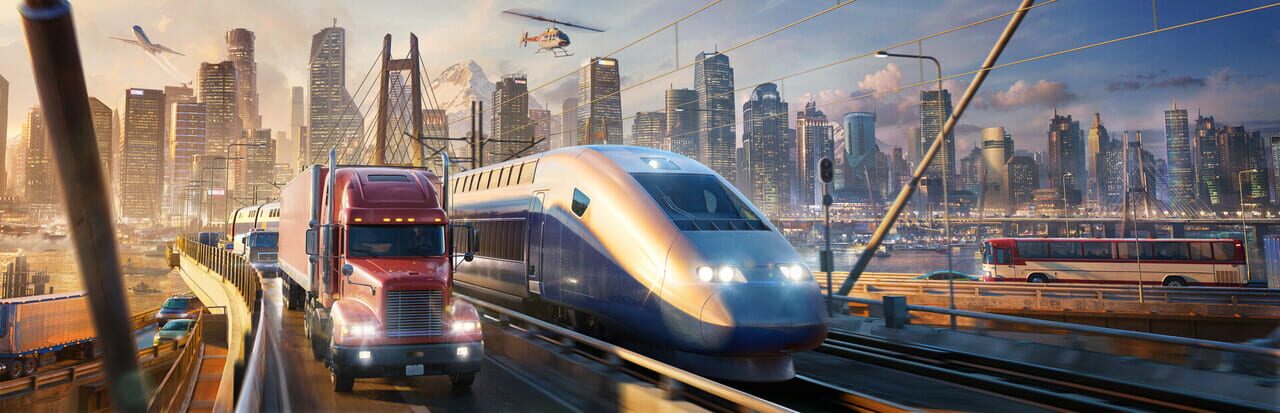
Plan, build, and optimize! Transport Fever 3 puts you in charge of your own transport empire. From humble beginnings with horse-drawn wagons, steam trains, and paddle-steamers working towards the latest jet planes, supertankers, high-speed trains, and helicopters, you will build the network that drives the world!
Every delivery earns money, while every train, truck, plane, or ship increases your costs. You’ll plan and build profitable routes, balance infrastructure expenses, and invest in upgrades to stay ahead of growing demand.
With success comes the financial freedom to expand your reach, while earning the right to build world famous landmarks to demonstrate your achievements. Fall short, and you’ll be seeking efficiencies and improvements to propel your company forward.
As your influence expands, the needs of every city become more challenging to fulfill. There's no such thing as one plan that works forever, you will need to adapt, overcome, and solve problems as they come up, balancing your desire for growth with the needs of the populations you serve.
BECOME THE TYCOON
Build your personal transport empire by creating perfect routes to maximise your profits. Ensure that cargo and people get where they need to be, when they need to be. Manage and optimize your vehicle fleet, balance maintenance costs, efficiency, and priorities. Resolve bottlenecks and meet the evolving demands of dynamic towns and a multitude of industries that operate on- and offshore. Develop commercial centers, industrial powerhouses, and commuter cities by specializing deliveries and mastering every transport decision.
CONNECT THE WORLD
Connect towns and industries to fuel their growth. Plan and construct rails, roads, sea- and airways to build your transport empire. Grow tiny villages into major cities as you master traffic priorities and management systems. Analyze trouble using data layers and visual displays to identify traffic hotspots, delivery problems, or excessive noise and pollution. Make use of intuitive building tools to further optimize your network and grow from small country roads to highways and from old-wooden rails to modern high-speed tracks.
EXPERIENCE A LIVING SIMULATION
Every citizen has a home, a job, and places to go in the expanded living simulation, letting you follow each one along the way. Dynamic weather and a full day-night cycle let you experience your world in countless moods, from sunny mornings to rainy, clouded afternoons. Each of the four climate zones brings unique challenges, from temperate valleys and subarctic swamps, to desert plains and tropical islands, all demanding a fresh approach to your transportation strategy.
PLAY IT YOUR WAY
Customize your game with multiple difficulty options, enabling you to create your perfect game. Adjust the way the world, economy, and its citizens react to your style of play. Design ultimate tycoon adversity, that will test you to the limit, as you race to complete contract objectives in the fastest possible time. Ease the difficulty to a more relaxed setting and play for fun, or disable the economy entirely and build the most stunning city, station, or diorama you can imagine.
WRITE TRANSPORT HISTORY
Solve epic transport missions from history that will test your planning, efficiency, and cunning in the extensive story campaign. Immerse in the full tycoon experience, making use of the largest range of vehicles in the series that spans over a century of transport evolution. The whole world, including buildings, people, and cars, follow designs and trends through time. Rewrite transportation history and run steam trains and jets side by side as you progress through the 20th century and beyond.
CREATE WITHOUT LIMITS
Modding tools have been greatly improved, enabling mod creators to bring their favourite vehicles, buildings, and infrastructure to life. The fully featured in-game map editor allows anyone to craft maps closely matching reality or drawn from your wildest imagination. Share your creations or expand your collection and the scope of your worlds with ease using the in-game mod browser, expanding the range of possibilities in directions that will keep your experience fresh again and again.
BUILT ON WHAT WORKS
Transport Fever 3 builds on everything that has made the series a favorite among transport and tycoon fans for years. Every system has been refined, every feature expanded, and every tool streamlined to deliver the most complete and rewarding experience yet. With smarter cities, deeper logistics, improved performance, and an even greater focus on tycoon gameplay, it’s the ultimate evolution of a proven formula, built for both newcomers and veterans to enjoy for years to come.
FEATURE OVERVIEW
Tycoon mode with highly-adjustable difficulty to set the perfect level of challenge
Sandbox mode to build with unrestricted creativity and strong mod support
Campaign mode featuring entertaining missions inspired by real historic events
Map editor to design comprehensive maps in-game and accessible modification tools
Wide range of tricky achievements with unique goals and rewarding challenges
More than 125 years of transport evolution - from horse-drawn wagons to high-speed trains
275+ realistic vehicles such as trains, buses, trams, trucks, ships, aircraft and helicopters
All major transport types covered, including light rail systems and dedicated cargo trams
Modular infrastructure spanning multiple eras - from classic train stations to modern airports
Physically-based atmosphere and cloud-coverage, day/night cycle and dynamic lighting
Multiple highly immersive climate zones, including a brand new subarctic region
Randomly generated maps with distinct biomes that offer unique game-play challenges
Town growth featuring dynamic districts based on simulating individual inhabitants
Advanced traffic simulation with lane control and realistic behavior such as overtaking
Landmarks inspired by real-world architecture, adding character to towns and regions
Over 35 unique industries, including off-shore sectors such as fishing grounds and oil platforms
Demand-driven industry expansion with production boosted by workers and optional inputs
Redesigned cargo simulation providing full control over loading and unloading
Warehouses and specialized terminals for intermediate storage and logistics optimization
Dynamic loan and contract system offering risk versus reward opportunities
Simple yet deep game mechanics based on maintenance, noise/pollution, reputation and more
Extensive customization options ensuring a high replay value and diverse play styles
Powerful road and track construction tools including overland trams and highway ramps
Flexible road design options with individual tram lanes and configurable lane connections
Intuitive landscaping tools for terrain sculpting, ground painting and vegetation placement
Cross-platform modding support with in-game mod browser for easy content discovery
From the game's Steam store page.
THE GAMEQ VERDICT2,426 reviews analyzed
What players are actually saying
1. Summary
Most reviewers recommend Transport Fever 3, and some of the negative reviews say they enjoy it anyway. What they praise sits underneath the map: industries that need workers and supplies to grow, goods that spoil if they travel too slowly, warehouses that let cargo go wherever the player sends it instead of to a fixed destination, town ratings for noise and pollution, and subsidy contracts that give free play a sense of direction. It also looks much better than Transport Fever 2, with weather and a day/night cycle that reviewers often single out, and plenty of players describe losing whole evenings to it.
Stutter and unstable frame rates, often on high-end PCs, dominated the complaints on the first day of reviews and kept coming up all week. The redesigned interface, which buries actions that took one click in Transport Fever 2 under several menus, is the other complaint that runs through the negative reviews. Around both runs an argument about whether this is a true sequel or "Transport Fever 2.5" at full price, sharpened by removed content (the 1850 to 1900 era, regional vehicle sets), modern-looking industries in 1900, and what reviewers describe as a switch from the Steam Workshop to an in-game mod hub. Even some negative reviews call the core game good, and reviewers on both sides advise waiting for patches or a sale.
2. What keeps coming up
What players praise
Graphics, weather and the day/night cycleHigh
Reviewers praise the vehicle models, the new subarctic biome, tunnels, lighting and the cockpit camera, and a few describe riding along with a vehicle just to watch the scenery: "Rain, sunsets, sunrises, and the changing light throughout the day create some absolutely beautiful scenery." A small number push back. A few find the colours oversaturated, one calls the oak tree level of detail terrible at close range, and some say the jump from Transport Fever 2 is smaller than the trailers suggested.
A deeper industry and town economyHigh
When reviewers explain why this is more than a reskin, they usually point here. Industries no longer produce at a flat rate: they grow when you bring in workers and secondary supplies such as fertilizer or tools, new industries appear as towns demand new goods, and cargo is no longer locked to a destination the moment it is produced. Food and fish spoil if they take too long, which kills the old trick of hauling goods across the map for distance pay. One player put the effect plainly: "Industry production can be boosted by bringing in workers or equipment from other locations on the map." Another, recalling how many people turned the earlier games into a sandbox train set, wrote that "TF3 does everything in it's power to actually make a game out of this."
Some find the passenger happiness and delivery-time windows too strict, and a couple of players say towns grow far too fast. Even so, several negative reviews say they like the new systems and fault the game for other things.
Quality-of-life upgrades from Transport Fever 2Medium
Players coming from the previous game list practical fixes: trucks can load directly inside industries instead of needing a separate truck stop, lines and vehicles are managed in one window, vehicles can be bought straight onto a line, lines can be auto-named, track and road can follow terrain, and there is a lane and intersection tool for traffic. "TRAFFIC MANAGEMENT!!!! Being able to micro intersections when needed is worth buying the game by itself." Cargo trams, light rail that runs on train track, underground tram stations and helicopters are also mentioned fondly in a number of reviews. Some of these were popular Transport Fever 2 mods; a few players take that as the developers listening to the community, while critics see it as a sign of how little is truly new.
Subsidy contracts give free play directionMedium
Reviewers who mention the time-limited contracts from towns and industries mostly like them. They say the contracts pull them into parts of the map they would have ignored and ease the early cash crunch, one calling it a system that "adds a huge incentive to explore new parts of the map." The usual caveat is balance. Rewards of several million for a short worker run feel far too generous to some ("Nerf Subsidies please, they are so OP that nothing else matters."), others report contracts that are impossible to complete, such as transfer-free links across a lake before bridges are affordable, and a few find the offers too frequent or stressful.
The "one more line" pullMedium
Reviews describing the game eating whole evenings turn up throughout the week, many of them short, and a handful mention staying up far too late. "Not a single game has grabbed me like this since 10 years." Newcomers write several of these, and one player says Transport Fever 2 never fully grabbed them because of its usability flaws, while this one did.
Native Linux and Mac versionsLow
Linux players single out the native build and often report that it runs well: "Runs like a freight train down a hill." Mac reviews are more divided, with some M-series owners happy and others reporting low frame rates and resolution problems.
Where players are split
A real sequel, or "Transport Fever 2.5"?High
Comparisons with Transport Fever 2 appear in a large share of reviews, and they cut both ways. One camp, heavy with players who have hundreds or thousands of hours in the previous game, says the core loop, engine and long-standing bugs are unchanged and the additions could have been a patch or a paid expansion: "90% of the game is Transport Fever 2 with barely upgraded graphics." The other camp says the changes are under the hood and only show after a few hours. One TF2 and TF1 veteran wrote: "I would say the difference between this and TF2 is bigger then the difference between TF2 and TF1." Some positive reviews sit in between, calling it an evolution rather than a revolution and saying that is enough for them. Newcomers to the series rarely raise the question at all.
The cargo and warehouse reworkMedium
Fans like that cargo can be stockpiled and routed wherever they want, so they can build real hubs: "Cargo is no longer assigned to an end destination once it is produced, and it can be carried wherever you want and used wherever you want." Critics, often veterans with large networks, say the game lost Transport Fever 2's demand-based routing, so every line now needs its cargo set by hand, mixed-cargo trains are awkward, there is no direct control over what unloads where, and warehouses fill with goods nobody wants. "Well they changed the core of the game from a transportation game to a line manager game." A player who enjoyed it put it more gently: "the new cargo model sometimes makes me feel like the game has outsourced its ERP system to the player." Partial unloading shows how little the game explains: one reviewer lists it as impossible, while others describe doing it through load percentages.
Economy balance: too easy or a loan trap?Medium
Players disagree on difficulty. Some say money stops mattering once subsidies start: "First try on hard, in 1923 I am swimming in money." Others, often newer or playing on harder settings, describe spiralling loan repayments and maintenance costs: "But what they did is a complete loan simulator." One player blames the finance screens instead, where every line can show green while the company loses millions.
Campaign and tutorialMedium
The campaign gets mixed notices. Some enjoy its cutscenes and voiced characters and say it teaches the new systems well. Others find the first missions heavily hand-held ("The first scenario is a bit insulting to peoples' intelligence."), one calls the desert truck-driving mission annoying, and several regret that it is short: "seeing only 8 missions here was honestly pretty disappointing." The free-play tutorial draws specific bug reports, including objectives that demand a costly bridge across a lake before the player can afford it while locking other actions. A wider point that comes up again and again is that the game shows a line is broken but not why: "when a route breaks or stops moving goods, good luck figuring it out."
Noise, pollution and town reputationLow
Some players like that towns now react to noise, pollution and demolition, because it forces better planning. Others call the numbers incoherent, with newer electric vehicles rated noisier or dirtier than old diesels ("why is an 1990 electric train dirtier than a 1935 diesel and louder than a jet powered aircraft?!"), and dislike that upgrading a congested road or smoothing terrain tanks a town's opinion. Several players on both sides point out that the systems can be adjusted or switched off.
What frustrates players
Stutter and unstable performanceHigh
Performance comes up in more negative reviews than any other problem, and several players say it is why they refunded. Reviewers describe frame rates swinging between 30 and 60 on medium settings, stutter when panning or building, single-digit drops on high-end cards, and GPUs or laptops running hot. "Devs have skipped the optimization phase." Players name specific triggers: opening a vehicle window (which renders a live camera view), rain, dense trees on subarctic maps, autosaves, and the purple icon over vehicles on subsidy routes ("I have noticed a huge FPS drop whenever the world-space UI is drawn on vehicles with active subsidy boosts"). Larger cities bring a separate CPU-side slowdown: "Under 15-20k population the game plays fine, over 30k its a real struggle."
Experiences vary widely, and many positive reviews say it runs fine. Players share fixes that worked for them: switching from the default borderless or windowed mode to fullscreen, turning off V-Sync, updating GPU drivers, lowering grass, or waiting a few minutes for shaders to compile. A couple say the preview branch fixed their stutter. Others ask for a frame-rate cap and DLSS or frame generation, which they say the game lacks.
A redesigned UI that takes more clicksHigh
Complaints about the interface often come from Transport Fever 2 veterans, who describe vehicle windows that dump every statistic at once, line and platform edits buried in sub-menus, filters that reset each time, map icons that vanish whenever a window is open, and no clear alert when a line or train gets stuck. "Something that was a one click thing in Transport Fever 2 is now 3 to 5 clicks in sub sub menus." A first-day review puts it more bluntly: "Things are now locked behind triple the clicks you needed beforehand." Some feel it was designed for consoles and controllers first. A minority, often newcomers, prefer it: "The UI/UX is leaps better than TF2s often kinda ugly, convoluted design and a much needed improvement." Reviewers on both sides often say it takes a while to get used to.
Price for what is newMedium
Price is a regular theme of negative reviews, usually tied to the Transport Fever 2.5 argument: players say the game is fine but not worth the $50 or so they paid (more for the Deluxe Edition) when Transport Fever 2 with mods is much cheaper. "Feels more like a DLC than a full $50 game." Some positive reviews add the same caveat and suggest waiting for a sale, and opinions on the Deluxe Edition extras run both ways.
Mod hub instead of Steam WorkshopMedium
Reviewers describe the move from Steam Workshop to an in-game mod.io hub as a sore point for a community built on mods. Complaints cover slow downloads that only happen inside the game, no comments or changelogs on mods, no easy way to see or uninstall subscribed mods, and mod files saved to the C drive. "the review is staying negative until Workshop support returns, because this whole franchise's success was built off the workshop." The issue peaked on October 7, when reviewers reported a mod hub failure that unsubscribed them from their mods and left modded saves unplayable: 12 of the 38 reviews written that day describe it, most of them negative reviews ("Modhub in game also unsubscribes your mods randomly and stops you from playing your saves..."). Others defend the hub as cross-platform and note that "you don't have to log in with a Paradox Account, you can sign in with your Steam Account."
Crashes and bugsMedium
A smaller group report frequent crashes to desktop, sometimes every 10 to 30 minutes, on high-end systems without mods: "Crashing every 10-30 minutes no matter what settings I tweak or what I do." Others list bugs such as building rotation hotkeys stopping until the menu is reopened, trains or helicopters stuck at stations, tunnel junctions that break, lines that stop working until rebuilt, and an "internal error" on loading saves. Other players report no crashes at all.
Modern industries in a 1900 startMedium
Players who like the early eras keep pointing at the same thing: industries, depots and warehouses use one modern model for every year. Oil rigs with helipads, forklifts, asphalt, excavators and parked trucks all appear while players are still running horse carts. "your steam wagon will pull up to a modern factory with diesel excavators and work trucks in the year 1900." One reviewer refunded over this alone; others treat it as an immersion problem they hope a patch or mod will fix.
A thinner vehicle roster and the lost 1850 startMedium
Some veterans say the vehicle list is smaller than Transport Fever 2's once its regional sets (European, North American, Asian) were merged into one pool, with North American wagons especially scarce. Players who build themed networks dislike being forced to mix regions: "Building my Swiss-style network with Chinese coaches won't do." Dropping the 1850 to 1900 era is a related grievance: "removing 50 years of transport history makes absolutely no sense to me." Some players defend the cut as removing a slow, boring stretch, and one notes that the early vehicles can be re-added as a mod, though using mods disables achievements.
Map generation and industry placementMedium
Players complain about rivers that loop or cross each other, mountains as isolated bumps, and raw materials spawned on the far side of the map from the factories that need them, sometimes behind water the player cannot yet afford to bridge. "I've spent more time restarting the game looking for a decent map than I have playing it." A detailed late-game review describes the deeper version of the problem: one refinery on a large map that can never supply all its farms, "That is not a difficult logistics problem. It is an unsatisfiable one."
Traffic that won't overtakeLow
Road vehicles stuck behind horse carts or slower traffic, even on multi-lane roads, are a recurring irritation that matters more now that late deliveries anger towns. Some also report AI traffic piling onto one road or junction while wider routes sit empty.
No Steam Cloud savesLow
A few players who play across machines or through cloud gaming services note that saves don't sync: "No Steam Cloud support."
3. The player conversation
The share of positive reviews held fairly steady over the week. The first day of reviews (September 29) was the weakest full day at 69% positive, driven by short first-session reviews about stutter and refunds; September 30 and October 5 were the best at about 76%, and the other days sat between about 70% and 74%. October 7, the day of the reported mod hub failure, came in at 50% from a much smaller batch.
Two groups of negative reviews rarely overlap. One is players who refunded within the first hour or two, often over performance and some on powerful hardware, though others refunded over price or because it felt too close to Transport Fever 2. The other is Transport Fever 2 veterans, frequently citing hundreds or thousands of hours, who played longer and wrote detailed lists about the interface, removed content, cargo micromanagement and anachronisms. Players who say they are new to the series are mostly positive.
Some positive reviews are written as rebuttals, telling readers to ignore performance complaints, update drivers or switch to fullscreen, and to give the new mechanics a few hours. The advice to buy it later, after patches or in a sale, turns up in positive and negative reviews alike, and a few reviewers say they would have picked a neutral rating if Steam offered one. Reviews from players with longer sessions talk less about launch problems and more about balance: subsidies that are too generous, industries that cannot keep up with town demand, and performance falling off as populations climb.
4. What the developers could do
- Fix the stutter and frame-time spikes first. Performance comes up in more negative reviews than any other problem and is a reason several players give for refunding, and players have already pointed at specific triggers such as the subsidy icon over vehicles, the live vehicle camera window, rain and borderless mode.
- Cut the clicks out of everyday line and vehicle management. Veterans say routine tasks like changing a line's platform or adding vehicles now take several menus, and they want map icons to stay visible with windows open and filters that remember their settings.
- Make the mod hub reliable and easier to manage. The October 7 failure that reviewers say unsubscribed their mods broke saves and drew a burst of negative reviews, and players also want uninstall, enable-all, collections and comments, with some still asking for Steam Workshop support alongside it.
- Explain why a line or cargo chain is not working, and add clear stuck-train alerts. Players across experience levels describe lines failing with vague warnings about clashing or misconfigured cargo and having to work out warehouses, partial unloading and terminals on their own.
- Add era-appropriate models for industries, depots and warehouses. Modern forklifts, helipads and trucks around 1900 industries are a recurring immersion complaint, and at least one player refunded over it.
- Stabilise crashes and save handling. A smaller group reports crashes every few minutes, and a few lost progress when a save did not complete or the simulation locked up.
- Widen the vehicle roster and bring back regional vehicle filters. Players building themed networks say the merged pool is thinner than Transport Fever 2's, with North American wagons especially missing.
- Rebalance subsidies and make map generation place industries more sensibly. Experienced players say subsidy payouts remove financial pressure, while random industry placement creates supply chains that cannot be completed no matter how good the network is.