Big Walk
House House · Puzzle, Open World, Adventure
Overview
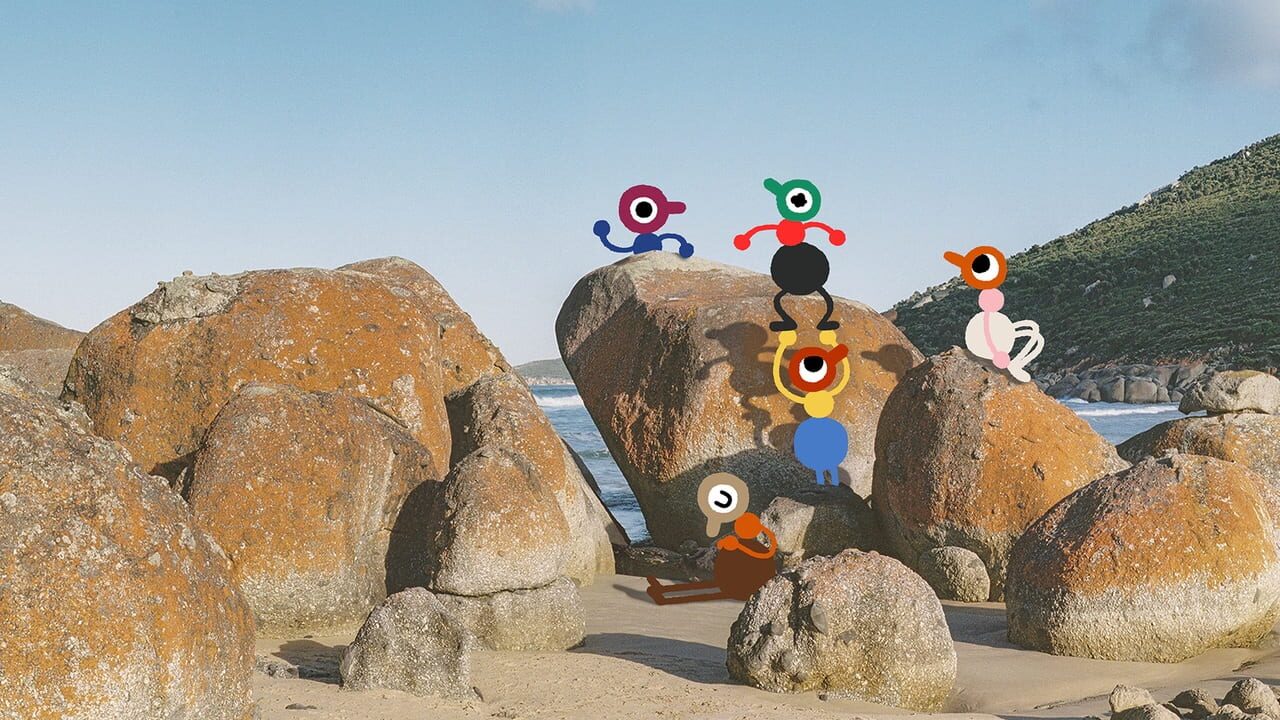
Hang out and get lost with close friends in a big world. A cooperative online walker-talker from the creators of Untitled Goose Game.
Read moreShow less
Big Walk is a cooperative multiplayer adventure about teamwork and talking.
Set out with your friends through a wide-open world full of challenges, puzzles, and discoveries. You’ll need to work together to find your way around, stay in contact using an assortment of tools and toys, and figure out new ways to communicate when you suddenly find yourself speechless.
Adventuring aside, there’s plenty of time to just hang out. Sit and watch the sunset, or steal your friend’s binoculars and kick them into the ocean. Spending time with friends is the best part of a big walk.
Features:
Talking!
Our proximity voice chat system makes voices fade across distances, echo down corridors, muffle through walls, and crackle through walkie-talkies
Walking!
Find your way around an open world together, at your own pace
Arms!!
Point, wave, and gesture (or just flail around wildly) to communicate in situations where talking isn’t an option
Tools and Toys
Walkie-talkies, laser pointers, binoculars, megaphones, flares, whiteboards (?), cowbells (??), a big golden head (???) and more
Flexible Player Count
Big Walk can be played with as few as 2 players (i.e. a focused co-op experience) or as many as 12 (i.e. an absolute mess)
Crossplay
Play online with your friends on other platforms
An Ending
Big Walk is a hand-crafted cooperative adventure meant to be played start-to-finish with a group of friends
From the game's Steam store page.
THE GAMEQ VERDICT10,000 reviews analyzed
What players are actually saying
1. Summary
Big Walk sends a group of friends across a large island, modeled on the Australian bush, to find and solve puzzles that are built around talking, signalling and splitting up. The reviews are close to unanimous. Players describe it as a game about spending time with people: 38% of the longer reviews talk about playing it with friends, a partner or family, 15% single out communication, and others write about bonding or the memories it left them with. The puzzles get credit for making groups invent their own ways to pass information through radios, gestures, flares and poses. The ending hits people hard: 11% of longer reviews bring it up and 7% mention crying or tears. Sound design, music and the island's atmosphere also come up often in the praise.
Most complaints are caveats inside reviews that still recommend the game. Fans and critics both mention getting stuck on rocks, branches and slopes, which grates in a game that is mostly walking. Others ask for a longer proximity voice range and per-player volume controls, easier access to your own belt and backpack, brighter nights, faster trains, steadier connections and better performance. The small group of players who did not like it say the walking between puzzles is slow, the puzzles are easy, and the fun comes from their friends more than from the game. Reviewers point out that Big Walk is multiplayer only, so it depends on having people to play with.
2. What keeps coming up
What players praise
A game about the people you play withHigh
38% of the longer reviews describe playing with friends, partners, siblings or children, more than any other theme, and many also write about bonding, friendship or memories. Players describe it as a place to hang out with a goal attached: "It's a game that encourages communication, tomfoolery, stupidity, detours, wandering, lingering, and being with your friends." Another calls it a "childhood before smartphones" simulator. Couples using it for date nights, parents playing with young kids, and old friend groups in their 40s all appear, and a few reviewers recommend it even with strangers.
Critics see the same thing and count it against the game. A negative reviewer asks: "If the players have to make the game fun, rather than the game itself being fun... is it really a good game?" A couple of negative reviews say they could have just talked to their friends on Discord for free.
Puzzles built on limited communicationHigh
15% of longer reviews talk about communication, and many name the tools the puzzles hand out: walkie-talkies, radios, flares, gestures, poses, megaphones, whiteboards. Players like that many puzzles cut off voice chat or split the group, so they have to build a shared language: "The variety of tools to communicate lend the system a surprising depth". Outer Wilds, The Witness, Myst and Portal 2 come up as comparisons, usually to say Big Walk gives the same sense of discovery with friends beside you. Plenty of other reviews simply call the puzzles fun, clever, creative or well designed.
The endingMedium
11% of longer reviews bring up the ending, and 7% mention crying or tears. For some players it raised their opinion of the whole game: "that ending sequence pushes this game from a 8/10 to an easy 9.5/10 at the least." Others write "these little bird guys shouldn't make me cry, but they did." Negative reviewers rarely mention the ending, and the few who do are split between calling the final area the best part and calling it a letdown after the walk it took to get there.
The island, its sound and its Australian settingMedium
11% of longer reviews praise the world, scenery or atmosphere and 8% the music, soundtrack or sound design, with the squeaky sand and the radio songs singled out. Australian players write about recognising the setting: "The bush is so instantly recognisable - its sounds, colours, textures." A minority of negative reviews find the mix of realistic terrain and simple, low-detail characters jarring or ugly.
Better than its "friendslop" labelMedium
7.5% of longer reviews use the word friendslop or a variant, usually to argue that Big Walk rises above the cheap co-op games the term describes ("Not friendslop but friendgem, this game is designed from the ground-up as a co-op experience."). PEAK and Lethal Company come up as reference points, with Big Walk described as slower and more about teamwork than traversal. A handful of negative reviews use the same word as an insult.
Players want moreLow
2.9% of longer reviews ask for DLC, new puzzles, another map or a sequel, often in the same breath as saying they wish they could play it again for the first time. One writes "HOUSE HOUSE, MAKE BIGGER WALK AND MY LIFE IS YOURS".
Where players are split
The pace and all that walkingMedium
11% of longer reviews praise the game as relaxing, chill, cozy or wholesome, and many say the long walks between puzzles are where the conversations happen. One player notes "Nothing made the game more efficient, trains and lifts are a choice, not a must." Slow walking between puzzles is also the most common thread in negative reviews: "The puzzles are fine but they are so simple and easy that you complete them in 10 seconds and have to spend 15 minutes holding W to the next one." That reviewer sums it up as "Essentially too much walking, not enough game." Some positive reviews add that backtracking for the last few collectibles drags.
How many players it needsMedium
Reviews often mention group size, and opinions on duos are split. Some found two players worked well ("At first I was nervous how Big Walk would play with only 2 players but it turns out my fears were unfounded."), while others say four or more is the intended experience and that two players turns some puzzles into a slog ("Two players is doable but exceptionally suffering."). Players also note that the puzzles change with group size, and several advise sticking with the same group from start to finish.
Puzzle difficultyLow
Fans tend to describe the puzzles as approachable: "The puzzles are also very simple, yet ingenious." Some say the challenge is in communicating, not solving: "Most of the puzzles are relatively simple compared to the range of puzzle games on the market." Some negative reviews call them braindead or too easy for the time it takes to reach them, and players expecting The Witness or Myst come away disappointed. A smaller group points the other way, at a few late audio and memory puzzles that felt obscure or needed a guide.
Carrying one item and the shared backpackLow
You hold one item at a time, and the belt and backpack you unlock can only be used by other players. Some love it as a forced reason to cooperate ("Got extra inventory spaces? You can't access them, only other people can. Talk with your friends."). Others find it a constant chore, especially when a needed radio or light is stuck on their own back, and even fans ask for a change: "would still like to be able to pull items off my own belt though".
Pitch-black nightsLow
The day and night cycle gets both reactions. Critics say "When it gets dark, you can't see anything and it makes getting around miserable." Some groups stop to wait for sunrise. Others enjoy getting lost in the dark or treat it as a rest: "With how dark it would get, It made it so you had to sit and take a break". Even some fans call the nights a little too dark.
The waiting "puzzles"Low
A few challenges ask the group to sit together for 5 or 30 minutes, or leave one player waiting at a station. Most of the reviews that mention them come from players 10 or more hours in. Fans count them among their favorite moments ("One of the puzzles literally forced you to sit and wait in a room together for 30 minutes and the whole goal of that 'puzzle' is just to make people start a conversation."). Critics read them as padding: "A thirty minute 'harder' version is just the devs flipping you the bird and telling you that your time is worthless to them."
Price and lengthLow
Reviewers who give a finishing time quote figures such as "about 15 hours just getting the normal ending" and "I completed it in under 20 hours and got all the achievements". More reviews call the price fair for that than too high ("This game is a steal for $20."). Others think it is a little high for a game you play through once with one group ("20€ is a bit too much for this game."), and a few negative reviewers would only buy it on sale. Reviews that discuss replay value describe it as limited unless you bring new friends through it.
What frustrates players
Getting stuck on terrainMedium
Fans and critics both raise this, in 2.6% of longer reviews overall and in negative reviews too. Players snag on pebbles, roots, branches and small rocks, jumps fail, and steep slopes stop them dead: "For a game that relies on walking it is insanely unpleasant to traverse: you get stuck on the smallest things, pebbles and grains of sand." Some fans laugh it off ("Its really easy to get stuck in the terrain, but you can usually eventually get out, or a friend can help you, which kind of adds to it in a fun way."), and for several fans it is the only complaint they list.
Short voice range and missing audio settingsLow
For a game built on proximity chat, players want more control. Complaints say you must stay close to hear anyone ("the proximity radius is so short you have to be glued together to hear each other"), that voices are quiet, and that there is no per-player volume or output device setting: "Per-player volume controls, and an in-game output audio device setting, are table stakes". Fans raise it too: "I think the proximity chat range should be increased slightly, often times my friends would be with in speaking distance and we wouldn't be able to hear". A smaller number report microphones cutting out or not working at all, and one review notes that an early low-volume problem was fixed.
Disconnects and rejoiningLow
A small number of reviews describe players timing out and being unable to get back into a session: "Unable to rejoin after disconnecting from a friend's session, constant timeout." For some groups the fix is drastic: "The only solution is to have the host restart the entire game, sending everyone back to the start". One reviewer describes a random player each session losing voice and desyncing, with no ping or connection readout to diagnose it.
Performance on strong PCsLow
Several reviews say the game runs heavier than its look suggests, with frame drops, high GPU and memory use, and a few reports of crashes and driver failures: "I can't imagine why it would need to use 65% of my new graphics card to render an underground tunnel with one light source." Others report it running well, including on Mac.
No solo mode and no way to find a groupLow
The game requires other players, and reviews without a ready group feel stuck. A few ask for a server browser or public lobbies ("it lacks a server browser, which will make it unplayable for you"), and some fans point people to community Discord servers instead. Others note that a group who keeps playing without you can leave you behind.
Slow trains and late-game travelLow
The train and chairlift get mixed reviews as transport. Players like riding them to chat, but several say the train is barely faster than walking and serves only one challenge: "The train needs to be faster and actually stop at the stations". The complaint sharpens late in the game, when groups criss-cross the island for the last few collectibles.
Accessibility and motion sicknessLow
A few reviews report motion sickness or headaches, and some praise the anti-motion-sickness overlays while still limiting sessions ("I super appreciate the anti-motion sickness settings"). Others list missing settings: "There are functionally no proper graphics or accessibility settings, so adjusting gamma, FOV over 90 degrees, color correction, contrast, or even individual players mic volumes is something that you can't do." A couple of reviews point out that several puzzles rely on audio cues, which shuts out players with hearing loss.
3. The player conversation
The conversation is warm and often personal. Long reviews read like thank-you notes to friends and to the developer, many naming the people they played with, and many of the short reviews are puns on the title or "10/10" one-liners. Negative reviews are a small minority. Those from players who quit within a couple of hours often call the game boring and the walking slow. Critics who played deep into it are more likely to list specific problems: terrain snagging, voice range, the one-item rule, dark nights and the waiting puzzles.
Both sides use the word "friendslop". Fans use it to say Big Walk is better than the genre, and critics use it to say the fun comes from the group rather than the game. Fans reach for Outer Wilds and The Witness to describe the sense of discovery, and the few critics who name The Witness do it to say Big Walk's puzzles feel familiar or easy next to it.
Sentiment held steady over time. Every week from the end of August to mid-October stayed between 97% and 98% positive. Complaints about voice range and volume were more common in reviews written before the end of August than in later ones, which fits a couple of reviews that mention a patch fixing low voice volume.
4. What the developers could do
- Smooth out terrain collision and jumping. Fans and critics both complain about getting stuck on pebbles, branches and slopes, in a game where walking takes up most of the time.
- Add voice options: per-player volume, an output device setting and a range or loudness slider. Players call the proximity chat range too short and the voices too quiet, and one negative review calls per-player volume table stakes for a co-op game.
- Let disconnected players rejoin without a host restart. Several groups describe timeouts that only a full restart fixes, which sends everyone back to the start.
- Speed up late-game travel. Reviewers ask for a faster train that stops at stations, a chairlift station near spawn and less backtracking for the last few collectibles.
- Add brightness, gamma and FOV settings, plus visual cues for audio puzzles. Pitch-black nights, a 90-degree FOV cap and audio-only cues come up in complaints from fans and from players with motion sickness or hearing loss.
- Optimize GPU and memory use. Players with recent hardware report frame drops and heavy GPU load that they find hard to square with the game's simple look.
- Offer host options for the friction rules. Fans ask to soften the own-belt rule and the darkness of nights while other players defend both, so a host toggle would serve both groups.
- Help players find a group. A few reviews without a ready friend group ask for a server browser or public lobbies, since the game cannot be played solo.