Bladesong
SUN AND SERPENT creations · RPG, Management
Overview
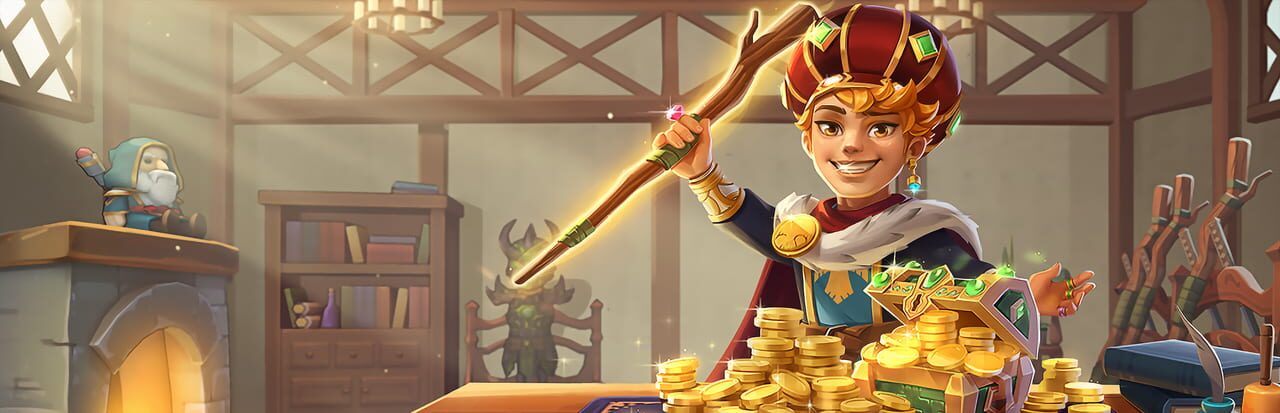
The ultimate swordmaking game. Forge unique weapons with freeform blade shaping and modular hilts, perfectly balanced to your customers’ needs. Master the art of smithing and uncover the secrets of Eren Keep, a last haven of a dying world – or so they say.
Read moreShow less
The Songs have fallen silent and the world lies in ruin, lost to madness and despair. But within the high walls of Eren Keep, life persists – held together by unbreakable will and the iron fist of the Masked King, ruler and tyrant, savior and messiah.
As the swordsmith of Eren Keep, you turn steel into something more precious than gold. Customers come with coin in their hands and demands on their lips, seeking blades of deadly precision, balance, and beauty. Meet their requests, perfect your craft and find trusted companions in one of the last beacons of civilization.
Yet in the dark corners of Eren Keep, whispers of rebellion stir. The former blacksmith’s mysterious disappearance looms as an ill omen over the role you play. But play it you must, for in Eren Keep, the right blade in the right hand will change everything.
Craft swords your way using freeform blade shaping and an intricate modular building system. Create the weapons of any world – East to West, history to fantasy – with every detail customized, every piece meticulously crafted and adorned. Explore a vast library of sword parts and engravings, with plenty of materials like metal, leather, wood, obsidian and ivory to choose from. No two creations are the same.
Take commissions from warriors, nobles, and mercenaries. Use innovative tools to design and craft each sword, balancing ratings and requirements with precision to meet your customers’ specific needs and expectations. Learn how to curve blades and carve engravings, acquire rare materials, and expand your arsenal of sword parts. Keep up with demand by hiring unique characters to your forge, each with their own ambitions and stories.
Visit beautifully illustrated locations around Eren Keep, from the bustling Citadel Square to the local tavern The Den, to find opportunity, alliances, or merely a moment of respite. As you craft blades for Eren Keep’s various factions – like the scavenging Crows or the scholars of the Magisterium – will you be drawn into their visions for reclaiming the fallen world? Or will your growing influence risk attracting the Masked King’s silent gaze?
Grow your collection of sword parts in Campaign Mode and forge without limits in Creative Mode, a deep swordmaking sandbox featuring a vast library of sword parts, tools, materials, and engravings. Use Magic Words to easily share creations among Bladesong’s active community of swordsmiths, and print models of your in-game creations by exporting STL files for 3D printing. Find inspiration in regular community challenges and join the club of champions!
We think you'll love Bladesong if you enjoy…
Kingdom Come: Deliverance II, Mount & Blade II: Bannerlord, Baldur’s Gate 3, The Elder Scrolls V: Skyrim, Hellish Quart, Half Sword, Blade and Sorcery, PC Building Simulator, Potion Craft, Disco Elysium, Clair Obscur: Expedition 33, Total War: MEDIEVAL II, Dungeons & Dragons, Pathfinder.
From the game's Steam store page.
THE GAMEQ VERDICT1,136 reviews analyzed
What players are actually saying
1. Summary
Bladesong arrived in Early Access as a sword-crafting game, and players found a dark fantasy story attached to it. 54% of all reviews bring up the story, writing, lore or worldbuilding. Many of them read as surprise: people bought it to shape blades, expected a light shop sim, and ended up reading every line of a grim tale about a refugee smith outside the walls of Eren Keep. The sword editor gets nearly as much praise, for how far the blade and hilt tools go, for a creative mode with everything unlocked, and for STL export so designs can be 3D printed.
Commissions pay the same for a bare-minimum blade as for a masterpiece, and material costs push long-time players toward cheap, plain swords. The daily loop of near-identical requests and repairs wears thin over long sessions. The hilt editor is fiddly, and customer dialogue sometimes ignores what was actually forged. A smaller group feels misled by the "forging" label and calls it a sword designer with no heating, quenching or grinding. Dozens of reviewers reached the end of the released chapters and want more. Most of these complaints sit in reviews that still recommend the game.
2. What keeps coming up
What players praise
A story nobody expected from a smithing gameHigh
54% of all reviews (619) mention the story, writing, lore or worldbuilding, and 3% (38) use some version of "came for the swords, stayed for the story." Reviewers describe a bleak, post-apocalyptic medieval setting, a mystery about the previous smith and the vanished gods, and customers whose lives continue after you hand over their blade. A handful compare it to Disco Elysium, Baldur's Gate or Fallen London, and others liken it to a tabletop D&D campaign. One reviewer asked: "Why does a game about crafting pretty swords have some of the best writing of any game this year???" Another wrote that "the story and worldbuilding are far more interesting than it has any right to." Several say they rushed through commissions just to reach the next story beat. A few found the writing simple or the characters shallow, and one negative review called the lore generic, but they are a small minority next to the praise.
Dozens of these reviews talk about choices and consequences: commissions for side characters pay off days later, a refugee you ignored can die in a monster attack, and failed skill checks can kill the smith. Whether those choices really change outcomes is less settled (see "Where players are split").
Deep, freeform sword craftingHigh
Players lengthen, thin, curve, taper, engrave and polish blades, then build hilts from guards, grips, quillons and pommels, and story mode unlocks techniques through books and a skill tree. People recreate museum pieces and fantasy weapons, and the community pushes the tools into axes, guns, forklifts and food. "It's like Disneyland for sword nerds," wrote the same reviewer who praised the worldbuilding, and a real-life bladesmith said they plan to use it to design their projects. A number of reviews call it easy to learn with a lot of depth, and several players say the gradual unlocks stop it from feeling overwhelming. Several reviews note you can undo any forging step at no cost, which some see as friendly to experimenting and a few see as removing any challenge.
Creative mode, STL export and a busy communityMedium
Creative mode, with every part and material unlocked from the start, is a selling point on its own for players who never touch the campaign. 4% of reviews (43) mention exporting designs as STL files for 3D printing, often for cosplay props or D&D miniatures: "Managed to replicate a 16th century rapier to pretty bloody close and then export it." Shareable "magic words" let players swap designs. Some reviews mention the Discord community, its building contests and the developers' presence there. One early review said it "takes a few hours at most to get a response from one of the developers on bugs reported on the discord and they are usually fixed quickly," and two players edited their reviews after developer replies resolved their issues.
Painted art, sound design and atmosphereMedium
The hand-painted portraits and backgrounds, the moody music and the sound effects played during text scenes (screams in the camp, footsteps in the ruins) are credited with carrying a mostly text-based story. A few players found the music slow or basic, but the overall mood gets steady praise.
Good value and a demo that sells itMedium
A few dozen reviews say the game is worth the price, several of them quoting about $20, and some say the Early Access build feels polished. The free demo comes up often: some reviewers say it is what sold them, and others point newcomers to it as an honest sample of the game. A minority disagree on price (see "Where players are split").
Chlodo the dogLow
A small, affectionate group of reviews exists mainly to say you can feed and pet the forge dog, Chlodo.
Where players are split
A sword designer, not a blacksmithing simulatorMedium
Reviewers on both sides point out that every action is a hammer click that moves a slider: there is no heating, quenching, smelting or grinding. For most who raise it this is a fair warning to readers ("Bladesong is more of a weapon designer than a blacksmithing simulation"). One player who still recommended it called it "its basiclly just sword lego lol" and "not what I want." For a minority it is the reason they refunded or gave a thumbs down, and one negative review called it "a paid, heavily limited version of Blender." Several players coming from Kingdom Come: Deliverance 2's smithing minigame raise it, and some ask for an optional heating step. The store page's comparisons to combat-heavy RPGs drew one complaint for setting the wrong expectation.
An unfinished story told in chaptersMedium
The story ends at an Early Access wall, with side quests marked "on hold" in the journal. Most reviews that mention it simply want the next chapter; one wrote, "I'm sad to hit so many 'will continue later' story lines because I just want to read more about the world and the characters." Others feel that is a reason to wait: some say the released story lasted only a handful of hours, and one negative review put it as "This $20 game that has a 5$ games worth of content shouldn't have been released." By late summer, reviews mention finishing Chapter 3 and praise each chapter as better than the last. One player felt the pacing got worse with each chapter.
A lot of reading, and no voicesMedium
The story is text with portraits, and reviewers warn that people who dislike reading will struggle with it. Some would like voice acting, at least for main dialogue, with one saying "The only thing that could make this game even better is voice-acting, other than that it's a 10/10." Others defend the silent text and its sound design. A few players want the opposite balance: less story and more shop-management depth, or a mode that is only forging and selling.
Do choices and skill checks matter?Low
Some players praise branching outcomes and friends seeing different events. Others found that reloading and choosing differently changed little ("your choices don't really matter"), that commissions cannot be refused, or that skill checks feel like a coin flip with no clear way to raise stats. One summed up the main-quest checks as "Roll to charm the king: natural 20! The king is not charmed".
Creative mode's slidersLow
Creative mode replaces story mode's hammering with sliders. Some like the precision, while a handful of players find it bland or clunky and ask for a hammer option in creative mode.
What frustrates players
Repetitive commissions and repair jobsMedium
6% of reviews (63) describe the loop as repetitive, tedious or grindy, 12 of them negative. Procedural customers repeat the same requests and backstories, the first steps of every blade (length and thickness) are identical each time, and repair jobs pay so little that players skip them ("Repair jobs suck and there is 0 reason to do them"). One negative review put it plainly: "It's a really good sword editor, but the gameplay itself is very repetitive." Positive reviews describe the same grind, and several say short sessions or a break help. Suggestions include saved presets or "blanks" the apprentice could prepare, and more varied, more demanding commissions.
No reward for extra craftsmanshipMedium
Players raise this at every stage, from short first impressions to reviews written after 90 hours, and they tend to explain it at length. Payment is fixed whatever the blade looks like, decorations cost materials you are never reimbursed for, and customers praise any blade that meets the stats: "Ugly or not they'll accept it and say it's perfect." One wrote: "There is no bonus for overachieving on a commissioned sword. Doing the bare minimum is treated the same as going way above and beyond." A negative review said "it genuinely feels like i've made 100s of lowest-effort swords" just to afford a handful of special requests. Reviewers suggest tips or a quality score, a smith reputation that unlocks better clients, pay that scales with client wealth, and story text that reacts to what you forged.
A fiddly hilt editor and controlsMedium
Hilt parts pop off when resized, refuse to snap or align, and sit in one long scrolling list that gets harder to navigate as unlocks pile up. One reviewer wrote: "Hiltmaking is far and away the most frustrating and imprecise part of the sword creation experience." Players ask for snapping and symmetry options, numeric inputs, imperial units, an undo in hilt mode, rebindable keys and hotkeys (one could not move the camera without a middle mouse button), a way to flip the blade, and a post-forge camera that shows the whole sword.
Thin explanations of stats and sword partsLow
Players new to swords say the tutorial skips how balance, stiffness and the secondary options work. One nearly quit before learning "that the location of the bar within the meter is actually the point of balance on the sword." Others ask for a codex explaining what quillons, ferrules and peens are for, clearer action-point and stat progression, and a story recap or journal.
Customer text that ignores the bladeLow
Several reviews note mismatches between the story text and the commission: a giant two-hander gets tucked into a belt or a basket, the shortest possible "dagger" is a short sword, replica quests accept any blade as an exact copy, and dialogue asking for a one-handed blade comes with a two-handed requirement. Reviewers treat these as immersion problems, since the commissions themselves still work.
Crashes, fatal errors and heatLow
A small number of players hit Unreal fatal errors, crashes in story mode, high CPU or GPU load and heat on a game that mostly renders one sword, or launch problems on Linux. Several of these reviewers later fixed their problem with a driver update or a different Proton version.
Only swords to forgeLow
A recurring wishlist asks for axes, spears, polearms, scabbards and armor, more colors and materials in story mode, and a way to forge blades for a shop shelf without a commission. One early complaint was that finished story swords vanished forever; that reviewer later edited the review to say the Chapter 2 update lets story swords be saved to creative mode.
3. The player conversation
The tone is warm and often giddy. Short reviews like "peak" and "I like swords" sit next to long, careful essays, and even the long reviews that list a dozen problems usually end with a thumbs up. There is little real division: negative reviews are 3.3% of the total, and they split into three small groups. Some wanted a hands-on forging simulator, some were worn down by the grind and the flat economy, and a few could not get the game to run.
Who raises what follows how far people got. Quick refunders mostly talk about expectations, saying it is a designer and not a forge, or that they did not understand the mechanics. Players who reached the end of the released chapters raise the story wall and on-hold quests. The lack of reward for effort is noticed within the first few hours, but the long economy critiques (material costs, books that do not matter, fixed upkeep, money with nothing to spend it on) come from players past 30 hours. Creative-mode builders with hundreds of hours talk about the community, engine tricks and STL export, and many say they have barely touched the story.
41% of all reviews arrived in the first two weeks after the January 19 launch. Later bumps in the week of April 20 and in late August line up with reviews discussing the new story chapters. The positive share stayed between 91% and 100% in every week with ten or more reviews. Over time the conversation moved from demands for more story and early bugs (a missing gallery, a Chinese font in the Japanese text, both reported fixed in later review edits) toward balance: by the later months, reviews more often ask for rewards for craftsmanship and a less repetitive daily loop.
4. What the developers could do
- Reward craftsmanship in commissions. The most detailed critiques say fixed pay and unreimbursed material costs make the best strategy "the bare minimum," so tips, a quality score or a smith reputation tied to effort would answer a complaint raised from the first hours onward.
- Vary the daily loop and fix repair jobs. Players report repeated customers, identical opening steps and repairs worth a few thalers, so more varied and more demanding requests, better repair pay and saved presets or apprentice-made blanks would ease the grind.
- Make the hilt editor precise. Snapping, symmetry, numeric input, undo in hilt mode, a categorized parts list and rebindable keys are the fixes players name for the hilt editor's alignment and navigation problems.
- Keep the chapters coming and signpost the wall. Dozens of reviewers ran out of story, some finding quests on hold, so a clear marker of where the released story ends and a visible chapter roadmap would soften the stop.
- Teach the stats and the parts. A tutorial step on the balance meter, stiffness and secondary options, plus a codex for sword anatomy and clearer stat progression for skill checks, would help the newcomers who nearly quit early.
- Make customer text match the forged blade. Belts and baskets holding greatswords, short-sword "daggers" and replica quests that accept any design break the immersion that the writing builds.
- Fix the remaining crash and heat issues. Fatal errors, story-mode crashes, high GPU load (one player's machine still ran hot after enabling v-sync and capping frames) and Linux launch problems are rare but end the game for those who hit them.
- Offer a hammer option in creative mode and broaden what can be forged. Requests for story-style hammering in creative mode, plus axes, polearms and scabbards, come from players who build a lot of swords.