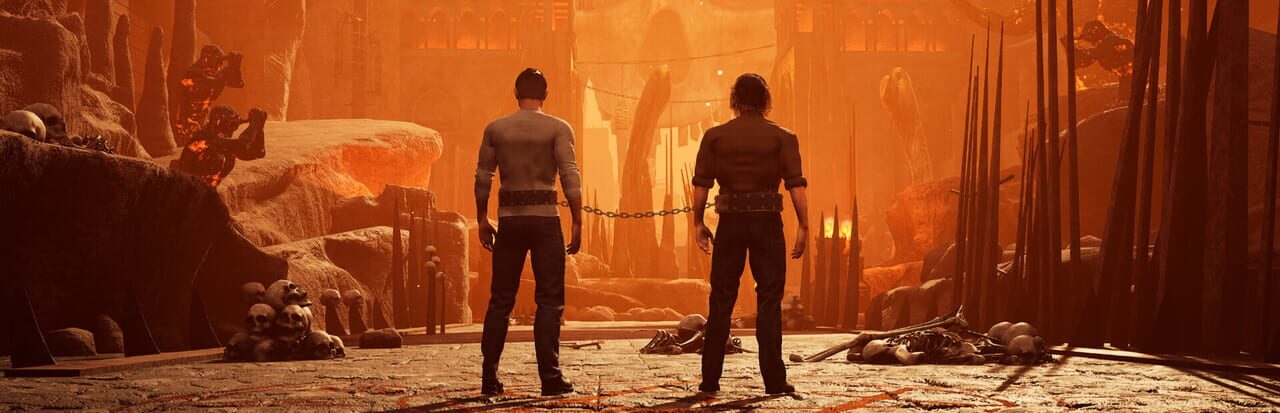
Chained Together
Anegar Games · Puzzle, Simulation, Adventure
Overview
Climb up from the depths of Hell. Scale various worlds solo or chained together with your friends in the 1-4 player platforming sensation.
Read moreShow less
Climb or die!
Take on the challenge of the infamous hardcore platformer either alone or chained together with up to three friends.
Climb as high as possible to escape Hell. Coordinate your clambering and perfect your jumps to scale punishing platforms and outrun the scorching heat. Every layer threatens your ascension with unique challenges, each tougher than the last.
Features
Choose your difficulty: Brave the punishing Normal Mode, play with checkpoints in Beginner Mode, or race against constantly rising flames in Lava Mode. It's masocore heaven!
Local and online co-op: Play together in person or online
Realistic chain physics: The chain is fully simulated and wraps around platforms. Use this power to your advantage
Leaderboards: Compare your climbs with the world
Meaningful rewards: Leaderboards and Achievements are only valid in Normal and Lava Modes
From the game's Steam store page.
THE GAMEQ VERDICT10,000 reviews analyzed
What players are actually saying
1. Summary
Chained Together is a climbing platformer where up to four players are physically chained to each other, so one bad jump drags the whole group back down toward the bottom of Hell. The longer reviews are mostly stories of friends, partners and siblings screaming, blaming each other and laughing until they cry, and some count the low price as a bonus. A smaller group keeps playing after the first climb for Lava mode, the hidden wings and speedrunning.
Fewer people complain, and their complaints are mostly technical: bugs and crashes, jank in the chain and climbing physics, and poor performance on mid-range PCs. These come up far more often in the negative reviews than in the positive ones. Another group says the game is something you finish once, in the three to eight hours reviewers usually report for a first climb, and then leave. Players disagree about solo play, about how hard the game really is, and about whether checkpoints save the experience or cheapen it.
2. What keeps coming up
What players praise
Chaos and laughter with friendsHigh
64% of the longer reviews (1,077 of 1,697) talk about playing with friends, partners or family, and 19% pair that with laughter, chaos or "a blast". Couples, siblings, parents with kids and groups of four describe sessions where the falling is the fun: "We spent way more time falling than climbing, but it was all great fun." Players credit the chain for making every jump a shared decision, and one said it feels unlike co-op games where you play alongside each other. Communication comes up in 7%, and a couple of reviewers praise the built-in countdown; one wrote that "the game even aids the player in this with the inclusion of a countdown button". The same reviews make clear that the fun depends on the group, an idea that also runs through the complaints.
The friendship test and the blame gameHigh
"Half the game is climbing. The other half is blaming each other." 13% of the longer reviews frame the game as a test of friendship or relationships in this way. The tone is usually affectionate, with arguments that turn back into laughter a few minutes later. One reviewer called it "the perfect friend-slop rage game, where you can laugh, argue, blame each other, and somehow convince yourselves to try again." For a minority the stress was real and they stopped playing (see the split items below).
Lots of fun for very little moneyMedium
11% of the longer reviews bring up price or value, and 6% say outright that the game is worth it or a bargain. Some accept rough edges because of the cost: "It's worth it because it's cheap. It's not polished, it's not a great game, but 5€ base price this is a decent way to kill a saturday night with friends." A smaller 2% say to wait for a sale or that it is not worth the money, usually because the fun lasted a single evening or depended on friends who lost interest.
Lava mode, wings and speedrunsMedium
Lava mode, the ten collectible wings, achievements or speedrunning come up in 9% of the longer reviews. Reviewers describe Lava mode as a climb under rising lava and call it the hardest challenge, and several give it as their reason for going back. Collecting all the wings unlocks a flap that, according to reviewers, lets skilled players skip large sections; one solo player said "It's broken in the best way possible and it makes a fun game even more enjoyable." Achievement hunters describe 100% as fairly easy apart from Lava mode, and a small speedrunning crowd plays mostly alone for times.
Reaching the next area feels earnedMedium
"Every bit of progress feels earned, and every failure becomes a memorable moment." 5% of the longer reviews describe progress as rewarding or satisfying, usually right after describing a long run of failures. The sense of accomplishment, players say, comes from execution and coordination, with no upgrades involved, and several finished their first full climb in one long sitting.
The ending and narrationLow
4% of the longer reviews speak warmly about the ending, the story or the taunting imp and narrator. Some expected little and were surprised: "Honestly thought it was gonna be cheesy towards the end but it was actually a beautiful experience." A handful found the ending flat or anti-climactic, and a few found the narrator annoying.
Community workshop mapsLow
A small number of players (under 1%) mention the Steam Workshop and level editor, and those who tried custom maps say they extended the game after the main climb.
Where players are split
Falling all the way back downHigh
17% of the longer reviews use rage or frustration words, and 4% describe losing big chunks of progress after a fall. Many tell stories of losing an hour of climbing in ten seconds with something close to pride, and treat the pain as the point. For others it is simply exhausting. A long negative review summed up that side: progress can feel "more dependent on patience and repeated attempts than on genuinely satisfying gameplay."
How hard it really isMedium
6% of the longer reviews call the game very hard, punishing or brutal, while 2% call it easy or more forgiving than expected. Reviewers on both sides tie it to group size and partner skill. Several solo players and platformer veterans say the climb is moderate and gets easier past the early areas; one negative review said "you can easily beat this game by brainlessly jumping around and chatting the entire way through". Groups of three or four describe a much harder game (2% say outright that more players make it harder), and one reviewer wrote "I truly don't know how anyone beats the highest difficulties with three or four players." Several players say the opening Hell section is the hardest part.
Checkpoints and Beginner modeMedium
Checkpoints, Beginner mode or teleporting back to the highest point come up in 7% of the longer reviews. Many of these reviewers see the options as what makes the game playable for ordinary groups, and a recurring tip is to start on Beginner or turn checkpoints on: "Do beginner a few times before you touch normal." A recurring story is groups who spent their first hours restarting from the bottom before discovering they could load their highest point. Criticism comes from two directions. About 1% complain that checkpoints are too far apart, that progress is lost when quitting between checkpoints, or that Normal mode has none; another reviewer asked for something between Normal and Beginner. A few purists say the opposite: "JUST KNOWING that I could skip parts I got through ruined the climb."
Playing soloMedium
Solo play comes up in 10% of the longer reviews, and they disagree. Some solo players found it a solid, even absorbing platformer; one wrote "I found Chained Together as a solo experience to be quite engrossing." Others say the chain is the whole game and solo is empty without it ("Playing Solo is So Much Boring."), and one reviewer scored it "4/10 solo, 9/10 with a decent mate." A common middle view is that solo is good practice for learning the map and for speedrunning, but not a reason to buy the game. Several players who could not keep a group together ended up finishing alone.
One climb, then doneMedium
5% of the longer reviews mention a short run, usually three to eight hours for a first climb, and 4% say there is little reason to replay. Some are fine with that at the price: "Buy if you have friends, spend a few hours on it and have some fun. Then ofc never touch it again lol." Others treat it as a weakness and ask for a second map, new modes or a sequel (2%). Replays with a different group, Lava mode and workshop maps are the counter-argument from players who kept going.
Physics and controlsMedium
5% of the longer reviews criticise the physics, collisions, hitboxes or climbing as janky, while 1% praise the controls as tight or predictable. Many of the jank complaints come with a shrug: "The physics are just janky enough to be funny but not so bad that you can blame the game (sadly)." The harsher reviews say the engine, not the player, causes falls: hitboxes that push you off, chain physics that change from section to section, and lag turning a teammate into dead weight. One wrote "Here, you're constantly fighting the engine itself". On the other side, a reviewer said "The physics are predictable, not floaty or loose like a lot of platformers I've tried to play."
The asset-built lookLow
The visuals split a small group. 1.5% of the longer reviews call the game an asset flip and 1% call it ugly or basic, while 1.4% praise the environments, the shift from Hell to the city to Heaven, or the views. A few critics go further and accuse the game of using AI-made content in parts of the interface or art.
What frustrates players
Bugs and crashesMedium
5% of the longer reviews mention bugs, glitches, crashes or freezes, and they appear in 11% of the negative longer reviews. The reports are varied: chains that misbehave in four-player groups ("Good game but some passages are not playable with four players due to chains bugging during jumps."), characters that stop running or fail to grab a ledge, a temple puzzle that can lock, crashes that freeze the screen without an error, and save files that do not load in local play. Positive reviewers who mention bugs tend to call them minor, while the negative ones describe bugs that ended a run.
Performance on modest PCsLow
3% of the longer reviews discuss performance or optimisation, but they make up 10% of the negative longer reviews. The complaint is that a simple-looking game runs poorly: frame drops and stutters even on recent graphics cards, high CPU and GPU temperatures, and a recommended GPU that players find excessive ("Why in the world would this thing have the RTX 3060 as it's recommended graphics card."). Others report it runs fine on low settings or older machines, and one player suggests lowering the "Sharpen" option.
Online play: lag, desync and lobbiesLow
About 2% of the longer reviews describe ping, lag, desync or disconnects, and another 2% talk about public lobbies with strangers. Players with friends far away say the netcode punishes latency; one negative review said "the netcode is really not optimized for having 200ms+ latency between the two of you." Non-host players describe glitchy loops when mantling moving objects, and some saw every session at 9999 ping. Public play draws its own complaints: hosts who kick or close the game when someone joins, trolls who drag lobbies down on purpose, no quick matchmaking, and no in-game voice chat. A custom map maker wrote that "the lack of any kick or ban feature means that the host has no solution except to shut down the whole server and start anew."
Levels that repeat or thin outLow
2% of the longer reviews call the level design repetitive, tedious or empty, and this shows up in 6% of the negative longer reviews. The specific points are that later areas get easier rather than harder ("The difficulty transitions from tricky platformer to literal walking sim."), that some areas are floating assets with little logic, and that the chain itself is underused as a mechanic. One reviewer regretted "how some of the most fun mechanics are used only once throughout the entire run".
Controller and local co-op menusLow
Under 1% of the longer reviews, plus a few short ones, report controller problems in local play. Controllers work in the climb but menus require mouse and keyboard, the cursor disappears on menu screens, and one group found jump inputs stopped responding for players two and three. Couch players say this undercuts the local co-op that otherwise works well.
Update regressionsLow
A small cluster of reviews, mostly short and written in early September 2026, say an update broke trampolines, introduced desync after a two-versus-two mode arrived, or replaced the old character models with plainer ones ("now its like we took a step backwards with the game."). One reviewer later wrote that a hotfix fixed their problems.
Small irritationsLow
A few reviewers each raise smaller issues: having to aim directly at a teammate to pull them, a tip about getting unstuck that pops up constantly with no option to turn tips off, characters with different speeds and pull strength (some players read it as female characters being faster), and Steam Deck or Linux not working for some while running fine for others.
3. The player conversation
The tone is loud, joking and mostly friendly. A large share of the reviews are one-liners about hating your friends or losing your sanity, where the joke is the recommendation. The longer reviews are more measured and describe a game whose value depends on who you play with, and some call the price low enough to forgive the rough edges.
Who raises what follows how people played. Groups of three or four write about chaos, difficulty and four-player chain bugs. Pairs, especially couples and siblings, write about laughter and the relationship test. Solo players and speedrunners write about wings, Lava mode, route-finding and the difficulty curve, and several of them call the game easy. Negative reviewers who stopped within the first two hours mostly point to performance, crashes, sessions they could not join, or a partner they could not stand. Negative reviewers with ten or more hours lean toward update regressions such as the trampoline changes, lingering bugs and the level design. The few players with very long playtimes include custom map makers and speedrunners, and the map maker's complaints were about lobby tools, desync and silence on future updates.
Each of the split items above involves a small share of the reviews. Over time, reviews in this slice written in late 2024 were the most positive (97% for November and December 2024, boosted by the short award-season wave), reviews written in 2025 sat at 88%, and reviews written in 2026 at 84%. Because this is a most-recently-updated slice rather than the full set, that drift is a hint rather than a measurement, but it fits the later complaints about bugs, performance and a September 2026 update.
4. What the developers could do
- Fix the chain, trampoline and climbing bugs first. Bugs show up in 11% of the negative longer reviews, with four-player chain failures, broken trampolines after an update, and ledge grabs that fail named as run-ending.
- Improve performance on mid-range hardware. Performance complaints make up 10% of the negative longer reviews, and players with recent graphics cards still report stutters and high temperatures in a game they expect to run easily.
- Make online play tolerate latency. Players far from their friends and non-host players describe desync and chain yanks from lag, and one said moving-platform puzzles became impossible above 200ms.
- Give hosts lobby tools. Public players asked for kick and ban options, lobby names and quick matchmaking, because trolls and hosts who leave make random lobbies hard to use.
- Add more content built around the chain. Players ask for new maps, modes or a sequel, and critics of the level design want obstacles that use the chain instead of treating it as a tether.
- Finish controller support for local co-op. Couch players report menus that need a mouse, a vanishing cursor and jump inputs that stop responding for extra controllers.
- Offer a middle checkpoint option. Some players found Normal too punishing and Beginner too forgiving, and others lost progress when quitting between distant checkpoints.
- Trim the small annoyances. Let players turn off the constant tip about getting unstuck and make pulling a teammate work without aiming directly at them.