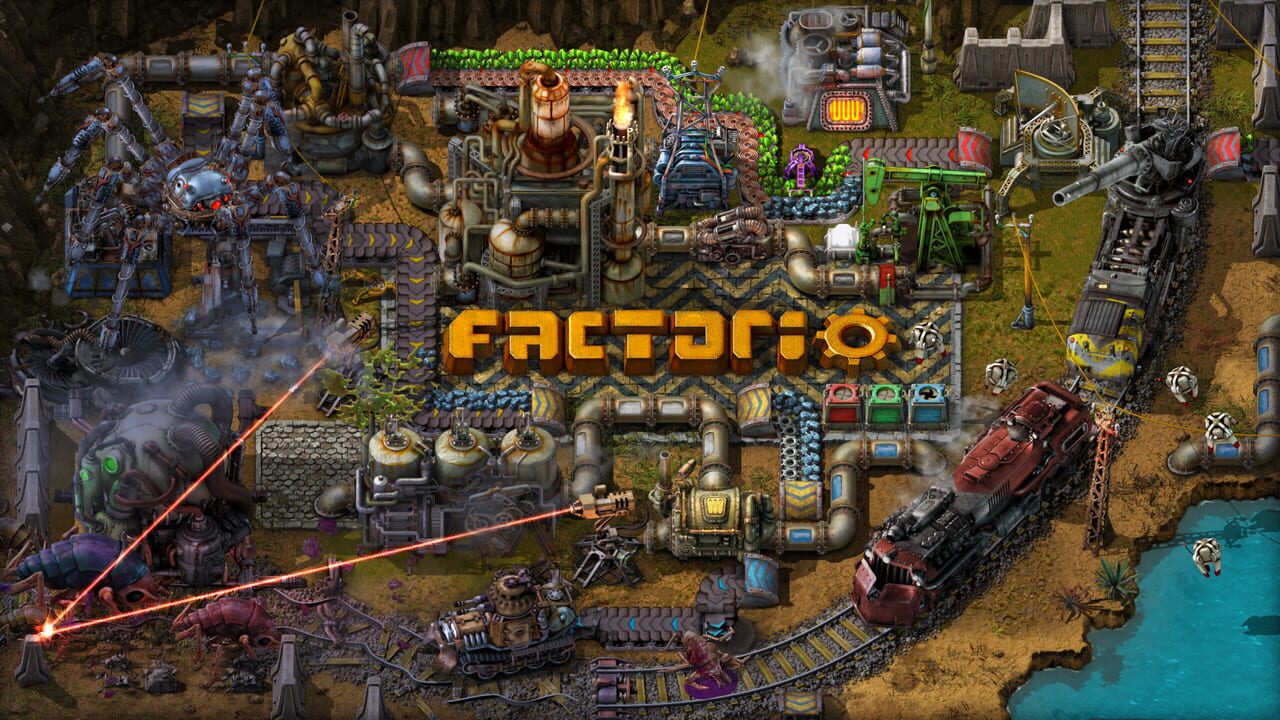
Factorio
Wube Software · Strategy, Survival, Automation
Overview
Factorio is a game about building and creating automated factories to produce items of increasing complexity, within an infinite 2D world. Use your imagination to design your factory, combine simple elements into ingenious structures, and finally protect it from the creatures who don't really like you.
Read moreShow less
Factorio is a game in which you build and maintain factories. You will be mining resources, researching technologies, building infrastructure, automating production and fighting enemies. In the beginning you will find yourself chopping trees, mining ores and crafting mechanical arms and transport belts by hand, but in short time you can become an industrial powerhouse, with huge solar fields, oil refining and cracking, manufacture and deployment of construction and logistic robots, all for your resource needs. However this heavy exploitation of the planet's resources does not sit nicely with the locals, so you will have to be prepared to defend yourself and your machine empire.
Join forces with other players in cooperative Multiplayer, create huge factories, collaborate and delegate tasks between you and your friends. Add mods to increase your enjoyment, from small tweak and helper mods to complete game overhauls, Factorio's ground-up Modding support has allowed content creators from around the world to design interesting and innovative features. While the core gameplay is in the form of the freeplay scenario, there are a range of interesting challenges in the form of Scenarios. If you don't find any maps or scenarios you enjoy, you can create your own with the in-game Map Editor, place down entities, enemies, and terrain in any way you like, and even add your own custom script to make for interesting gameplay.
Discount Disclaimer: We don't have any plans to take part in a sale or to reduce the price for the foreseeable future.
What people say about Factorio
- No other game in the history of gaming handles the logistics side of management simulator so perfectly. - Reddit
- I see conveyor belts when I close my eyes. I may have been binging Factorio lately. - Notch, Mojang
- Factorio is a super duper awesome game where we use conveyor belts to shoot aliens. - Zisteau, Youtube
From the game's Steam store page.
THE GAMEQ VERDICT9,996 reviews analyzed
What players are actually saying
1. Summary
In Factorio you build a factory that builds more factory, and the thing reviewers say most often is that they can't stop. Finding a bottleneck, fixing it and uncovering the next one is the loop they describe, and calling the game addictive, "crack" or a time sink is the most frequent comment in the reviews. Players also praise how well it is made. They report it running smoothly on old laptops, Macs, Linux and the Steam Deck even with enormous factories, some call its quality-of-life features the best they have seen, and the built-in mod portal and the Space Age expansion keep people playing for thousands of hours. Plenty of reviewers call it the best factory game they have played.
Price is the most concrete complaint: about one in six thumbs-down reviews brings it up. They point to a game that never goes on sale, has risen in price over the years, and has an expansion that costs as much as the base game, while other players say it is worth full price. The start is the other sticking point. Some newcomers say the tutorial explains too little and quit at oil processing or train signals, and others praise how gradually it teaches. Some veterans dislike how Space Age reshaped the game, with the jungle planet Gleba drawing most of the anger, and smaller groups object to fiddly controls, slow early hours, and updates that changed existing saves.
2. What keeps coming up
What players praise
A problem-solving loop players cannot put downHigh
Reviewers call Factorio addictive, call it "crack", or describe one more fix turning into sunrise, and a large number simply repeat the community motto "the factory must grow". When they explain the pull, they get specific: every solution creates the next problem (more iron needs more power, more power needs more coal, the coal patch is too far so you build trains), there is never one correct design, and they enjoy watching a messy line finally flow. Some engineers and programmers say it feels like the good parts of their jobs. One player summed up the loop as "A game where your biggest enemy is yourself from an hour ago when you made a seemingly inconsequential choice." Most of the addiction talk is affectionate, and some thumbs-down reviews are really compliments ("too addictive"), though a few players describe genuinely needing to stop (see the frustrations below).
Optimization and polish that make huge factories possibleMedium
Optimization comes up often, and some reviewers call Factorio one of the best-made pieces of software they have used. They report it running on "a potato", integrated graphics, decade-old MacBooks, business laptops and the Steam Deck, with native Linux support and a controller scheme that Deck and Switch players like. Veterans describe megabases with thousands of machines and robots holding 60 updates per second. "We care that we can put a few thousand iron plates on belts on the screen and not drop a single frame," one reviewer wrote. Others single out blueprints, copy and paste and the in-game encyclopedia, and say they rarely meet a bug: "Everything in this game just works exactly how you'd hope it does." Several mention the DRM-free copy available from the developer's site. The caveats are modest: very large factories eventually slow the simulation on any hardware, and a handful report lag spikes, an occasional crash, or a slowdown on an old PC.
Mods and near-endless replayabilityMedium
Mods come up often, and players like that they install from inside the game with dependencies handled automatically. They name overhauls such as Pyanodon's, Space Exploration, Krastorio 2, Seablock and Bob's and Angel's as games in their own right that can add hundreds or thousands of hours. "I'd say 4 times out of 5 a mod already exists for all the QoL features you think of while playing," one reviewer wrote. Map settings (resources, enemies, cliffs, research cost) let players tune each run, and some describe restarting several times because each new factory comes out better than the last. Mods do switch off Steam achievements, which is covered below.
Space Age, the expansion that adds new planetsMedium
Reviewers who have played the separately sold Space Age expansion describe it as a second game stacked on the first: four new planets with their own rules (Vulcanus with its lava and foundries, the scrap planet Fulgora, the spoilage-driven jungle Gleba, frozen Aquilo), space platforms that ferry goods between them, elevated rails, and an optional quality system. "And with space age, each planet is legitimately a whole game worth of content," one player said, and a couple call it the best expansion they have played. Some advise finishing the base game first, others jumping straight into the expansion. Veterans who dislike its design are covered in the split section.
Trains and rail networksLow
"I like trains" is a running joke, but plenty of reviewers mean it. They treat rail signals, stations and stackers as a puzzle inside the game, enjoy watching automated trains run on schedule, and laugh about being run over by their own locomotives. "This game has the best train control system I've seen, period," one wrote. Signals are also among the things players say they could not figure out without outside help.
Better with friendsLow
In co-op, players describe splitting up the work, comparing what each person built, and arguing happily about bus design. One reviewer who found the solo scale overwhelming wrote "In multiplayer it's a totally different game." A few report connection lag or that a friend without the expansion could not join their game.
A generous free demoLow
Reviewers often point newcomers to the free demo and say it shows within a few hours whether the game will click. "I suggest you try the demo first, but if it hooks you, it hooks you hard," wrote one long-time player, and several say they bought the full game partway through it.
Where players are split
Price and the never-on-sale policyMedium
Price is the most concrete complaint in the thumbs-down reviews, raised by about one in six of them. Critics point out that the game never goes on sale, that its price has gone up (reviewers cite €15 or €25 rising to €32 and $20 rising to $35), and that Space Age costs as much as the base game, putting the full package at around $70 (players quote $90 to $100 in some currencies). Players in several regions, including Russia and Brazil, report steep local price rises, and one complained "I cannot get any friends to play with me because of how expensive it is." Others say it is worth full price several times over, count their cost per hour in cents, and like that a no-sale policy means no regret about buying early: "this game never goes on sale but it is well worth the full price for me." Several positive reviews still name the price as their one reservation.
The bitersMedium
The hostile native creatures, which attack in response to your pollution, divide players. Fans say they give the factory a purpose and a reason to build defenses, artillery trains and nuclear weapons: "They're a great outside pressure that gives meaning to your factory expansion." Critics find them a chore, especially re-walling and resupplying turrets every time the base grows, and one player called them "utterly asinine tedium". Some newcomers describe being overrun before they understood defenses. Several reviewers recommend lowering them or playing in peaceful mode, which the game allows, although a few beginners did not realise the option existed.
The learning curve and the tutorialMedium
Nobody disputes that the game is deep; the disagreement is over whether it teaches well. Supporters say research unlocks things at a steady pace and that the tutorial and tips teach the basics without hand-holding ("The tutorials are excellent, some of the best I've seen in a game."). Critics say too much is left to wikis and YouTube. Even a positive reviewer listed "The tutorial is bs. It's clearly written by people who've played this game for thousands of hours." among their dislikes. Oil processing at blue science ("a HUGE beginner filter", one player wrote), circuit networks and train signals are the walls players name. Some advise watching a beginner series, others insist on figuring everything out alone and say that is the fun.
Gleba and how Space Age reshaped the gameLow
Space Age has its critics among veterans. Gleba, where products spoil and production depends on fast-growing fruit, draws both the loudest complaints and some defenders. "As most of you know, Gleba just sucks. Completely ruined the game for me," wrote one player, while another called it "the best challenge that turns the rules upside down and makes you think again." Other complaints: technologies like spidertrons, cliff explosives and the best modules moved behind other planets, the free 2.0 update that came with the expansion changed the base game (some say it rushes the early game or pushes players off the starting planet), interplanetary shipping feels too manual ("Current system is too manual."), and trains matter less once bots and space logistics arrive. Quality splits players too: some call it an optional extra layer, others call it gambling.
GraphicsLow
The art puts off some players at first. Some find it dated or hard to read, and one reviewer called it charmless, "staring at the same beige belts for hundreds of hours." Others praise the detailed animated sprites and gritty industrial look, and some say screenshots put them off for years before they changed their minds: "I can say it grows on you pretty quickly."
Factorio versus Satisfactory and Dyson Sphere ProgramLow
Comparisons with other factory games are common. Players who came from Satisfactory often say Factorio is deeper and scales further: "Factorio is more distilled automation with a higher ceiling." Some thumbs-down reviews say Satisfactory or Dyson Sphere Program does it better, with prettier 3D worlds and smoother building, and one found Factorio's interface "far too primitive" after playing games that built on it.
What frustrates players
Slow starts, waiting and constant rebuildingMedium
Before automation takes over, players describe a lot of friction: hand-crafting and hand-feeding machines, waiting on research, and tearing down working lines whenever a new unlock or a missing resource demands a redesign. One newcomer said "the amount of waiting you need to do is absurd." Another objected to clearing a full inventory before every rebuild, calling it "the kind of micro-friction that completely turns me off." Others point to electric furnaces arriving late, ore patches running dry, and the jump in cost for the last science packs. Some add that construction robots and blueprints remove most of this once you reach them, and advise new players to rush them.
Fiddly controls and missing conveniencesLow
A minority find the controls dated in places, often comparing them with newer factory games. Reported annoyances include vehicles that stop instead of reversing, inserters that only place items on the far lane of a belt, no way to pin a recipe, a cursor that holds a whole stack when you wanted one item, and keyboard-heavy controls on laptops. "The controls are outdated; modernization with significant simplifications is urgently needed here," one long-time player wrote. Others praise the keybinds, so this stays a small complaint.
Updates and achievements that change under existing savesLow
A few long-running players were burned by balance changes. One said a change to asteroid crushers removed thousands of legendary modules from a 400-hour save ("The update that introduced that change deletes the modules from the crushers to keep your save legal."), and another wrote that "patches can change eligibility for achievements on existing save files with no warning." Achievement hunters also object that any mod disables achievements ("Using a simple QoL mod shouldn't be disqualifing for achievements.") and that Space Age achievements appear in the base game's list, so 100% completion requires the expansion.
When the hours turn into burnoutLow
A small number of players say the pull became a real problem. Some uninstalled to protect work or studies, one wrote "This game started to negatively effect my life, and I had to quit," and another said that after weeks of daily play the game "went from every-day addiction to something I look at and cringe just thinking about." Only a handful of reviews say this, and they read as sincere.
Isolated technical problemsLow
Technical complaints are rare and scattered: multiplayer lag or sync issues on home connections, a friend unable to join without the expansion, a 60 FPS cap that bothers high-refresh players, motion blur when the camera follows the player, controller quirks on Linux, a save corrupted with mods, and slowdowns after an update or on an aging PC.
3. The player conversation
Most reviews are warm and many are jokes. They compare the game to hard drugs, list the jobs, degrees and relationships it supposedly cost, or repeat "the factory must grow" for a full screen, and a running gag has players with hundreds or thousands of hours saying only "it's alright". Alongside the memes, long-time players who have owned the game since early access write about buying extra copies for friends and family and give long, careful praise of its design and the developers' care.
Who complains about what differs by experience. Thumbs-down reviews written after a few hours are often about confusion (nothing explained, early biter attacks, the waiting), about price, or about the game simply not clicking, sometimes alongside a preference for Satisfactory. Veterans with hundreds of hours rarely question the core game; their complaints are about Space Age and Gleba, changes the free 2.0 update made to the base game, price rises they lived through, and balance changes or achievement rules affecting old saves. Newer players often arrive from Satisfactory or after watching YouTubers, and some credit content creators with getting them past the first walls.
The mood held steady across the period these reviews cover: the weekly positive share stayed between roughly 93% and 100% from late December 2025 to early October 2026. In summer and autumn 2026 some reviewers began discussing the experimental 2.1 update, which they describe as the developers' final major update before moving to other projects. Some welcome its quality-of-life changes, a few worry about changes to assemblers or mod compatibility, and a few read it as a farewell.
4. What the developers could do
- Rebuild onboarding around the known walls. Newcomers who quit name the same points, oil processing, circuit networks and train signals, so in-game lessons or tips that explain these directly would answer the complaint that the tutorial leaves too much to wikis and YouTube.
- Offer a cheaper way into the full package. Price is the most concrete reason in the thumbs-down reviews, and players ask for a base-plus-expansion bundle, an occasional discount, or a fresh look at regional prices that have risen sharply.
- Give Gleba and interplanetary logistics a smoother on-ramp. Veterans who stalled on Space Age point to Gleba's spoilage and to space shipping routes that feel too manual, and ask for better automation of routes and an easier start on Gleba.
- Protect existing saves when rebalancing. Players who lost items from a long-running save or found achievement eligibility changed after a patch say it made them stop playing, so migrations that preserve progress, or a warning beforehand, would answer them directly.
- Rethink achievements for quality-of-life mods and the expansion. Achievement hunters want small convenience mods to stop disabling achievements and want Space Age achievements kept separate from the base game's list.
- Smooth the early-game friction. Reviewers ask for fewer inventory-clearing chores during rebuilds, a way to choose which belt lane an inserter fills, recipe pinning, and vehicles that reverse.
- Show new players the enemy settings up front. Several reviewers recommend lowering or disabling biters for a first run, yet some newcomers got overrun or did not know a peaceful option existed.