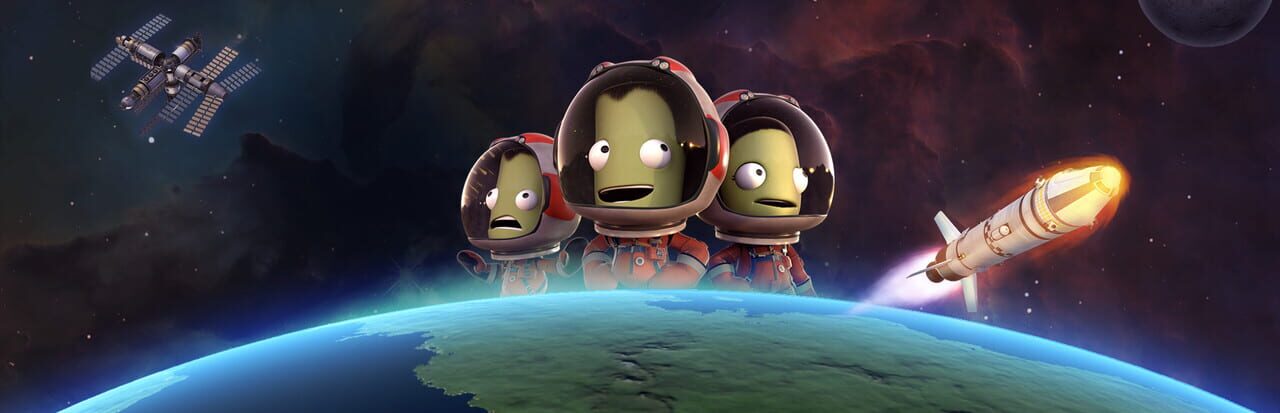
Kerbal Space Program
Squad · Simulation, Indie
Overview
In Kerbal Space Program, take charge of the space program for the alien race known as the Kerbals. You have access to an array of parts to assemble fully-functional spacecraft that flies (or doesn’t) based on realistic aerodynamic and orbital physics. Launch your Kerbal crew into orbit and beyond (while keeping them alive) to explore moons and planets in the Kerbol solar system, constructing bases and space stations to expand the reach of your expedition.
THE GAMEQ VERDICT10,000 reviews analyzed
What players are actually saying
1. Summary
Kerbal Space Program turns real orbital mechanics into a sandbox where players learn by failing. In the longer reviews, 32% tell some version of the same story: a rocket flips, Jeb gets stranded, a rescue mission needs its own rescue, and the first Mun landing feels earned. Mods come up in 24%, usually with a pointer to the CKAN mod manager, and 18% praise the physics and what they taught. Dozens of reviewers credit the game with teaching them orbital mechanics, and some say it pushed them toward engineering. Reviewers who compare it with KSP 2 nearly all say to buy this one.
Complaints are few. The learning curve is the main caveat: fans describe pushing through it as part of the reward, while the ones who quit say the tutorials left them stranded. Stock visuals look dated, and the usual answer is visual mods. A smaller group reports bugs, Kraken physics glitches, crashes and lag with big crafts or long mod lists, plus a clunky interface and save files that are easy to lose. Some reviewers also point out that the game no longer gets updates. Among the 200 thumbs-down reviews, 22% cite bugs, crashes or physics misbehaving and 19% cite difficulty.
2. What keeps coming up
What players praise
Learning by failure: crashes, stranded Kerbals and rescue missionsHigh
Reviewers describe building a rocket, watching it fail, working out why, and trying again, and they treat the explosions as part of the fun. Step-by-step lists of disasters, from forgotten parachutes to rescue missions that need rescuing, are a review genre of their own. One player wrote "Every mistake is a lesson learned, and once everything finally clicks, it all starts to come together." Another put it as "Not many games teach you so much through so much failure." A third singled out the strictness itself: "The best part about this game is how unforgiving it is." The payoff they describe is the first orbit, the first Mun landing, or bringing a stranded Kerbal home, and words like satisfying and rewarding come up again and again. The same loop wears some players out: a handful of negative reviews describe hours of failed launches with no idea why, which is where this theme meets the learning-curve split below.
Mods and CKAN keep the game aliveHigh
Mods come up in 24% of the longer reviews, usually as a reason to buy. Players list visual packs (volumetric clouds, Scatterer, Parallax, EVE, Waterfall), new planets and star systems, realism overhauls like RSS and RP-1, life support, MechJeb autopilots and kOS scripting. CKAN is the advice that repeats: "Use CKAN to mod, don't be like me." Several say the mods now make the game look and play better than its sequel. Some players see the end of official updates as a help here, since "now that the game is no longer in active development, mod version compatibility is not as much of a pain as it used to be." The downsides they mention are practical: long load times and heavy memory use with big mod lists, setup that can overwhelm newcomers, and a couple of Mac players who say many mods don't work there. Whether you need mods at all is a separate argument, covered in the split section.
Physics that feel real, and what they teachHigh
Taken together, 18% of the longer reviews praise the realism of the simulation or what it taught them. Reviewers name delta-v, gravity turns, Hohmann transfers, rendezvous and aerobraking as things they learned by playing. A few say it taught them more than school did, one of them in exactly these words: "It taught me more about orbital mechanics than school ever did." Some say the game led them to study aerospace engineering, one heard about it from university professors, and a teacher says they use it with students. A few who know the subject push back on details: one reviewer who tried to apply aerospace design principles says lift "isn't modeled very well" for planes, and another calls the stock physics "janky" while adding that mods fix a lot.
The better buy than KSP 2Medium
8% of the longer reviews compare the two games, and nearly all of them say to buy the first one. "Buy this one, not KSP2." Players call the sequel abandoned and unfinished, and some add that the original plus mods matches or beats it on looks, for example "KSP1 is far more stable and using mods you can get the graphical improvements." A few say they bought KSP 2 first and moved back. Some reviewers also say they are watching Kitten Space Agency as a possible successor.
Freeform building beyond rocketsMedium
5% of the longer reviews talk about building planes, spaceplanes, rovers, boats or helicopters, and some admit they spend more time on aircraft than on space. What draws them is how much the editor lets them build. Planes are also where several players hit limits: "for some reason flying/building a plane is harder than a literal spacecraft," and one reviewer summed it up as "Great game for designing spacecraft. Not so great for aircraft."
A helpful community and YouTube teachersMedium
Reviewers describe the community as friendly and still active ("Everyone is really friendly and helpful"), and they name YouTube teachers such as Scott Manley, Matt Lowne, Mike Aben and Quill18 as the way they learned. That praise doubles as a criticism of the game's own teaching, since several say outside videos were necessary.
Where players are split
A steep learning curve, and tutorials that don't always helpHigh
13% of the longer reviews talk about difficulty, tutorials or the need for outside guides. Some fans frame the difficulty as the price of the reward: "fight through that discouragement and i promise you it will be worth every agonizing second of trial and error." Others shrug it off with jokes about needing a degree. Players who quit describe a wall instead: "This game doesn't have a learning curve, it has a learning acute angle." Opinions on the tutorials differ too. Some call them good or point to the in-game KSPedia as "a great yet underutilized resource for beginners," while others say they are broken or too dense. A positive reviewer admits "I couldn't manage to get past the To The Mun Part 1 tutorial no matter what I did," and a negative one says "i want to like this game but it makes zero sense and the tutorials do nothing." Fans' advice for newcomers includes starting in science mode and doing the training missions with a video guide at hand.
Do you need mods? Stock visuals look datedMedium
7% of the longer reviews mention graphics, and the usual line is that the stock game looks old and visual mods fix it. Some go further and say the game shouldn't be played without mods: "Wouldn't recommend to a new player, unless they were willing to install mods on their first playthrough." Others say the stock game holds up fine ("Mods make beauty, but the stock game is perfect anyway") or that the look stops mattering once you play. One player joked "you completely forget that the graphics look like a microwaved spider man lego minifigure." Some advise learning the stock game before adding mods.
Performance: light on old PCs, heavy with big crafts and mod listsMedium
5% of the longer reviews talk about performance, and they describe two different games. The stock game runs on work laptops, school computers, Macs and Steam Decks, and players are pleased about it: "runs extremely well even on a minimal setup." Big part counts and long mod lists change that. Reviewers describe lag around large stations, load times that stretch to many minutes, and high memory use ("modded has god awful RAM usage tho"). One summed it up as "this game will happily run on a potato, and yet also take a supercomputer down to its knees." Some say performance mods help; one wrote "Can lag when loading in large space stations, however mods completely solve this issue."
Career mode: the best teacher, or a grindLow
Fans say career mode teaches the game step by step and pushes you into creative missions: "PLAY CAREER MODE!!!! It forces you to do things youd never do." Others find it grindy early on or thin, with one reviewer wanting more than "a shallow career mode," and a couple report contracts that wouldn't complete or that sent them to awkward places. A frequent tip is to start in science mode, then move to career: "I recommend playing in science mode first."
Price: full price or wait for a saleLow
Far more reviewers tell buyers to wait for a sale ("get it when it's on sale for 75% off or more") than call the game worth full price, though a few do ("Absolutely worth full price"). Reviewers say deep discounts come around often. Two negative reviews object to a price increase in their currency: "Increasing the price on a 10 year old game that doesn't even receive updates anymore is completely unjustified."
The expansionsLow
Several reviewers recommend buying the DLC, often as the complete bundle on sale. Which expansion is better is disputed: one reviewer says "Breaking Ground is great. Making History isn't all that good.", another prefers Making History, and one negative review says the Breaking Ground robotics parts barely work. Two reviewers bring up Steam Workshop craft and DLC parts: one says to get the DLC because without it "most workshop items wont work," while the other says Workshop craft still show missing parts with the DLC installed.
No more updates: a dead game or a stable oneLow
Some reviewers point out that the game is finished and won't be updated. Several mention it in passing ("This is a dead game in the sense that it's definitely never going to receive updates ever again, but it is a classic I love dearly"), and some see an upside for mod stability. For a minority it is the reason for a thumbs-down, especially paired with old bugs that will now never be fixed.
What frustrates players
Bugs, the Kraken and crashesMedium
4% of the longer reviews mention bugs, glitches, the Kraken or crashes, and these complaints account for 22% of the negative reviews. Fans joke about the Kraken as folklore and advise frequent quicksaves ("Kraken attacks happen allot when you time warp"), and others accept "Some bugs and jank around the edges, but more than enough creative possibilities to make up for it." The negative reviews get specific: rockets tipping or wobbling on the pad, landers that slide or pop their tires, trajectories that change after time warp, robotics parts that shake crafts apart, crashes on revert ("Frequently crashes... ALL THE TIME! Especially when reverting back to launch"), and loading screens that hang. One reviewer wrote "Game works until you try going further than Jool, then its so buggy its unplayable."
A clunky interface, editor and cameraLow
Players describe part placement in the editor fighting them, especially for spaceplanes ("Great concept, but the interface is frustratingly unusable"), overlapping maneuver-node menus, slow camera rotation, a game that launches in a small window, and controller support that didn't work for them. One reviewer put the core of it as "Missions should be difficult, game navigation should not be." Another's long list of grievances includes "Why are the orbit lines NOT NUMBERED??"
Thin late game and empty worldsLow
A small group says the stock content runs out once you have the basics: "Enjoyable for a max of 2 months or so before it starts becoming extremely slow and repetitive." Some find the planets lifeless, with one reviewer calling the game "30% rocket science and 70% missed opportunities," and a few wish for a light story mode, more planets or multiplayer ("There should be a multiplayer... Apart from that this is great.").
Data sharing and the old launcherLow
Two negative reviews complain about data collection and an opt-out they say doesn't work ("You can't opt out of data sharing."), and one reviewer dropped the game over what its user agreement asks for. A launcher that used to sit in front of the game still draws a thumbs-down in one review, while another reviewer who had left a negative review over it switched to positive once it was gone: "I can see the launcher has been removed, so I'll switch this to positive and begin playing again."
Lost saves and missing backupsLow
Only a few reviewers raise this, and they are angry about it. They describe accidental quickloads wiping weeks of progress, ship designs overwritten with no backup ("not having backups be made when you overwrite a ship design"), and saves stored where a reinstall can delete them: "SAVES ARE STILL STORED IN THE PROGRAMFILES FOLDER INSTEAD OF THE APPDATA FOLDER."
3. The player conversation
The tone is affectionate and joking. A large share of the reviews are mission logs played for laughs, with Jeb, Bill, Bob and Valentina stranded around the Sun, crude rocket names, and song lyrics, and a lot of the praise is hidden inside those jokes. A common line is that it is the best space game there is, and the same advice to newcomers turns up again and again: be patient with the learning curve, and install mods once the basics click.
The negative reviews come from two different groups. Players who give up on the difficulty tend to leave early, most of them before 10 hours, and UI complaints follow the same pattern. Bug complaints come from players at every level, including some past 100 hours, and those veterans write the most detailed criticism of the physics, interface and save handling; the lost-save complaints come from long-time players too. One negative reviewer described the divide this way: "This is a game that will sharply divide people."
58 reviews mention the Artemis II launch or Project Hail Mary, usually as the reason they started the game or came back to it, and several describe it as a game they bought years ago, bounced off, and finally learned. Talk about what comes next centers on Kitten Space Agency, which some reviewers hope will carry the idea forward.
4. What the developers could do
- Fix the long-standing physics bugs and crash paths. Bugs, Kraken glitches and crashes appear in 22% of the negative reviews, with specific reports of crashes on revert, wobbling and tipping craft, and trajectories that change after time warp.
- Rebuild the onboarding and fix the broken tutorials. Difficulty comes up in 19% of the negative reviews, mostly from players under 10 hours, and several name tutorials that soft-locked or that they couldn't finish.
- Bring stock visuals and mod support up to what players install anyway. Mods come up in 24% of the longer reviews and dated visuals in 7%, and players lean on CKAN because the game has no built-in mod manager.
- Clean up the editor, camera and maneuver interface. Reviewers describe parts that won't attach where intended, overlapping menus, unlabeled orbit lines and slow camera rotation as friction separate from the intended difficulty.
- Protect saves and craft files. The few players who lost progress to quickloads, overwritten designs or reinstalls want saves kept in the user folder and automatic backups.
- Improve performance for large crafts and modded installs. Players report lag around big stations, long load times and heavy memory use, even while praising how light the stock game is.
- Make the data-sharing opt-out work. Two reviewers say the opt-out doesn't work, and one left the game over what its user agreement asks for.
- Keep pricing in line with a game that no longer gets updates. Most reviewers who talk about price advise buying on sale, and two negative reviews object to a price increase in their currency.