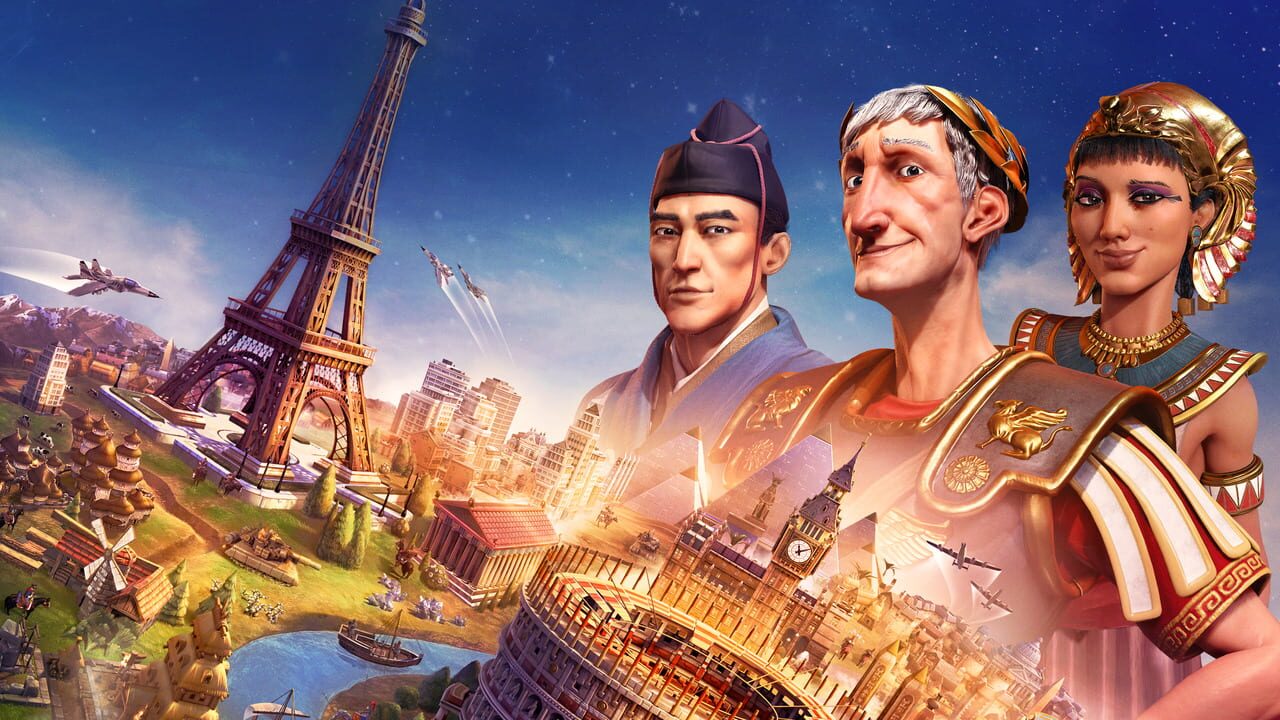
Sid Meier's Civilization VI
Firaxis Games · Strategy, City Builder
Overview
Expand your empire, advance your culture and go head-to-head against history’s greatest leaders. Will your civilization stand the test of time?
Read moreShow less
Civilization VI offers new ways to engage with your world: cities now physically expand across the map, active research in technology and culture unlocks new potential, and competing leaders will pursue their own agendas based on their historical traits as you race for one of five ways to achieve victory in the game.
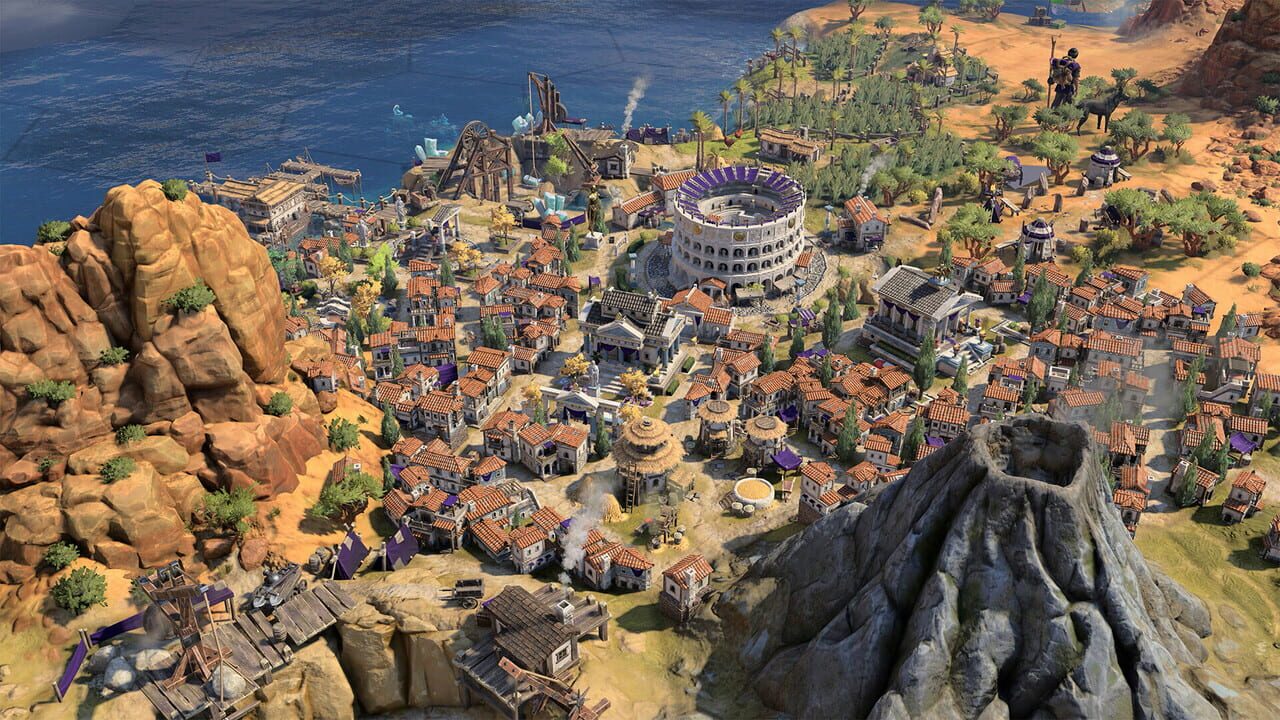
- See the marvels of your empire spread across the map like never before. Each district, wonder, and improvement is built on its own hex, allowing you to customize your city to your heart’s content.
- From the Commercial Hub to the Spaceport, every district provides unique and powerful bonuses. Pick and choose which districts to build to fit your needs!
- Build better than your opponents, place yourself strategically for your allies, and become the best civilization on Earth.
- Boost your civilization’s progress through history to unlock powerful bonuses before anyone else! To advance more quickly, use your units to actively explore, develop your environment, and discover new cultures.
- Research isn’t just limited to science. Explore the Civics tree to unlock powerful new governments and cultural policies
- Cultivate the civilization that fits your playstyle, or switch it up every time you play!
- As the game progresses, so do your diplomatic relationships. From primitive first interactions where conflict is a fact of life, to late game alliances and negotiations.
- Carry influence with nearby city states to gain its diplomatic allegiance and earn game-changing city-state bonuses
- Enlist spies to gather crucial intel on rival civilizations, steal precious resources, and even topple governments.
From the game's Steam store page.
THE GAMEQ VERDICT10,000 reviews analyzed
What players are actually saying
1. Summary
Nearly a decade after launch, Civilization VI reads as a comfort game that players keep reinstalling. Positive reviews return to the same few points: it is the "one more turn" game they know, the leaders, maps and victory types make each game play differently, and with its two big expansions it feels complete. Reviews that bring up Civilization VII often hold it up as the weaker game, and some players say they went back to VI after trying its successor. When fans explain what VI added to the series they tend to name districts, which spread each city across the map, and reviewers speak fondly of Sean Bean's narration and the civ themes that change with each era.
Fans often list the game's frustrations in positive reviews. Players say higher difficulties give the AI bonuses instead of better play, and that diplomacy is erratic (leaders who attack you and then brand you a warmonger). Late games slow into micromanagement and long AI turns. Multiplayer desyncs, crashes (Mac owners report them too) and early barbarian swarms push some players away, and the 2K terms-of-service prompt and account checks turned a group of long-time owners against the game. Players split over whether VI improved on Civilization V, over the cartoonish art, over a steep learning curve with a thin tutorial, and over how much of the game sits in paid DLC, with the usual advice being to buy the expansions on sale.
2. What keeps coming up
What players praise
The "one more turn" pull and near-endless replayabilityHigh
The phrase "one more turn" appears in 227 reviews, sometimes as the whole review. Players describe starting a session in the evening and looking up at dawn ("no one can open the game at 8 PM and confidently say they'll be able to log off by 3 AM.") and joke about lost sleep, missed meals and ruined schedules. The second half of the praise is variety: dozens of leaders with abilities that change how a game plays, random maps, several ways to win (science, culture, religion, domination, diplomacy) and game modes from the expansions, so that "no two games" feel alike. Players with thousands of hours say they still find new strategies. Fans and critics both warn that it eats time, and a few negative reviews are joke warnings about exactly that ("DONT DO IT BRO!").
Still the series' benchmark next to Civilization VIIHigh
About 6% of reviews (636) bring up Civilization VII, and 216 of them say outright that VI is better than VII. Many of those are one-liners ("better than 7"), but longer reviews give reasons: VI keeps one civilization from the Stone Age to the space age instead of switching civs between eras, it has more content after years of updates, and its UI and mechanics feel finished. Several players say they bought or pre-ordered VII, went back to VI, and stayed: "The calamity of Civ Seven has pushed myself and several friends into the loving arms of good old Civ Six." A few prefer VII, and one says returning to VI no longer feels the same. One long-time fan sees VI as where the half-baked ideas they dislike in VII began.
Districts and city planningMedium
Districts are the system fans name when they explain what VI does differently. Splitting campuses, holy sites, industrial zones and wonders across the map makes terrain matter and turns each city into a planning puzzle: "Civ VI took the city apart and spread it across the terrain, and suddenly where you put a thing mattered more than what you built." Fans like that cities specialize instead of building everything, and that wonders need specific tiles, so one capital can no longer collect them all. Detractors find the same system restrictive, hard to read without guides, and punishing if you plan badly in the first hundred turns (see the learning-curve and Civilization V themes below).
A game for friends, partners and familiesMedium
A recurring group of reviews describes VI as a shared ritual: long weekend sessions in Discord, couples playing as allies, parents and children, hotseat on one PC. "It's just a really good game to sit in Discord, hang out for a few hours, build up your civilizations, make alliances, start some wars, and see what happens." Hotseat gets specific praise, and one player adds that VII does not seem to have it. The catch is the online netcode, covered under frustrations: some of the same groups describe fighting desyncs to finish a game.
Mods and the WorkshopMedium
Players credit the Steam Workshop with keeping VI alive: UI overhauls, balance mods (a handful name the community BBG mod), new leaders and maps. One player calls VI "BY FAR the easiest game to mod". Some reviews add that mods are needed to fix things the base game should do ("you still need mods to make the interface user friendly"), that updates break mods, and that mod limits and conflicts cause crashes.
Music and Sean Bean's narrationLow
Reviewers name the main theme, Christopher Tin's "Sogno di Volare", the civ themes that change through the eras, and Sean Bean's narration as reasons the game feels special: "Love all the different music for the different leaders, and the narrations by Sean Bean." A few find the soundtrack repetitive or miss earlier games' music and Leonard Nimoy.
Where players are split
DLC: essential, but buy it on saleHigh
DLC comes up in about 5% of reviews and pricing or sales in about 4%. Reviews that weigh the base game against the full package say the base game feels thin and that the expansions they name, Rise and Fall and Gathering Storm, make VI what it is: "great fun but they really make it a half baked game without DLCs". The split is over whether that is acceptable. Satisfied players say the full Anthology regularly drops to a low price ("at 90% off, there is really no reason not to buy"). Others object that a game this old still lists at full price, that individual leaders cost extra, that friends need matching DLC to play together, and that the complete package costs far more than the game. One fan sums up both sides: "A masterpiece of strategy design with a serious DLC price problem."
Better or worse than Civilization V?Medium
Negative reviews bring up Civilization V far more often than positive ones (14% against 3%), and about 90 reviews say outright that V is the better game or that VI falls short of it. Players who prefer V cite its simpler city management, permanent and automatable workers, global happiness, more readable map and art, and better quotes: "It has some interesting ideas, but the way they work together is just too clunky. not as much fun as civ 5." On the other side, some former V loyalists say it took them a long time, but VI won them over with districts, policy cards and the expansions.
The cartoonish art styleMedium
Critics call the leaders cartoonish and "clown like", compare it to mobile games or Pixar, and dislike the fog-of-war map that blends explored and unexplored land. Defenders say the stylized art has aged better than realism and makes a busy map easier to read: "The cartoony nature does take some getting used however I found it quite charming and it makes the map very easy to read". Several reviewers say they disliked it at first and came around.
A steep learning curve and a thin tutorialMedium
Newcomers often say the first hours are overwhelming: districts, adjacency, governors, policy cards, envoys, eurekas and victory conditions arrive at once, and the Civilopedia and advisor rarely explain the numbers behind them. Some say it clicked once they learned the basics, a few of them from YouTube guides: "This game has the worst onboarding I have ever seen in a strategy game, BUT once you do learn some of the basic mechanics the game becomes really enjoyable". A smaller group gives up, calling the tutorial absent ("Worst tutorial in gaming history, as there is none") or the game too complex to enjoy, including some older players who loved earlier entries.
What frustrates players
An AI that cheats instead of thinking, and erratic diplomacyMedium
The AI is mentioned in about 3% of reviews but in 10% of negative ones, and positive reviews complain about it too. Players say higher difficulties hand the AI extra settlers, units and yields rather than better play, so early games on Immortal or Deity can be lost to a turn-20 rush while late games are trivial because the AI cannot run an army, navy or air force: "Don't bother including difficulty options if the only change is numbers." Diplomacy draws the same frustration. Leaders denounce players for arbitrary agendas, declare surprise wars, and the warmonger penalty hits players who were attacked first: "I also find it funny that the entire game I play peacefully then the AI declares war then the game labels me a war monger." Some reviewers with hundreds of hours say this is what makes the game feel solved.
Late-game slog and micromanagementMedium
Several reviews call the early and mid game the most fun. From the industrial era on, players describe managing dozens of cities and units one at a time, waiting through long AI turns on big maps, and clicking through to a victory already decided: "By that point, managing every city, unit, district, and decision can sometimes feel more like work than gameplay." One reviewer calls the science victory a "waiting simulator", and another admits to rarely finishing the games they start. Requests for automation (unit groups, build queues, automated builders) recur.
Crashes and launch failures, on PC and MacMedium
Crashes, freezes and failures to launch come up in 12% of negative reviews. On Windows, players report access-violation crashes, freezes on alt-tab, lockups after meeting a leader, and saves that fail to load, with switching between DirectX 11 and 12 a common workaround. Mac players describe crashes every few minutes on Apple Silicon machines ("Game is broken on Mac (constantly crashes)") and feel the port is no longer maintained. A couple of long-time players say the crashes started after VII came out. One who loved the game tried the suggested fixes without success: "I cannot recommend a game that will crash sometimes 15-20 times in a single night's gaming, requiring the game to be completely rebooted." Another changed a negative review to positive once a fix landed, so experiences vary by machine.
Multiplayer desyncs and connection problemsMedium
Multiplayer comes up in 9% of negative reviews. Desyncs every few turns, players dropped from lobbies, "Please wait, loading" screens after each turn, multiplayer saves that will not reload, and mixed Mac, Windows, Linux and Epic groups that cannot join each other: "For a whole year, we could not finish a single game, as each turn would take four hours to progress." One player calls single player great and play-by-cloud multiplayer so broken that it has started to sour them on the game.
Smaller interface annoyancesLow
Text and UI scaling are a recurring complaint on large and 4K monitors ("Can't increase font size easily."), along with the trade screen, map clutter, notification spam, the camera jumping between units, and no undo for a misclick. Unit pathing that routes through enemy land or embarks needlessly also draws complaints.
Barbarians that out-produce real civilizationsLow
Early barbarian camps that spawn horsemen and ships faster than a new city can respond are a recurring early-game complaint, especially from peaceful builders: "What kind of insane game devs make it so barbarians consistently have stronger militaries and military production capabilities than any developed nation you'll encounter?" The usual answer is turning them off, which some say makes the game too easy. A few players like the Barbarian Clans mode.
2K terms, account checks and launcher promptsLow
A group of negative reviews, many from long-time owners, is about what happens before the game starts. Players object to an updated 2K terms of service and privacy policy that, they say, must be accepted before playing and allows broad data collection: "Cannot play in any capacity without consenting to 2K online EULA and sharing data with any country of their choice, even for an offline game." Others hit 2K account errors ("Randomly I have an error that says my 2k account is too young to play online."), and describe cloud saves tied to a 2K account, LAN games that need an internet connection, and a main menu that advertises Civilization VII: "Nothing like getting regular updates... to update the in-game ad for Civ VII." Terms and privacy complaints alone appear in 6% of negative reviews, and several of those reviewers say they love the game itself.
Loyalty, World Congress and disastersLow
Some expansion systems divide even fans. Loyalty can flip a freshly captured or distant city back ("You take a low-population city with barely any production, and somehow the people there are mounting a significant revolt"), the World Congress makes players vote with civilizations they have not met, and the disasters and rising seas that reviewers tie to Gathering Storm feel too frequent to some even on the lowest setting. Others list these same systems as highlights, and the usual advice is to switch off what you dislike.
Builders with limited chargesLow
Civilization V veterans miss permanent, automatable workers. Builders that vanish after a few uses and cannot be automated make tile improvement a chore for them ("Workers cannot be automated anymore?"), and roads built only by traders confuse newcomers. A few players say they came to prefer the instant builds.
3. The player conversation
The tone is warm and nostalgic. Many reviews come from players who have owned VI for years, some on several platforms, and write a short endorsement or a joke about lost sleep and nuclear Gandhi. Long reviews split into two camps: fans who praise the depth and list known flaws (AI, late game, DLC price) in a positive review, and Civilization V or IV loyalists who explain why VI never clicked. Where Civilization VII comes up, it often makes players appreciate VI more, and a few who disliked parts of VI at first say trying VII warmed them to it.
Newcomers talk about the learning curve and the addictive first games. Veterans talk about AI bonuses on Deity, balance, mods and the late-game slog. Groups of friends raise desyncs, Mac owners raise crashes, and long-time owners returning to the game raise the 2K terms prompt. The sentiment stayed steady over the period these reviews cover: monthly positive shares held between 85% and 91% from July 2025 to October 2026. Complaints about the 2K terms were most concentrated in the first two months of that period, while crash reports and Civilization VII comparisons stayed constant.
4. What the developers could do
- Fix multiplayer desyncs and reconnects. Players in groups say they cannot finish games because of desyncs every few turns, lost connections and multiplayer saves that will not reload.
- Stabilize the Mac and newer-PC builds. Crashes and launch failures run through 12% of negative reviews, with Apple Silicon Mac owners describing crashes every few minutes.
- Make higher difficulties smarter, not just richer. Players complain that Immortal and Deity only add AI bonuses while the AI still cannot wage war, and they want the warmonger penalty to stop punishing defenders.
- Let players start and play offline without 2K hurdles. Owners object to the terms prompt that blocks play, account age errors, LAN that needs internet, and Civilization VII ads on the main menu.
- Add late-game automation. Builder automation, army orders and multi-city build queues would address the micromanagement that players say turns the industrial era into a chore.
- Price the full game for its age. Players say the base game feels incomplete without Rise and Fall and Gathering Storm, and that a near-ten-year-old game with expensive DLC only makes sense on sale.
- Improve onboarding and text scaling. Newcomers say the tutorial explains buttons, not districts, adjacency or victory conditions, and players on large monitors ask for a font-size option.
- Tune early barbarian spawns. Peaceful players describe camps out-producing their first cities, leaving them a choice between constant defense and turning barbarians off.