Sintopia
Simulation, Strategy
Overview
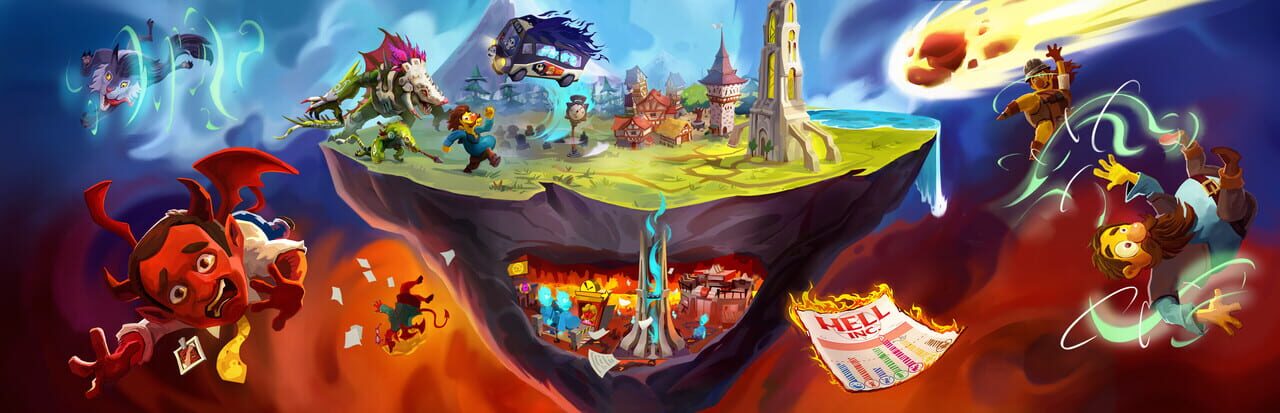
Manage Hell. Manipulate the Overworld. Build the resurrection business of your dreams! In Sintopia, you’re tasked with managing the bureaucratic administration of Hell: “re-educate” the sinful, generate profit, play god and expand your hellish empire. All part of a day’s work at Hell Incorporated.
THE GAMEQ VERDICT696 reviews analyzed
What players are actually saying
1. Summary
Sintopia stacks a god game in the Black & White mould on top of a factory-style puzzle in which you route dead souls through Hell's buildings to scrub off their sins. About a quarter of longer reviews compare it to Bullfrog and Lionhead era classics, and the praise extends past the concept to the writing, the fully voiced cast, the dense visual detail and a soundtrack people keep humming. A similar share describe Hell as more of a circuit or logistics puzzle than a city builder, and some who bought it expecting a city builder or a classic god game were let down.
Above ground, you can only nudge your little chickpea people with spells and by killing rulers, so raids, zombie outbreaks and demon spawns can wipe out a run you had little power to defend. Below, the balance is knife-edge: small mistakes cascade into upkeep debt, worker strikes and soul backlogs, and players disagree sharply on whether that is a satisfying challenge or a design flaw. Memory leaks crash some long sessions. The tutorial strikes some reviewers as too long and others as too thin, and the soul dispatchers are called buggy by some players while others say they work once you understand them.
2. What keeps coming up
What players praise
A god game and a factory sim in oneHigh
Players come for the pairing of two genres that rarely meet. 24% of longer reviews compare Sintopia to older classics, mostly Black & White (18% name it or Lionhead), along with Dungeon Keeper, Theme Hospital, Two Point, Afterlife and Majesty. A quarter (25%) frame Hell as a factory, automation or logistics puzzle, often with Factorio as the reference point. One reviewer's summary, which a second review quotes as getting it right: "Black & White + (LucasArts) Afterlife (Hell-only) + quasi-factory game + Dungeon Keeper's campaign structure, combined with its own unique twists and mechanics." Players like how the two halves feed each other: sins earned above decide what flows into Hell, and what you send back up changes the world. "This looks like a city builder but it's more of a circuit builder," one reviewer warns. Fans of automation call the routing satisfying. Some who expected a city builder or a hands-on god game bounced off, and several negative reviews say the game is neither a full god game nor a full factory game.
Writing, humor, characters and voice actingHigh
Story and characters come up in 28% of longer reviews, humor in 23% and voice acting in 9%, mostly as praise. Players single out the satire of Hell run as a bureaucratic corporation, the fully voiced cast and the finale, which a couple of reviewers call epic. "The writing makes me laugh out loud, the characters are great for a game about managing hell and I adore the voice actors who give it their all," one wrote. A couple of players who usually skip story scenes say they sat through these. A minority finds the jokes tired or the sexual humor grating, covered under the split section below.
Art, detail and soundtrackHigh
17% of longer reviews praise the art style, animations or detail, and 10% the music. Players zoom into buildings to read posters, books and staff memos: "If you zoom in on a book or poster it isn't squiggles it is written text, often with relevant topics." Others point to the sin-punishment rooms and even the demons' names. One reviewer calls the soundtrack "an absolute 10/10, chockfull of earworm bangers", and another singles out the 80s synth-rock songs in Hell. The complaint about the music is that there are too few tracks for long missions.
Challenge and sandbox modes after the campaignMedium
17% of longer reviews mention the challenge or sandbox modes, mostly as a reason to keep playing once the campaign (eight missions, reviewers note) ends. Challenge runs unlock boons from earlier Hell administrators that change core mechanics, and the players who like them say this keeps runs varied: "Campaign mode is just a tutorial but challenge mode is really fun." Some sandbox maps and options are locked behind challenges, though, and one negative review warns against buying it as an endless game: "But don't buy it if you expect to be able to keep repeating the gameplay after the Campaign." Others asked for more campaign missions or a DLC follow-up to the ending's tease.
Quick launch patchesLow
A few launch-week reviewers switched to positive after the first patches fixed crashes and stuck souls. "As this has been fixed in less than 2 weeks, I can happily say, I reccommend this game," one wrote, and another edited their review to say the developer responded quickly to their bug report.
Where players are split
Difficulty, death spirals and the upkeep economyHigh
17% of longer reviews raise unbalanced difficulty, unrecoverable spirals or the upkeep and strike economy. The complaint is that one mistake snowballs: unpaid imps go on strike, which earns less money, which causes the next strike; untreated sins breed deviants and demons; a lost army leads to zombies. "The Doom Spirals in this game are both real and frequent," one fan wrote while still recommending it. Another: "Staff go on strike cos you can't pay for a quarter of the day so you struggle to make enough money to pay them the following day." Several reviewers name the third or fourth campaign mission as the point where it got hard, and a few say the per-mission cap on upgrade points, with no respec, can lock a run without warning: "If you buy the wrong things, you're done."
Other players call the challenge the point of the game and say the difficulty eases once the systems click: "It felt good to fail and feel like my only option was to start over and optimize a bit better." Several suggest that struggling players restart missions with the lessons learned, play on Easy first, or follow the campaign's upgrade tips. A few noted in the first weeks that a patch had already reduced some of the difficulty.
Soul dispatchers, pathing and building toolsMedium
12% of longer reviews discuss soul dispatchers and pathing or the building UI. Launch-week reviews in particular report sorters that stop working, souls standing still at waiting lines, and rules that reset: "The logic gates have a tendency to brake, leaving your souls just standing there." One workaround offered is picking the sorter up and putting it back down. Other players insist the dispatchers work and the jams are self-inflicted: "Every time one of mine got clogged, it turned out to be a problem I'd created somewhere upstream." Requests for missing tools come from both camps: no copy-paste for dispatcher rules ("You have to re-enter the entire rule set EVERY. SINGLE. TIME."), no undo, no blueprints, no way to mirror line buildings, tiny UI elements and a camera that won't zoom out far enough.
Depth versus repetitionMedium
Some players say the systems run deeper than they first look and reward experimenting with cults, demons and soul modifiers. Others find the opposite once a working layout is found: few building types, specialist sin buildings that rarely pay off, upgrades that are mostly percentage bonuses, and every map ending up built the same way. "You simply lose unless you have the exact optimized path and logic gates," one critic of its rigidity wrote. Some also find demons and several tech-tree buildings not worth unlocking.
PriceMedium
9% of longer reviews comment on value. Some call it "Definitely worth the price." Others suggest waiting for a sale; "I don't think it's worth more than $30," wrote one player who still recommends it, pointing to the limited building options. The price complaints tend to come attached to the balance and content caveats rather than standing alone.
The humor's toneLow
Where the humor comes up it is mostly praised, but a small group dislikes it: some find it safe or stale ("The comedy is particularly unwelcome."), others object to the sexualized succubus assistant, the all-female secretary imps and some campaign gags ("Like, it's just boomer humour and I'm mad they have my money lol."). A few others enjoy the same adult humor.
What frustrates players
Little control over the overworldHigh
12% of longer reviews say the overworld gives too little control, spells feel weak, or the humus can't look after themselves. You cannot build or command units above ground, so whether soldiers get recruited depends on a randomly rolled ruler you can only replace by killing them. Players describe archers who don't retreat from approaching melee mobs while their own melee troops arrive too late, armies dog-piling one enemy while a mini-boss levels the town, and timed missions where raids escalate every night. "I didn't feel like i was influencing the overworld but rather babysitting a civilization that was constantly on the verge of death and had no intention of helping its self," reads one negative review. Healing rain and lightning that hit allies and enemies alike, lava bombs with no aiming reticle and a small mana pool add to it. Some fans defend the hands-off design as true to Black & White, and others say cultists and spell upgrades fix it later. Positive reviews ask for more overworld tools too: warnings before a deviant turns into a demon, or a minimap.
Crashes, memory leaks and performanceMedium
13% of longer reviews raise technical problems, and 9% mention crashes, freezes or saves that won't load. Reviewers describe memory use that climbs over a long session or with a large population until the game crashes, several of them in the final campaign mission. "I watched my 12GB of VRAM go from 1.5GB to 6GB on game startup," one Linux player wrote. Others report frame drops once Hell grows, lag spikes when switching between Hell and the overworld, and only preset graphics options. Some players say patches fixed their crashes, while later reviews still report memory leaks.
Tutorial that is both too long and too thinMedium
Reviewers with little time in the game call the tutorial slow and over-scripted: "Imagine playing factorio and there is a VA guide with cheesy lines explaining machines to you for 30 minutes." Players who stayed say it still left key systems unexplained, including fear and motivation decorations, which upgrades matter, what the difficulty levels change and how much rides on the first upgrade picks. "This justified negativity is a result of how very, very poorly the progression is explained," wrote one player who recommends the game. A few say they had to learn from YouTube or the discussion boards instead.
Slow pacing and micromanagementLow
Some players find the pace dragging, with stretches of waiting for money or souls, and more micromanagement than a management game should need, such as poking imps back from breaks and smiting deviants by hand. Others call the same rhythm relaxing.
Linux and Steam DeckLow
A handful of players on Linux (Proton) and Steam Deck report crashes at mission load, intermittent lag and VRAM exhaustion: "If you are playing on Linux of any flavor, avoid this title." Other Linux players say it ran without issue.
No more updatesLow
A few late reviews turned negative after reports that the Imployee Retention update would be the last planned update, which they read as leaving the remaining bugs and balance issues as they are. "can I recommend a good game knowing that it's already been abandoned by the developers?" asked one player who otherwise liked it.
3. The player conversation
The tone is warm and often protective. Some fans write long reviews defending the game against the "too hard" crowd, and a few critics open with some version of "I wanted to like this". A few reviewers on both sides wish Steam had a middle option. The concept and presentation are rarely questioned; the arguments are about balance, control and polish.
What players raise shifts with how far they got. Reviewers with an hour or two played mostly talk about the tutorial, expecting a city builder or a classic god game, the jokes, and crashes on load. Players who reached the middle of the campaign focus on the third and fourth missions, the strike and upkeep spirals and dispatcher behavior. Those who finished the campaign and moved to challenges or sandbox write about overworld AI, soldier and ruler balance, missing quality-of-life tools, late-game memory leaks and whether the sandbox can sustain a long game.
Launch week sat at 78% positive, with crash reports, stuck souls and a harsh third mission. The second week rose to 90% as patches landed and a few reviewers flipped their verdicts. From May onward weekly volume dropped to a few dozen reviews or fewer, and the positive share mostly sat in the 70s and 80s, with the smallest late weeks swinging further. Later reviews moved from launch bugs to the overworld, the spirals and memory use, and a few reacted to news that support had ended.
4. What the developers could do
- Give players more tools to protect the overworld. Overworld complaints come from fans and critics alike, with players asking for a minimum soldier count, a way to mark priority targets, spells that spare allies, and fewer runs lost to raids they could not influence.
- Fix the memory leaks that crash long sessions. Crashes and VRAM exhaustion in large or late missions, including the campaign finale, stopped some players from finishing the campaign.
- Add a way back from death spirals. Players describe strike and upkeep loops, sin cascades and zombie chains as unrecoverable, and they ask for loans, a way to switch buildings off, or warnings before a deviant becomes a demon.
- Explain the systems and allow upgrade respecs. Reviews ask for clear difficulty descriptions, explanations of fear, motivation and the upgrade tree, and a respec for mission upgrade points, since a wrong pick can lock a campaign run.
- Add dispatcher and building quality-of-life features. Players ask for copy-paste for dispatcher rules, undo, blueprints, mirrored line buildings and a way to inspect why a soul is stuck.
- Shorten and sharpen the tutorial. Reviewers with little playtime found it slow and interruptive, and players further in say it still missed what later missions demand, so fewer scripted steps and more on what actually causes failures would help both groups.
- Stabilize Linux and Steam Deck play. Proton and Deck players report crashes when missions load and runaway VRAM use.
- Widen Hell's building variety and the late game. Players who stay past the campaign report same-looking layouts, underused demons and specialist buildings, and a sandbox that runs out of challenge.