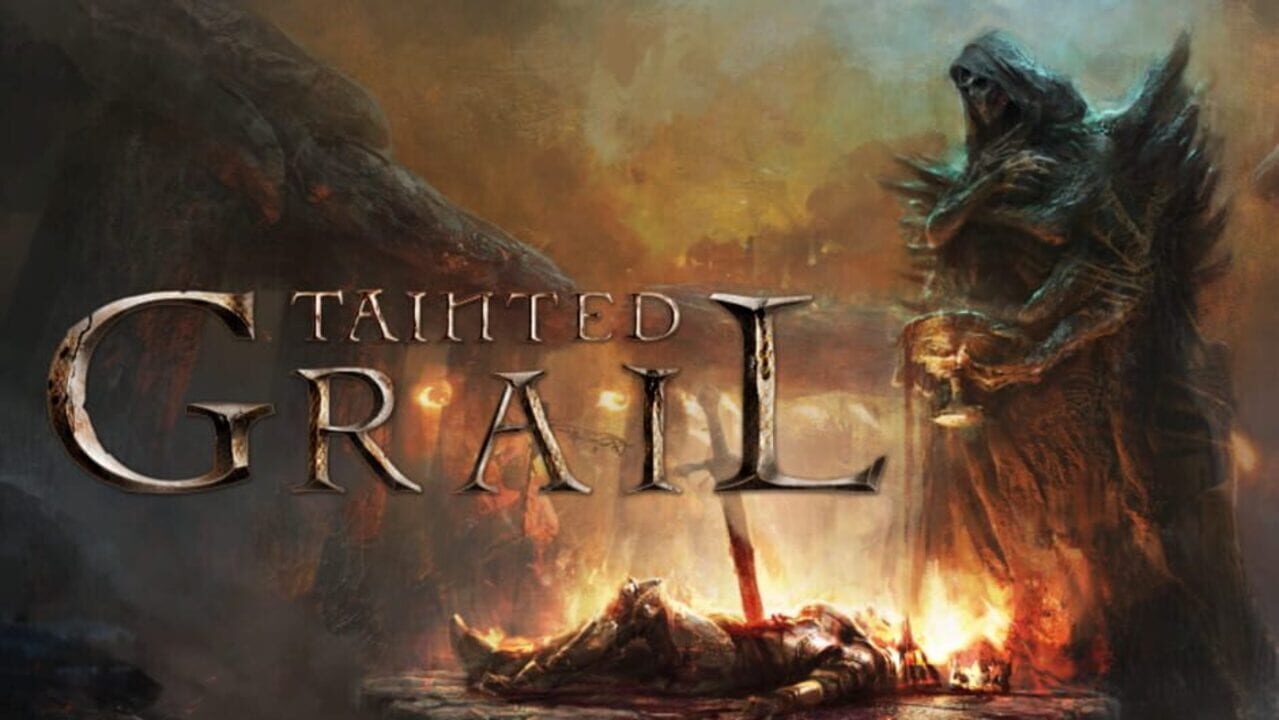
Tainted Grail: The Fall of Avalon
Questline · RPG, ARPG, Open World
Overview
Step into a dark reimagination of Arthurian legends in this first person, open world RPG. Explore a world stuck in everlasting autumn, witness falling legends and make meaningful choices woven into a complex, branching storyline.
Read moreShow less
Welcome to Tainted Grail: The Fall of Avalon
Step into the world of Tainted Grail: The Fall of Avalon, a mature, first-person perspective open-world RPG that immerses you in a dark fantasy realm inspired by Arthurian legends.
Uncover a complex and branching main storyline that lets you shape the legacy of King Arthur’s reign, 600 years after his fall amidst unending strife.
This game is a love letter to open-world FPP RPGs.
Key features
Massive gameplay experience: Dive into 50-70 hours of rich content spanning three expansive zones.
Branching narrative: Engage with a complex main story and hundreds of side quests featuring remarkable, voiced characters.
Limitless playstyles: Customize your gameplay with countless builds—mix attributes, skills, and gear to create your favorite setup.
Every corner of Avalon is packed with discoveries—hidden items, story secrets, unique enemies, dungeons, quests, and fascinating NPCs. Freely explore at your own pace and forge your path in a truly open world.
Switch seamlessly between melee weapons, shields, bows, magic, throwables, mixtures, and more. Dodge, parry, and block to protect yourself from danger. Experiment to develop your ultimate combat style against a wide variety of challenging enemies.
With all the stats, perks, equipment, and crafting, you can shape your playstyle exactly how you wish.
Want to be a crazy alchemist-berserker punching enemies to death? Sure.
A mystical blacksmith-mage summoning undead hordes? We’ve got you covered.
A stealthy archer lurking in the shadows? Say less—this is the game for stealth archer enthusiasts.
Experience three distinct zones, each packed with quests, NPCs, items, and more:
Frozen peaks of the Forlorn Swords
Avalon is alive with various supporting activities that enrich your journey. Participate in sketchbook journaling, fishing, farming, blacksmithing, alchemy, cooking, mining, managing your house, and more.
At night, the Wyrdness—a chaotic primordial force—descends upon the land, altering reality and introducing survival challenges. Your foes become even fiercer, leaving no place for mistakes or hesitation. Kill or be killed.
Confront morally ambiguous choices that will test your character and shape Avalon’s future. Follow the dark legacy of King Arthur Pendragon while engaging with over 250 NPCs and tackling 200+ side quests.
From the game's Steam store page.
THE GAMEQ VERDICT9,999 reviews analyzed
What players are actually saying
1. Summary
44% of reviews compare Tainted Grail to Skyrim, Oblivion, Morrowind or Bethesda, and many of them treat it as the darker Elder Scrolls game they had been waiting for. The writing gets the most praise: a grim and often funny reworking of Arthurian legend, with side quests whose outcomes are morally murky. Players also like the dense hand-made map full of hidden places, the classless build system, the soundtrack and Arthur's voice performance, and many credit the developers for patching hard and adding free content after launch.
Each frustration comes up in under a tenth of the reviews: bugs and quest-breaking softlocks, CPU-bound stutter in the open world, and a difficulty curve that starts harsh, spikes in each new region and then turns easy once a build comes together. A smaller group says the game uses AI-generated art and text without disclosing it on the store page, a complaint found in 10% of negative reviews. Combat divides players. More reviews praise its weight and its dodge-and-parry rhythm than call it clunky, but combat criticism shows up in 18% of negative reviews. The second half divides them too: Act 3 drew complaints of a rushed, empty final act soon after launch, and later reviewers disagree about how much the patches fixed.
2. What keeps coming up
What players praise
The Elder Scrolls formula, made darkerHigh
Skyrim, Oblivion, Morrowind or Bethesda come up in 44% of reviews, and many of those comparisons are compliments. Reviewers say it beats Skyrim, call it "Skyrim 2" or a stand-in for Elder Scrolls 6, or say it scratches a long-standing "itch". One reviewer put the pitch this way: "Imagine Skyrim, but instead of power fantasy you get moral ambiguity and constant dread." Dark Souls and Elden Ring come up to describe the tone and the dodge-based fights, Morrowind for a game that doesn't hold the player's hand, and Gothic as another older RPG it resembles. Avowed usually appears as the foil; the phrase "Avowed should have been" turns up in several reviews, as in "This is the game Avowed should have been."
The labels that sound dismissive, such as "Skyrim at home", "Skyrim clone" and budget or Temu Skyrim, are often used fondly by fans or quoted only to be rejected: "This isn't an Elder Scrolls wannabe. This is Tainted Grail." The critical version says the game plays like a "Skyrim mod", or that it copies the form without the feeling: "You can copy Skyrim, but not it's spirit of adventure."
Writing, side quests and dark humorHigh
25% of reviews praise the story, lore, writing or quests in the same sentence, and 6% criticize them. Players single out the grim take on Arthur and Avalon, with Arthur himself as the voice in the player's head, and quests with no clean answer. The humor has its own fans: the spell that turns enemies into cheese, the man waging war on seagulls, the husband who would rather stay a pig, the theological debate with a priest over confiscated smut. "Story and voice acting is top tier," one reviewer wrote; another praised a "great interpretation of the Skyrim formula paired with really high quality writing".
Critics of the writing object to its quantity and tone. Some find the NPCs exhausting, with long lore dumps on every errand, and a few call the dialogue too modern for the setting. Choices draw both reactions: some reviewers say decisions carry real consequences, while others say the world barely reacts and the effects show up mostly in the closing slides (see the split on the later acts).
Atmosphere and art directionHigh
Reviewers describe a decaying, plague-ridden Avalon with touches of Giger and Beksiński, the Wyrdnight cycle that makes nights dangerous and sends a ghost knight after the player, and set pieces such as a lake of blood. Criticism of the atmosphere itself is rare, and some reviewers who reject the game on technical grounds still grant this point: "Visually and atmospherically, the game is a 10/10. However, the technical execution unfortunately lets it down."
Exploration that pays offHigh
Leaving the road leads somewhere, say the reviewers who praise exploration: a hidden passage, a unique weapon, an unmarked quest from a talking corpse. "This game trully rewards exploration!!" wrote a 60-year-old RPG fan. The same reviewer who called Act 3 far weaker warned that "If you just rush the story without exploring you will be dissappointed." Several contrast the game's one-off locations with Skyrim's repeated dungeons: "Imagine if when you were wandering around the map and found an odd location, it was an actual unique event instead of just another dwarf ruin." Some also like that enemies do not scale to the player's level, so a return trip to an early area shows how far a character has come.
Build freedom and gearHigh
Players like the classless skill trees, weapons and armor with effects that change how a character plays, and the freedom to run a cheese-casting wizard, a necromancer with a small army or a dual-shield bruiser: "The hardest thing in this game is not starting a brand new build everytime i find a cool new piece of gear that would work great on a different playstyle." Reservations include perks that are mostly flat percentage bonuses, gear stat requirements that keep good loot unusable for hours, and respecs limited to a few potions. How strong these builds become is the core of the balance complaint below.
Music and voice actingMedium
The main-menu song, which reviewers credit to Danheim, and the Norse and Celtic folk tracks get quoted in reviews and praised as music worth hearing outside the game: "Also the music is freaking great Danheim was such a good choice for this." Arthur's voice performance gets singled out too. The minority view is that Norse chants feel out of place in an Arthurian setting and that voice quality is uneven among minor characters (see presentation below).
Developers who kept patching and adding contentMedium
6% of reviews recommend the game and mention fixes, improvements, free content or developers who care. Long-time players describe a game that changed a lot after release: those who started after patch 1.1 report more content in Act 3 and fewer bugs, and others list transmog, New Game+, free bonus content, a challenge mode and further patches through 2026. One long review opens with an edit saying the developers fixed nearly every complaint a couple of days after it was written: "The devs went through and fixed/polished EVERYTHING I griped about." Edited reviews from the first weeks after launch tell the same story: "they cleaned up the mess and added a bit of content. The game is quite decent now." The same frequent patching also angered players whose builds were rebalanced mid-playthrough (see balance).
Sanctuary of Sarras, the paid expansionLow
Under 1% of reviews name the expansion, and most of those mentions are warm: it adds a sea-themed region that some compare to Oblivion's Shivering Isles ("Sarras DLC: Get it without hesitation."). Critics say it leans on damage-sponge enemies and an awkward travel system, and warn that its loot makes the base game's Act 3 trivial if played early. One long review finds it smaller than any of the base game's regions and calls the claim that it is massive misleading. A few objected to a paid expansion arriving while base-game bugs remained.
Where players are split
Combat feelHigh
Combat comes up in 22% of reviews, more than any other system. Praise outnumbers criticism, 14% of reviews against 5% in the same sentence, yet combat criticism appears in 18% of negative reviews. Fans describe weighty first-person fighting where dodging, parrying and stamina matter far more than in Skyrim: "It feels like Black Metal Skyrim but with an actual good and fun combat system with great feedback." Critics call it clunky, floaty or unresponsive, with hitboxes that do not match the swing and a heavy reliance on dodging: "Everything hits for half your health, so it basically forces a dodge-roll meta." Fans list some of the same irritations: "If I dodge an enemy he shouldn't continue to lunge from outside of attack range to still hit me." Other complaints include enemies that run back to camp and heal to full when the player steps out of range, ragdoll physics that fling bodies (and the loot on them) out of reach, and a parry that needs its own tap input.
Acts 2 and 3, Kamelot and the endingMedium
The complaint about the later acts, in one reviewer's words: "Act 1 and 2 are great, act 3 is far weaker by comparison, it felt like the devs ran out of time/resources here." Critics describe Act 3 as empty snowfields, tribe-recruiting errands and recycled enemies; some place the drop earlier: "the writing and gameplay both fall off a cliff during act 2". Some are let down that Kamelot, built up all game, is never visited and its fall happens off screen, and that the ending is a slideshow whose cards sometimes contradict what the player actually did.
Act 3 came up in 22% of the 97 reviews dated June 2025, the month after launch, and in 4% to 7% of each month's reviews from November 2025 on. Some players who started after patch 1.1 or later updates call the complaint outdated: "What people said about act 3 during release no longer stands in my opinion, the team has really worked hard on fixing it." Others who wrote in 2026 still found it the weakest act: "Act 3: An absolute slog."
Graphics: dated technology, strong artMedium
Reviewers separate the art from the technology. Many who admire the art direction concede that the engine looks a decade or more old, with stiff animations, plain character models and low-resolution cutscenes. For some this is part of the charm; for others it compounds the performance problems: "game design from 2011, game performance from 2025".
Price and valueLow
More reviews advise waiting for a sale or discount than say the game is worth full price. Fans argue the amount of content justifies the list price ("This game is worth $45. That's only 2 skins in some games."), while more cautious reviewers recommend buying at a discount because of the bugs and the weaker second half. A few complained about regional pricing.
What frustrates players
Bugs, softlocks and broken questsMedium
9% of reviews raise bugs, glitches, softlocks or getting stuck, and this comes up in 17% of negative reviews. Some describe quest-breaking states: killing or angering a character the main quest needs (the blacksmith who must repair the gong, or a faction the player refuses to side with), a bounty that becomes "unforgivable" and turns a whole town hostile, dialogue choices that silently close off the main quest, and quest items lost when a ragdolled body flies off a cliff. "My problem is that the way in which I made the main quest inaccessible was not only stupid, but I wasn't informed of it." Smaller glitches include falling through terrain, elevators that drop the player through the floor, and summons that get stuck or block the way. Reviewers joke about the game's own unstuck option: "There's an option in the pause menu in case you get stuck in level geometry. It's that kind of game." Some long-time players say patches fixed most of what they hit, while reviews from 2026 still report quests that could not be finished.
Performance, crashes and lost savesMedium
8% of reviews raise performance, crashes, save corruption or launch-time file checks, and these issues appear in 20% of negative reviews. Several describe the same pattern: the opening prison runs fine, then frame rates fall in the open world and in hub towns. Reviewers blame a CPU-bound engine ("this is a Unity game and is not well optimized at that, you will be CPU bound HEAVILY."), pop-in, heavy fog, the vegetation setting and memory leaks that slow the game until a restart, and some Steam Deck owners question its Verified badge. Others report crashes and, in a smaller set of reviews, corrupted or lost saves, some after patches. Some players report smooth play, and some say performance improved a great deal over time: "Early Access had horrible performance, current release has very good performance".
Balance: a harsh start, a trivial finish, and nerfsMedium
8% of reviews talk about balance, difficulty spikes, damage sponges, nerfs or the game becoming too easy, and these complaints appear in 16% of negative reviews. The curve reviewers describe: a hard start, spikes at certain bosses and on entering each new region, where ordinary enemies have far more health ("bandits in the third zone have comparable HP to bosses in the first zone"), and then a point where a developed build flattens everything, even on high difficulty: "there was a tipping point at which the rest of the game became very, very easy." Magic and summoning get named as the easy route and stealth as a weak one, especially against bosses that lock the player into an arena after a cutscene. One reviewer put it briefly: "it's not too hard, it's not too easy, it's inconsistent."
The developers' balance changes split the audience further. In early March 2026 a few players blamed patch 1.20 for raising enemy health and cutting experience gains: "Update 1.20 ruined this game." "No matter the difficulty you chose, mobs are bloated hit point sponges." In the week of 2 March 2026, the positive share fell to 80.4%. Reviews from the autumn of 2025 show the same anger over nerfs to crit and mage builds, from players whose builds stopped working mid-playthrough: "Treating it much like a competitive MMO rather than a singleplayer experience that already has a difficulty setting." Other players welcomed the harder tuning, the optional challenge mode and the diminishing-returns setting.
Navigation and clunky systemsMedium
4% of reviews raise quality-of-life problems. They include no maps inside large dungeons and castles ("No maps for many large interior areas"); few fixed fast-travel points, with campfire travel costing a consumable; a horse barely faster than running; three quick slots and potion variants that do not stack; encumbrance in a game full of ingredients; upgrade costs that climb into the hundreds of thousands of gold while loot sells for a tenth of its listed value; and a default where left click swings the right hand (one reviewer quotes patch notes from April 2026 that added rebinding for attack and block). One recommending reviewer wrote that "the UI feels like an afterthought".
Fetch quests and a static worldMedium
3% of reviews complain about fetch quests, back-and-forth errands or an empty, static world, and these complaints appear in 9% of negative reviews. Reviewers describe NPCs who stand in the same spot all game, towns with a handful of residents, quest chains that send the player across the map to speak to one person and back ("I ended up feeling like Avalon Postal service after a while."), and a volume of side quests that wears some players down. "The world feels static," wrote one reviewer who still recommends the game. Several place the worst of it in Acts 2 and 3.
Rough presentation: lip sync, voices and third personMedium
3% of reviews point at presentation problems. Reviewers say lip sync barely exists, subtitles often differ from the spoken line, some lines sound recorded on home microphones or keep audible retakes, and names like Cuanacht and Dal Riata are pronounced several different ways. Some call the third-person view, which they say was added after launch, an afterthought. Recommending players raise this too: "Aside from the low res cutscenes and bad lip syncing, it's a really fun game."
Claims of AI-generated contentLow
1.6% of reviews (160) accuse the game of using generative AI, and these accusations appear in 10% of negative reviews. Players point at murals, paintings, item icons and cutscene stills, and at text: bestiary and codex entries and dialogue that they say read like ChatGPT output, a few down to the em dashes. Many of these reviews are about disclosure: they say the Steam store page doesn't mention AI use, and that "the consumer still deserves to know to make informed purchases." The complaint came in waves, highest in August 2026, when 4% of that month's reviews raised it ("cut corners with AI art, icons, and writing"). Some recommending reviewers mention it as a mark against an otherwise good game.
File checks at launchLow
Under 1% of reviews complain that the game verifies its files at startup and after updates, sometimes for 10 to 30 minutes and sometimes in a loop that never finishes. Most of these are negative reviews, and nearly half come from players with under 5 hours, who object that the wait "counts toward your playtime for the refund window". The complaint peaked in December 2025. A handful of reviews also object to the game's analytics and data collection.
3. The player conversation
The tone is warm and often nostalgic. Many reviews are short endorsements, often built on the Skyrim comparison, and the criticism lives in the longer ones: players who finished the game tend to write a list of praise followed by a list of caveats, usually the same few (bugs, balance, the second half), and still recommend it. Negative reviews fall into a few camps: players who bounced off the combat or the performance early, completionists who soured on Acts 2 and 3 or on balance changes, and a group that objects to AI-generated content. Edited reviews run both ways: some players who panned the game at launch or in Early Access came back after the updates to recommend it, and a few turned negative later, one of them over generative AI.
Early and late reviewers raise different things. Reviewers with under 5 hours bring up performance, AI content and launch-time file checks more often than others (file checks in 3% of their reviews, against under 1% for everyone else). Reviewers with 60 or more hours write about bugs, Act 3 and the game getting too easy, and the last two barely appear among reviewers with under 5 hours.
Reviews from the first months after launch are few in this slice. Launch week stood at 73.5% positive over 49 reviews, with bugs, performance and combat the most raised topics. From September 2025 to February 2026, monthly approval ran between 85% and 94%, and the week of 24 November 2025 reached 96.7% over 486 reviews, many of them short. The week of 2 March 2026, when the patch 1.20 complaints appeared, fell to 80.4%. The week of 15 June 2026 dipped to 73.5%, with combat and balance the most common topics in its negative reviews, and AI complaints rose through July and August 2026. September 2026 closed at 84%.
4. What the developers could do
- Close the softlocks and warn before irreversible choices. Quest-breaking states (unforgivable bounties, essential characters who can die or turn hostile, lost quest items) turn up among the 9% of reviews that raise bugs, and the players who hit them ask to be warned or given a way back.
- Fix open-world stutter, crashes and save corruption. These issues appear in 20% of negative reviews, described as CPU-bound frame drops once players leave the prison tutorial, crashes, and saves lost after patches.
- Smooth the difficulty curve without inflating enemy health. Balance complaints appear in 16% of negative reviews and describe region-entry spikes followed by a trivial late game. Reviewers who blame patch 1.20 object to bloated enemy health on every difficulty, so new tuning should be opt-in rather than applied to builds mid-playthrough.
- Keep reworking Acts 2 and 3 and make the ending slides match player choices. Players who reach the end complain about the thinner second half, the never-visited Kamelot and epilogue cards that contradict their choices.
- Disclose AI-generated content on the store page and replace it in the game. Claims of AI-generated content appear in 10% of negative reviews; many of those reviewers ask that buyers be told, and a few ask for the assets to be replaced.
- Add interior maps, more fast travel and better consumable handling. Missing dungeon maps, limited fast travel, three quick slots and steep upgrade costs are among the complaints in the 4% of reviews that raise quality-of-life problems.
- Stop launch-time file checks from eating the refund window. The complaint is small, but most of those reviews are negative and nearly half come from players in their first 5 hours.
- Polish lip sync, subtitles and voice consistency. Missing lip sync, mismatched subtitles and uneven recordings come up in 3% of reviews, including recommending ones.