We Were Here Together
Total Mayhem Games · Puzzle, Horror, Indie, Action
Overview
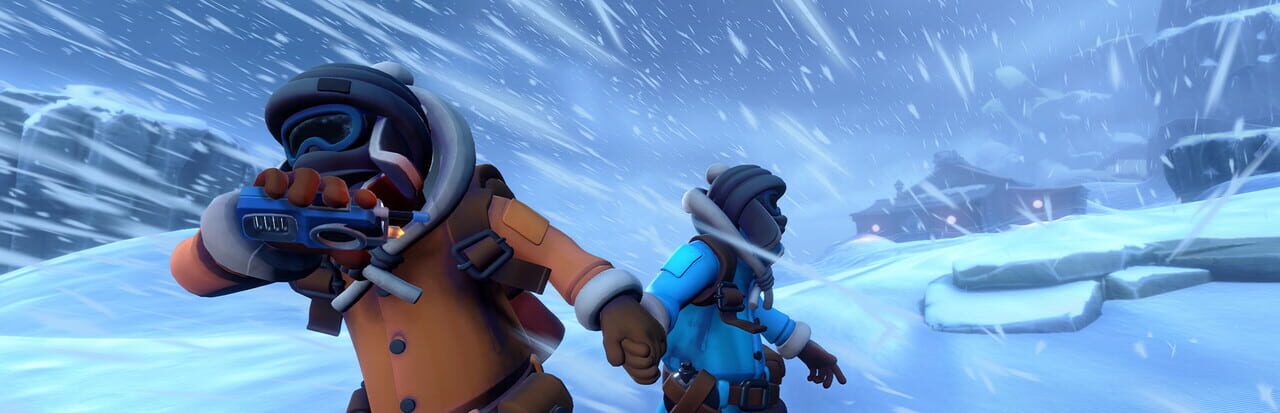
As we explore these frozen wastes, misfortune strikes once again. Through the fierce blizzard, an emergency flare lights the sky, followed by a cry for help over the radio - broken, dying... No one else will be able to come to their rescue. But can we make it back - together?
THE GAMEQ VERDICT6,316 reviews analyzed
What players are actually saying
1. Summary
We Were Here Together is the third co-op puzzle game in the We Were Here series: two players, a walkie-talkie, and rooms where each of you holds half the answer. Most players recommend it as a puzzle night with a friend, partner or sibling where describing what you see is the whole game, and a share of returning fans call it bigger, longer and better looking than the first two games. 26% of positive reviews frame the game around a specific person they played with or around communication and teamwork, and the shouting matches, betrayals and jokes about testing a relationship come up in that same affectionate tone. The music, the snowy castle setting and the Jester character also get steady praise.
Complaints gather around the second half of the game. 44% of the negative reviews that give a reason fault the puzzle design: puzzles that never say what they want, solutions found by trial and error, and rooms where one player does nearly everything. 35% describe technical failures, above all chapters that fail to load key objects (chapter 8 most of all), so players spend an hour on a puzzle that cannot be solved and only learn of the bug from a guide. Disconnects that throw both players back to the start of a chapter come next. Reviewers split on whether the later puzzles are a fair challenge or guesswork, and the share recommending it fell from 89% of reviews written before 2021 to 64% of those written from July 2025 onward.
2. What keeps coming up
What players praise
Talking each other through split puzzles with a friend or partnerHigh
Each player sees different clues and controls, so progress depends on how well you describe shapes, colours, sounds and symbols to someone who cannot see them. One launch-era reviewer explained it this way: "The majority of the puzzles rely on having incomplete information, and as such calm and clear communication is required." Another praised how "both players are repeatedly given different perspectives on the solution", so neither can solve everything alone. 26% of positive reviews talk about the specific person they played with (a best friend, girlfriend, husband, brother, daughter) or about communication and teamwork, and some say they worked through the whole series with the same partner. One reviewer who played it with a long-distance partner said solving puzzles together while apart made it feel special. The praise often comes with a caveat: the experience is only as good as your partner and your patience.
Bigger, longer and better looking than the first two gamesMedium
Returning fans who compare it with the earlier games often see Together as the point where the series grew up. 5% of all reviews (328) call it an improvement on earlier entries or the best of the series, almost all of them positive. They point to more puzzles, more varied mechanics, the opening section where both players explore together before splitting up, and a jump in art quality. A launch reviewer called it "Way more involved and much longer than the previous games." Typical completion times quoted run from about 5 to 9 hours for one side, and players who replay as the other role say it roughly doubles. Not everyone agrees with the comparison (see the split over its place in the series below).
Music, atmosphere and art directionMedium
7% of reviews mention the graphics, art style, environments or atmosphere. Players like the snowy expedition opening, the castle interiors and the colourful, slightly spooky tone. The music comes up in 3% of reviews, mostly as praise, and several negative reviews single it out as the best part. The guitar main theme, the "puzzle complete" jingle and the Jester's song are named most often; one player wrote "the jester's voice actor nailed it! his song gave me goosebumps".
Shouting at your partner is part of the funMedium
About 120 positive reviews joke about yelling, arguing, nearly breaking up or losing a friend ("Almost broke up with my partner while playing this one. Zero regrets"). These reviewers treat the frustration as part of the shared memory, in the same breath as the satisfaction of finally cracking a room together. About 20 negative reviews use the same language without the joke, blaming the arguments on the puzzles.
Where players are split
Hard puzzles: a satisfying step up, or too muchHigh
18% of all reviews talk about the game being hard, difficult or challenging. For one camp the jump in difficulty over the first two games is the point. A launch reviewer put the change neatly: "instead of wondering what to do like you used to sometimes in the older games, you wonder how to do it." Players in this camp say the solutions make sense in hindsight, that pen and paper helps, and that taking a break and coming back usually breaks the deadlock. The other camp, covered in the frustrations below, agrees the game is harder but says the difficulty comes from missing information. Some reviews hold both views at once, praising most rooms and naming one or two that ruined an evening. "This game has some of the highest highs and lowest lows of the series," wrote one fan who still recommended it.
Best or weakest in the seriesMedium
Reviewers place Together at both ends of the series. 5% of reviews (328) call it better than earlier games or the best entry, while 2% (135) call it the weakest, the "black sheep" or the one to skip, and those make up 11% of negative reviews with a reason. The dividing line is usually the same: fans who wanted longer, harder, more story-driven games side with Together, while fans who loved the tight, fair puzzles of We Were Here Too say it lost that clarity. Some reviews also compare it with We Were Here Forever and Expeditions: The FriendShip, and a few players who started with those games found this one a step back.
Story, cutscenes and the JesterMedium
Reviewers note that Together has far more story than earlier entries: cutscenes, voiced characters, the Jester, Princess Katherine and a plot that splits between the two players. Reviews praising the story or lore outnumber those criticising it by more than two to one (215 against 88 reviews), and fans like how it ties the series together. Critics find it confusing, disconnected from the puzzles, or hard to follow because each player only sees half of it. One reviewer said broken subtitles left them confused through the dagger cutscenes. A smaller complaint is volume: voice lines are loud enough to drown out your partner, especially during the final puzzle. "The NPC voices were obnoxiously loud," wrote one player, and some turned the dialogue down or muted it.
The ending and the sacrifice choiceMedium
At the end, one player can stab the other or sacrifice themselves, and reactions run both ways. Some positive reviews are gleeful betrayal stories, and some found it moving: "the ending of this one hits hard." Others call it rushed, depressing or anticlimactic after hours of work, and a recurring objection is that the choice is no longer shared: "In this one, it's just one who gets to choose." Achievement hunters add that the final cutscene has to be sat through again on replays.
The in-game walkie-talkieLow
Fans of the walkie-talkie say it adds tension and comedy, with one recommending "using the walkie talkies over discord, makes it more stressful (in a fun way)". Others found it a handicap, since "you cant speak at the same time as your partner", and a handful report microphone disconnect errors, very low incoming volume or a walkie that stopped working, which pushed them to Discord. 4% of negative reviews (45) mention the walkie, radio, mic or voice chat.
Length and priceLow
Players disagree on value. Some call it long for a We Were Here game and worth the money, especially on sale or in the series bundle. Others say it is short for a game that both players must buy ("€13 x 2 for 5 hours of gameplay is a bit much") and that replay value is low because "all puzzle solutions are fixed", unlike the earlier games. Advice to wait for a sale comes up on both sides.
What frustrates players
Puzzles that never say what they wantHigh
Puzzle design is the reason negative reviews give most often. 44% of negative reviews with a reason fault the puzzle design, calling it unintuitive, obtuse, convoluted or trial and error, and 18% say they needed a guide, a YouTube walkthrough or screen sharing to finish. The specific complaint is that the hard part comes before any solving: working out what a room is asking for. "The best puzzle games make the objective obvious and the execution obscure," one reviewer wrote, arguing this game does the reverse. Another put it bluntly: "This game is not a puzzle game. This game is a 'click things until you discover the correct sequence by happenstance' game." Reviewers also describe weak feedback (similar sounds for right and wrong attempts, no sign a step worked), interactable objects that look like scenery, and the absence of any hint system. Some say the first chapters were great before it turned (one wrote "up until chapter 3 this game was very promising"), and a few place the turn at the point where the players split up inside the castle.
Bugs that look like wrong answersHigh
22% of all negative reviews mention bugs, glitches, soft-locks or broken puzzles. A recurring pattern is a room that fails to load key pieces for one player, and chapter 8 (the mirrored rooms with paintings and books) is the chapter they name most often: "The room straight up doesn't load some of the puzzle elements for one of the pair." The most upvoted review of the game describes the same chapter 8 bug, and a few reviews written in 2025 and 2026 still report rooms failing to load. Because the game gives so little feedback, players say they cannot tell a bug from their own mistake, and some lost an hour before restarting or reading online that the room was broken. Other reports cover chapter 10 failing to load and sending players back to chapter 9, knights' banners showing all black, a missing fuse in the timed electricity puzzle, falling through the map and getting stuck in walls. The usual workaround in these reports is to restart the game or the chapter, sometimes several times.
Disconnects, missing lobbies and lost progressMedium
10% of negative reviews with a reason describe connection problems: disconnects every few minutes, invites that fail, being placed on the wrong region's server, and long waits to get both players into a lobby. Because progress is saved by chapter, a dropped connection can wipe several finished puzzles: "If you or your partner have even the slightest network hiccup, the whole game breaks". Players sharing one house are annoyed that the game needs online servers at all; one wrote "We are playing in the same house on the same LAN, it makes no sense to need stable serverside connections for this". 8 reviews written between July and November 2025, most of them in late July and early August, say an update erased their saves mid-game ("After the recent update, the progress me and my friend made was completely lost"), and that same reviewer says friends now have to be added in game instead of invited. Solo buyers add that public lobbies are empty, so there is no way to play without bringing a partner: "There are no active lobbies".
One player does the work while the other waitsMedium
7% of negative reviews with a reason say the roles are unbalanced: one player solves while the other reads out a book, stands on a switch or watches. "One person does 90% of the puzzles," one reviewer wrote, and another compared the second player to "a chatgpt servant reading things out of books". Some positive reviews raise the same point as a minor flaw. A smaller group of launch-era fans argued the opposite, saying Together involves both players more than earlier games, so the experience seems to depend on the room and on which role you get.
The same few puzzles stop groupsMedium
Reviewers name the rooms that stopped them. The chapter 8 mirrored rooms and library (including matching a cuckoo clock's tick by voice) come up most; others include the coloured gas pipes and barrels, the alchemy and soulstone potion puzzle, the timed tesla and fuse electricity room, the bridge of star symbols, the rotating knights with coloured banners, the greenhouse plants, and the elevators near the start. Opinion on the clock is divided. One player loved it, singling out the moment where "you have to figure out the speed and tonality of the ticks", while others call it close to impossible: "have you ever tried to describe the type of ticking a clock is making with no other ticking sound for reference."
Timed puzzles and long restartsLow
Timers come up in only 1% of all reviews. The players who raise them dislike timed rooms where the goal is still unclear, deaths that send them through a long reload, and the final stretch where "if you fail the second one you have to do the first one again as well." Some ask for an option to switch timers off.
No colour-blind supportLow
Colour-coded puzzles (fuses, banners, gas, crystals) shut out some players: "it uses color for a good handful of the puzzles, making communication nearly impossible between me and my teammate since I am colorblind." These reviews, about 1% of the total, say there is no colour-blind mode and that they had to screen-share or give up. One player added that the sound-matching clock puzzle cannot be finished by deaf players, since the subtitles do not carry the information.
3. The player conversation
Positive reviews tend to be short and affectionate, often from pairs who played the series together and treat the yelling and confusion as part of the fun. Negative reviews run longer and go into more detail, and a number come from fans who loved the first two games and say this one lost their fairness. Some of those start with praise for the opening chapters before describing where it went wrong, and reviewers on both sides name the same handful of rooms.
Connection failures, failed invites and crashes take up a bigger share of the complaints from players who quit within the first couple of hours than from those who played on, though puzzle complaints come up just as often among those early quitters. The puzzle-design and one-sided-role complaints mostly come from players several hours in, often after finishing. Bug reports cluster around chapters 8 to 10, so they tend to come from pairs who were close to the end.
89% of reviews written before 2021 recommend the game, against 81% of those written from 2021 to mid-2025 and 64% of those written from July 2025 onward. Negative launch reviews focused on technical problems (disconnects, crashes, falling through the map) while praising the puzzles as a step up. Later negative reviews say the same bugs were never fixed and add the save loss they blame on the 2025 update, and some judge the game against newer entries like We Were Here Forever. Praise for the co-op concept, music and atmosphere shows up in every period.
4. What the developers could do
- Fix the rooms that fail to load for one player, starting with chapter 8. The most upvoted review and dozens of others describe the same missing-objects bug in chapter 8; others report chapter 10 not loading and black knight banners, and players say these were left in for years.
- Add an optional hint or objective system. 44% of negative reviews with a reason fault the puzzle design, and the specific ask is to know what a room wants before solving it, with clearer feedback when a step succeeds.
- Save progress after each puzzle and rejoin sessions after a disconnect. Some players lost several finished puzzles to a dropped connection or crash because progress only saves at chapter checkpoints.
- Stabilise connections and offer a local or LAN option. Disconnects, failing invites and wrong-region servers are among the reasons early quitters give, and pairs in the same house question why the game needs stable online servers.
- Protect save data across updates. 8 reviews from the second half of 2025 say an update wiped their in-progress saves.
- Add a colour-blind mode with symbols or labels. Colour-blind players say several required puzzles are close to impossible without screen sharing.
- Rebalance one-sided rooms and soften the timed finales. Reviewers ask for both players to have real decisions in each puzzle, for timers they can switch off, and for the final timed sequence not to send them back a step after a failure.
- Lower voice-line volume during puzzles and fix the walkie-talkie mic issues. Loud Jester lines drown out partners in the final puzzle, and a handful of reviews report mic disconnect errors and quiet incoming voice.