Astro Colony
Terad Games · Simulation, Strategy, Indie, Action
Overview
Explore endless Universe and create the most efficient constellation of colonies. Build conveyor systems to automate production. Take care of Astronauts and their needs! Establish new colonies as part of intergalactic simulation.
THE GAMEQ VERDICT1,532 reviews analyzed
What players are actually saying
1. Summary
Astro Colony is a first-person factory builder on a floating platform in space. Reviewers who like it point to two things: the loop of mining, automating and expanding, and harpooning planetoids, docking them to your base and flying the whole thing off to the next resource field. They compare it to Raft and Satisfactory (15% of all reviews name Satisfactory, 5% name Raft), enjoy a pace with no combat, and through early access credited it with fast, frequent fixes. Some say they lost whole evenings to it, and 13% of longer reviews talk about getting good value for the price.
Clunky controls, building tools and menus come up in 13% of longer reviews and 28% of the negative ones. Players deep into the game add that it runs out of purpose: threats do little, colonists barely matter, and later universes become a wait for research. Co-op desync was reported from launch week onward and came up more often after 1.0, in 17% of the longer reviews written since the release. Many critics still call the core idea good or say it has potential; what divides reviewers is whether the game around that idea is finished. That split widened at 1.0, when some returning early-access players felt the full release still played like early access.
2. What keeps coming up
What players praise
A loop that is hard to put downHigh
Positive reviews, long and short, return again and again to the loop itself: catch asteroids by hand, automate the catching, build smelters and conveyors, unlock the next tier, repeat. 7% of longer reviews call it addictive or say they lost track of time, and one gave it the "oops it's 1 AM on a work night" seal of approval. A few players new to the genre describe it as an easy way in, while some genre veterans played it between bigger titles. Some of the same reviewers add a caveat about polish or depth, covered under frustrations.
Towing planetoids and flying your factoryHigh
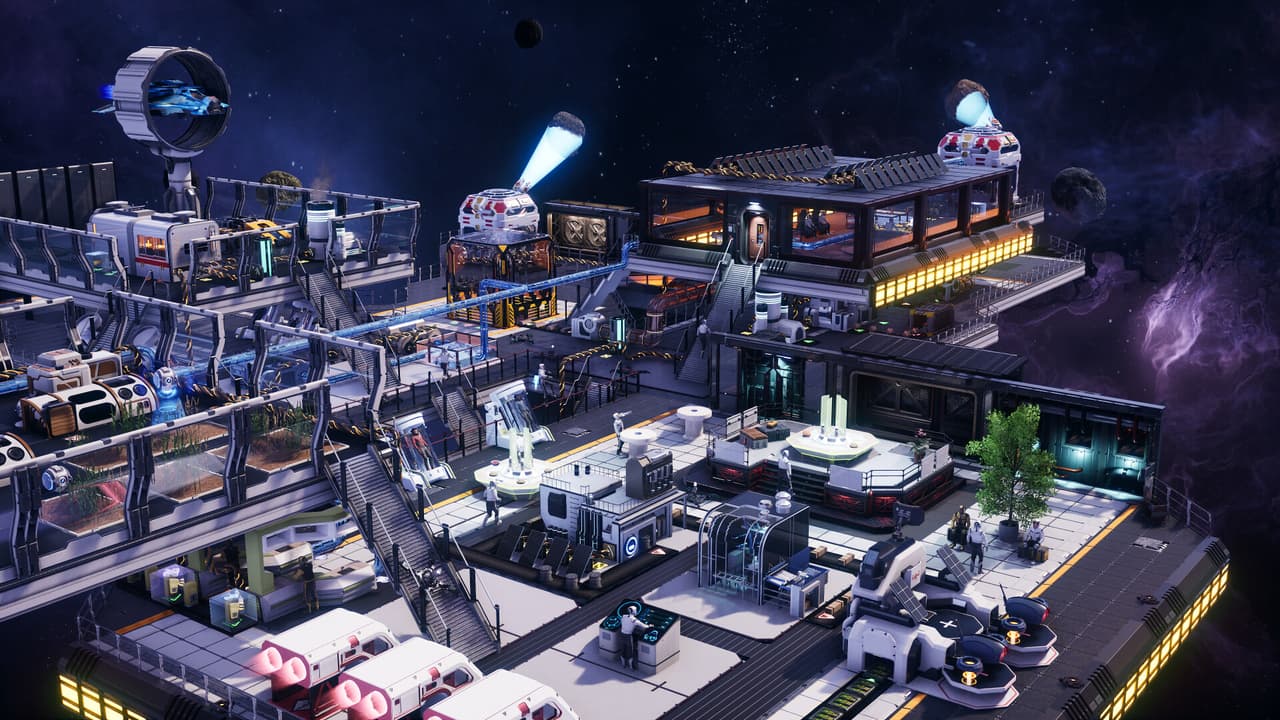
The signature mechanic gets the warmest language. Players harpoon floating islands, dock them to the station, strip them of ore and either drop them or drag them along, and some daisy-chain several into one flying base. One reviewer called it "the only game on the market that lets you both operate a factory and be a real estate mogul simultaneously," and another summed it up as "just chaining up planetoids and bringing them along with your ship? That's great." Several negative reviews also list docking as the part they liked. The complaints attached to it are practical: power and conveyors cannot simply cross between docked bodies, and miners must be rebuilt on each new planetoid.
Calm building with no combatMedium
Players like that there are no enemies, that oxygen is the only real survival pressure (and can be switched off), and that they can leave automation running while they listen to a podcast. 8% of longer reviews call the game relaxing, calm or cozy, or point out that nothing attacks you. "I personally like that it is more relaxed feeling and that you don't have enemies attacking you while I'm trying to focus and design my station." For other players the lack of anything pushing back is the problem, covered under frustrations below.
Frequent updates and quick fixesMedium
Early-access reviewers describe a developer who patched almost daily, sometimes several times a day in the first weeks, and 8% of longer reviews praise that pace. Bugs were fixed within hours: "I made a bug report at 1 AM and by 1 PM the next day the dev had found the bug, fixed it and issued a patch." At least one early reviewer switched to recommending the game once fixes landed. Another took the patch count as a sign of how buggy the game still was.
Plenty of game for the priceMedium
Most of the 13% of longer reviews that talk about value say the game earned its price in hours: "Worth it at full price, a steal if you catch it on discount." A smaller group (3%) advise waiting for a sale or say it is not worth full price, some because the content ran out sooner than in the genre's bigger names.
Logistics tools, blueprints and no inventory jugglingLow
Players who dig into automation praise the logic blocks (splitters with ratios, filters, pushers), the separate blueprint designer and the lack of carry or storage limits. "I cannot express enough how awesome the logistic system is in this game." Others found the same logic blocks limited (five item types per block) or unlocked too late.
Smooth performance and fast loadingLow
Loading gets singled out: "game loads in literally instantly and runs smooth as butter". 6% of longer reviews say the game runs well even on older hardware. Fewer report stutter, frame drops with several planetoids docked, or heavy GPU load, so performance comes out positive on balance but not for everyone.
Where players are split
Satisfactory and Factorio as the yardstickHigh
17% of all reviews mention Satisfactory or Factorio, and the comparison cuts both ways. Fans see a lighter, friendlier take with its own twist: "Like a "Satisfactory" lite, but in space." Detractors see a thinner copy: "If you like this game, Satisfactory is the game you should really be playing." Expectations seem to decide which side a reviewer lands on. Players who wanted a casual builder were happy; players who wanted deep production chains and tight ratios found the recipes simple and the logistics fiddly.
Slow burn or long waitMedium
Pacing divides people. Some enjoy the slow start and the steady grind ("Pretty grindy but I love the slower starts to a game."), and a few point out the built-in speed-up keys. Others describe waiting more than playing, especially in later universes, where research costs jump: "Instead of getting 50-100 points of research to discover something new, I was suddenly faced with 2000-3000 research point technologies." Reviewers who reached the late game raise this more than newcomers.
Machines that never fill upLow
Production machines accept unlimited input and run several recipes at once. Some love the convenience ("Unlimited. There is no building/storage/carry/resource limit. Pure joy."), while factory veterans say it breaks belt balancing and buffers: "I find the first reactor has 9.768 Carbon waiting to burn while others further down the line are empty." Players on this side ask for input limits on machines and visible belt and production rates.
Space that does not behave like spaceLow
A universal down direction, gravity boots that drop you off the base, trees growing in vacuum and a base that can never rotate draw comment in 5% of longer reviews. Some shrug it off ("Think of it more like "Treasure Planet"."), while others found it broke immersion: "Clearly built by game developers who thought "space" was an art palette rather than the thing they were trying to simulate."
Music and soundLow
The soundtrack draws both praise ("The Soundtrack will have you hooked") and complaints that it is too cinematic for a calm builder ("In-game music is quite aggressive and does not suit the gameplay at all."). A few reviewers note how quiet the machines are.
What frustrates players
Clunky controls, building tools and menusHigh
13% of longer reviews and 28% of negative ones complain about the controls, and the specifics repeat: tools that are hard to switch (radial menu, Ctrl plus number keys, no tools on the hotbar), no simple way to cancel build mode, belts that must be rotated with a separate tool, cables that occupy a full block and refuse to snap, and deletion that is either buried or dangerously instant. "So I tried clicking Ctrl + RMB and accidentally deleted my factory instantly with no prompt or warning." Genre veterans put it bluntly: "If you played Factorio or Satisfactory, you will hit a brick wall of clunk." Positive reviews raise the same friction too, and a few say remapping keys helps.
Bugs and crashesHigh
Belts that stop moving, invisible "ghost" objects, planetoids drifting off, objectives that never register and vehicles rolling off the base all turn up in bug reports. 9% of longer reviews mention crashes or freezes, and 18% bring up bugs or crashes without mentioning co-op. Reviewers split on how much this matters. Some call the bugs minor and work around them with frequent saves ("Yes, it has some crashes, so I recommend setting the autosave to 1min"), while others lost a save or long stretches of progress.
Not enough purpose, challenge or endgameHigh
"What this game is missing is a driving force." 10% of longer reviews, and 20% of negative ones, say the game runs out of reasons to keep going. Resources are abundant, solar power trivializes energy, and one reviewer wrote that meteor showers "pose almost no danger." Colonists come in for the same criticism, since a handful of scientists and a cook cover the whole game and "they do nothing but research and stand about." Another reviewer described how the loop wore thin "after a while it didn't feel particularly rewarding because there was no challenge; no problem to solve." This complaint comes mainly from players who reached the late game, and it shows up in positive reviews as well as negative ones.
Multiplayer desyncMedium
Co-op problems come up in 8% of longer reviews, rising to 17% among those written after 1.0. The reports are consistent: belts and inventories that show different contents for host and guest, guests unable to see planets, supernovas or black holes, disconnects when pasting blueprints, sessions that cannot be rejoined, and dedicated servers that did not fix it. Several co-op players end by recommending it for solo play only: "TLDR: Single player good, coop bad." Another titled their review "Great single-player foundation, but broken multiplayer ruins the 1.0 experience."
A tutorial that tells you what, not howMedium
The helper bot follows players around, blocks the view, and assigns tasks without explaining docks, harpoons, power transfer, logic blocks or where recipes live, so players end up on YouTube or Discord. 7% of longer reviews fault the onboarding. Two players who recommend the game put it as "the tutorial seems to have been maid by an alien" and "the tutorial bot is SUPER annoying." A few found it serviceable once they learned to put the bot to sleep.
Bots and astronauts that get stuckMedium
"Transport bots are way more inefficient than conveyors, to the point i'd rather make a conveyor spaghetti then use bots." 6% of longer reviews, and 12% of negative ones, describe transport, mining and farming bots or colonists getting stuck on each other, on doors or on narrow corridors, carrying one item at a time and idling until rebuilt. Another: "It gets old deleting confused bots and making new ones."
Dirt and quartz that cannot be automatedLow
Mid and late-game players object that two resources the tech tree needs in bulk must be dug by hand or with drills that need constant moving. "If it can NOT be automated, it should not be needed, for a game like this where automation is everything."
A 1.0 that felt like early accessLow
A small group of post-1.0 reviews say the full release did not feel finished, and a few returning players say reworked buildings broke their old factories. "Everything works but it feels unfinished for a 1.0 release." One group of friends put it this way: "This is really good for early access! Can't wait until they polish it. Wait, what? This is 1.0 release? Oof."
Controller support that does not hold upLow
A handful of players who bought it to play on a controller or Steam Deck found keyboard prompts and an unworkable layout. "This is unplayable on solely a controller."
3. The player conversation
The tone is mostly warm and constructive. Praise tends to be enthusiastic and simple, while criticism usually arrives as detailed lists of fixes, and many of those critics still call the concept good. A handful say they can't recommend the game in its current state and will revisit it after fixes.
Who raises what follows the game's arc. Control and interface complaints lean toward the first hours: a quarter of them come from reviewers with under two hours played, as do most of the few controller complaints. Complaints about missing purpose, idle colonists, research walls in later universes and manual dirt digging come from players deep into the game. Co-op problems come from friends and couples who bought it to play together, and some of them say solo play was fine.
Reviews came in waves. Launch week of early access in November 2022 drew the largest burst, already split between praise for the idea and reports of broken co-op. A second wave in June 2023 coincided with a Let's Game It Out video that several reviewers name as their reason for buying. At the 1.0 launch in June 2026, the first three weeks of reviews were 59% positive (36 of 61) as returning players hit the same rough spots plus new co-op desync; reviews written from late June 2026 onward came back to 71% positive (45 of 63).
4. What the developers could do
- Overhaul building and deletion controls. Clunky tools, belt rotation, cable placement and instant deletion come up in 28% of negative longer reviews, and players ask for tools on the hotbar, Esc to cancel, L-shaped placement and an undo or confirm on delete.
- Fix co-op synchronization. Desync of belts, inventories and space objects between host and guest led several co-op players to recommend the game for solo play only, and these reports doubled in share after 1.0.
- Give the mid and late game something to push against. Veterans say threats are harmless, colonists are idle after a few hires, and later universes add cost without new problems, which leaves them asking why they should continue.
- Replace the tutorial bot with real onboarding. Players describe leaving the game to learn docks, harpoons, power transfer and logic blocks, and the bot itself is described as in the way.
- Make bots and astronauts path reliably. Stuck transport, mining and farming bots force players back to belts and repeated rebuilding.
- Show rates and let players cap machine inputs. Factory veterans ask for visible belt and production rates and per-machine input limits to fix balancing that unlimited machine storage makes hard.
- Let dirt and quartz be automated. Mid-game players object to bulk resources that still require hand digging or constantly moved drills.
- Make the controller support match the store label. Controller and Steam Deck buyers report keyboard-only prompts and an unworkable default layout.