Deep Rock Galactic: Rogue Core
Ghost Ship Games · Shooter, Action, Roguelite
Overview
DEEP ROCK GALACTIC: ROGUE CORE is a 1-4 player co-op shooter with sci-fi dwarves, procedurally-generated caves and random roguelike upgrades. Explore maze-like mines and blast through hordes of alien abominations — no two runs are the same. Move quickly, work together and shoot first to survive.
Read moreShow less
Our deep-level mining operations have gone dark. Deep Rock Galactic needs them back online at any cost. We’re sending in a crack squad of Reclaimers to breach and secure the mines, and kill whatever’s down there.
Your survival is not necessary for the success of this mission.
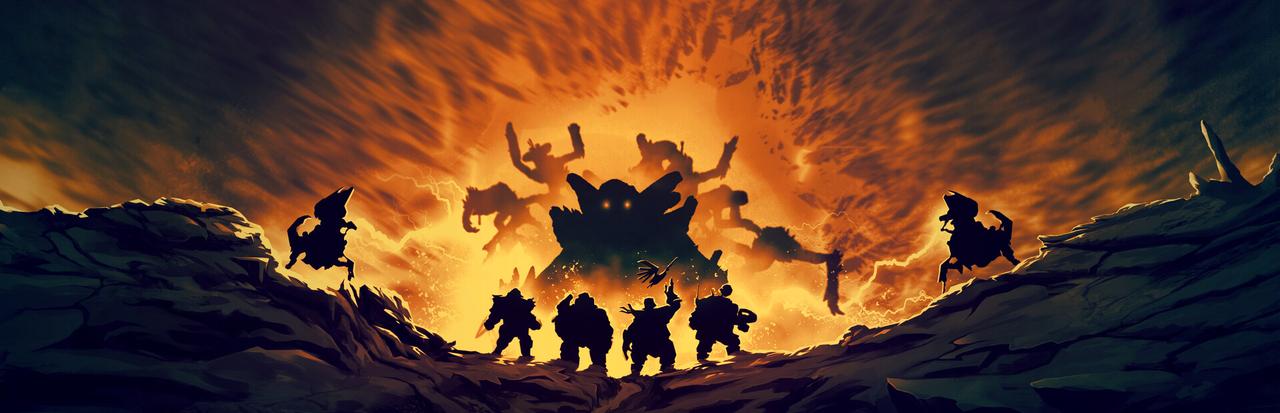
Step into the boots of the Reclaimers, Deep Rock Galactic’s elite corporate security force. In fast-paced 1-4 player co-op gameplay, you’ll fight through alien-infested mines as five playable classes:
GUARDIAN: The walking shield. An expert in area denial and close protection. Damages enemies with concussive blasts, and restores the team’s armor.
FALCONER: The aerial attacker. Deploys an airborne assault drone to electrify enemies. In an emergency, can even revive teammates from afar.
RETCON: The hologram berserker. Can warp back to a previous point in spacetime, restoring health and ammo to recover from dangerous situations. Lethal in all time zones.
SPOTTER: The marksman. Highlights and weakens targets with toxin darts, spots enemies through walls, and can deploy ammo crates for use in extended firefights.
SLICER: The melee expert. Carries an energy blade capable of dismembering all but the toughest opponents. Mobile, agile, aggressive.
No two runs are the same. The roguelike format means you’ll scavenge your weapons and equipment from within the mines, and collect resources to upgrade your gear and abilities. Choose from a deep pool of upgrades for your weapons and abilities, discovering lethal synergies and snowballing in power as you fight your way down to the Rift Gate.
Linger too long, and the Reaperworms will hear you. Explore each level of the mine for upgrades, equipment and resources — but remember that each stop costs precious time. Stick with your team, move quickly, and push forward at all costs.
Nobody said this would be easy. But death is only a setback. Dive, dig, die, and dive again.
Procedurally-generated caves mean every single mission gives a unique challenge of traversal and exploration. Featuring 100% destructible terrain, you can dig, carve and explode the caves around you to level the playing field. Fight your way deeper through natural caverns and enormous industrial structures.
These mines are infested with Corespawn: the most aggressive, resilient and intelligent alien life we’ve ever encountered on Hoxxes IV. 20+ different enemy types and 3 different bosses are lying in wait. Use whatever means necessary to eliminate them.
Between missions, you’ll find yourself aboard the RV-09 Ramrod. Here, you and your squad can access rich metaprogression and extensive character customization to bring into your next deployment. Lift weights, braid your beard, hit the dance floor, and have a beer with your team.
Think you’ve got what it takes to brave the depths? Wishlist Rogue Core and contact a local Reclaimers recruiting station today.
From the game's Steam store page.
THE GAMEQ VERDICT9,127 reviews analyzed
What players are actually saying
1. Summary
Rogue Core divides players along a clear line. Players who wanted a fast, punishing co-op roguelite in the Deep Rock universe found one: they praise the gunplay, the new weapons and class abilities, the sound and animation, and how good it feels with a coordinated group of friends. Those who wanted more Deep Rock Galactic found a game that rushes them with a timer, makes four people draft upgrades from one shared pool, and hands out small stat bumps where they hoped for wild builds. Deep Rock Galactic comes up in 46% of reviews, so much of the conversation is framed against the original, and the two most argued-over mechanics, the threat timer and the upgrade negotiation system, are both deliberate design choices.
Opinion also shifted over time. Launch week ran at 71% positive, the weeks after Update 1 (which reviewers date to June 17) climbed to 79%, and owners writing around Update 3 in November were strongly positive (84% of 236 paid reviews from November 9 on). The November free weekend then brought 550 newcomers who recommended it at 33%, citing a confusing first hour, an unskippable intro video, the upgrade pauses and a few blocking bugs. The core combat draws praise from both sides while the structure around it is contested, and some thumbs-up reviews come with a list of fixes.
2. What keeps coming up
What players praise
A Deep Rock roguelite that works on its own termsHigh
Defenders often answer that this was never meant to be a sequel, and "Not DRG 2" style phrasing appears in 6% of reviews: "It's a roguelite, it is not a sequel to DRG." These players describe it as faster and more combat-focused than the original, closer to a Deep Dive with random upgrades and a boss at the end, and some like it more for that ("Moment to moment gameplay is more fun than DRG. Gunplay feels better."). The familiar trappings still land for them: the dwarves, the space rig hub, the salutes ("Rock and Stone" appears in 11% of reviews). The same comparison drives the opposite camp, covered under "Where players are split".
Great with a coordinated group of friendsHigh
Long runs with friends on voice chat are where players describe the game at its best. With a regular group, the shared upgrade picks become a negotiation instead of a fight and the timer becomes a team puzzle. One review summed up how much the group matters: "Amazing and fun experience with friends. Ok solo. Mixed bag playing with randoms." Some couples and regular duos say they bought it to play together and kept going.
Gunplay, weapons and class abilitiesMedium
Some of the reviews that don't recommend the game still say the shooting is good. Players call the new weapons punchy and varied, like the hit feedback and animation work, and enjoy mixing traversal tools from different Deep Rock classes on one dwarf. The five classes and their cooldown abilities (the Slicer's sword, the Falconer's drone, the Retcon's time rewind) get specific praise: "The class abilities are varied and interesting". The criticism attached to this theme is balance, with some guns seen as clearly weaker and some players finding certain classes much stronger than others.
Updates since launch fixed a lotMedium
A steady stream of reviews say the game improved after each major patch. Update 1 in June gets the most credit: reviewers say it let one dwarf trigger upgrade picks instead of the whole team, added timer and difficulty settings and eased resources, and several flipped to positive because of it: "Definitely recommending after the june 17th update." Around Update 3 in November, returning players described rerolls, enemies dropping experience on kills, and more varied objectives. A few who had refunded at launch bought it again, and others who had been cold on it gave it another go: "Tried it again 6 months later with a friend, and it's actually a blast!" A minority say later patches made things worse, and one November complaint is that Update 3 reset unlocked cosmetics.
Sound, music and atmosphereLow
The soundtrack, the sound design and the darker, more oppressive tone of the caves all get singled out. One reviewer wrote: "This game also has some of the best sound design I think i've ever experienced in anything." Others found the same darkness and visual noise made enemies hard to read.
Where players are split
Is it different enough from Deep Rock Galactic?High
This comparison runs under much of the rest. Critics say Rogue Core reuses too many weapons, biomes and enemies from the original, lacks its charm and humour, and should have been a mode or expansion instead of a full game: "Should have been an expansion to DRG, not a rogue-lite straining against everything that made the first game great." A smaller group simply tells readers to go back to the original. Defenders accuse critics of wanting a sequel the studio never promised. In between, some veterans who mention hundreds of hours in the original say the game has not yet found its own identity: too close to Deep Rock to stand apart, too far from it to scratch the same itch.
The threat timer and the reaper wormsHigh
Raised in 18% of reviews, the timer is the most discussed mechanic. Fans say it gives runs urgency and forces real choices about which side objectives to skip: "The timer keeps you on your toes, forcing you to adapt to quick decisionmaking." Critics say it punishes the exploration that made Deep Rock special and turns every floor into a rush: "That timer is removing years from my life." The unkillable reaper worms that spawn when time runs out divide players too. Some call the endgame swarm a highlight; others hate an enemy that grabs teammates and cannot be fought. Timer mentions dropped from 21% of launch-fortnight reviews to 11% of reviews written from June to early November, after the timer settings reviewers credit to Update 1 arrived, though some players still ask for it to be optional or scaled to party size.
Difficulty, ammo and armorMedium
Some players enjoy that it is much harder than the original and say wins feel earned. Others found the early game brutal, especially at launch: "The difficulty and ammo economy are in the toilet." Ammo comes up in 8% of reviews, with players describing running dry against bosses and meleeing enemies to save rounds; mentions fell from 10% of launch-fortnight reviews to 5% of those written from June to early November. Armor that does not recharge, replacing the original's regenerating shield, is a recurring dislike ("armor is there for like 5 seconds before it disappears"). Defenders point to the lower depth levels and the difficulty options added after launch.
Playing soloMedium
Solo play draws opposite reports. Some say the game is tuned for four and that duos and solo runs are miserable, particularly against bosses ("Solo is unplayable"); others clear the hardest depths alone and push back: "Don't listen to reviews saying solo is impossible". Solo fans also note that they avoid the shared-upgrade friction entirely, and one points out that the game can be paused when playing alone. Several ask for a timer and enemy count that scale with the number of players.
What frustrates players
Shared upgrade drafts and constant pausesHigh
Discussed in 11% of reviews, the upgrade negotiation system is the most raised frustration. Weapons and expenite upgrades come from one shared pool that the team picks from in turn, so a teammate can take the upgrade your build needed, and the picks pause or stall play several times per floor. Players describe the result as adversarial in a co-op game: "I hope others won't take the one I want". Others complain about the waiting itself ("why is my game being paused every 2 minutes"), with each player allowed long stretches to choose. At launch the whole team also had to gather at the drone; Update 1 removed that requirement, and mentions of the system fell from 13% of launch-fortnight reviews to 6% of those written from June to early November. A vocal minority defends it as the heart of the game when playing with friends and asks that it stay, perhaps as an option for private lobbies.
Upgrades that barely change a run, and runs that repeatMedium
Most in-run upgrades, players say, are small percentage boosts that do not create distinct builds: "Most upgrades are just a plain increase on something like armour, reload speed, etc." Reviewers who bring up the original's overclocks miss them and ask for upgrades that change how a weapon behaves. Alongside that, players report the same objectives on every floor (workbench, bio booster, cameras, finding gears), a small enemy roster and a handful of bosses, several of which are called bullet sponges ("Bosses are pretty basic, boring bullet sponges."). One player put it bluntly: "once you do a few runs you have basically played the whole game." Runs of 40 to 60 minutes make the repetition feel heavier. Later reviews note new objectives and bosses arriving with updates, but positive reviews ask for more variety too.
Public lobbies and random teammatesMedium
Randoms come up in 8% of reviews. Because upgrades are shared and the timer punishes stragglers, one inexperienced or uncooperative player can sink a run that the original's drop-in co-op would have absorbed. Players describe teammates hoarding picks, wandering off, ignoring pings and chat, and occasional griefing with friendly fire. Several advise playing only with friends or solo, and some ask for voice-chat-free ways to coordinate picks.
Crashes, disconnects and blocking bugsMedium
Bug and crash reports run through the whole period. The recurring ones: crashes on floor transitions, disconnects that drop a player back in without their weapons and upgrades, and no host migration, so a host leaving ends a long run for everyone ("No host transfer system on a p2p game in the big 26 is crazy."). Some players report false crash pop-ups while the game keeps running. During the free weekend several newcomers could not start a mission because the drop pod doors never opened, and others lost runs because an elevator gear spawned inside a wall. Some reviewers report no crashes at all.
Price for an Early Access spin-offMedium
Price comes up in 5% of reviews. The usual complaint is that a game reusing so much from Deep Rock Galactic costs about the same as the original ("30€ for the same game is extremely rough"), and reviewers add that the discount for owners of the original was small and that a supporter pack at launch added to the irritation. Some otherwise positive reviews say it is worth buying on sale, and a few free-weekend players who enjoyed it said they would pick it up at the weekend's discount.
Performance during big wavesMedium
Frame rates collapsing when large waves arrive, high CPU usage, and drops in menus and the hub all show up in the reports: "With every wave, the FPS drops from 200 all the way down to 30 FPS." Some say lowering settings made no difference. Others report smooth performance on older or mid-range hardware, so the experience varies a lot by system.
A confusing first hourMedium
New players, especially during the free weekend, describe being lost: a long forced tutorial, unclear objectives, and no tracker for side tasks. "There should be a UI showing the mission objectives, what we've completed, and what we still need to do." The elevator gear objective is a frequent example ("Mini map isn't clear enough on where the gears are and you end up wasting a lot of time searching for said gears."). Free-weekend players also objected to an unskippable developer video on first launch: "it starts off with some unskippable video about nothing important". Experienced players point to the in-game logbook, though they also say the game explains little on its own.
Omega, the new mission handlerLow
Most reviewers who bring up Omega, the AI handler that replaces the original's Mission Control, dislike it. They find the voice abrasive, the constant reminders nagging, and the character flat next to the grumpy original: "Omega is fundamentally a charmless, uninteresting narrator." A few enjoy it, and one notes the distortion effect on the voice can be turned off.
Class limits and fixed charactersLow
A team cannot field two of the same class, which players say leads to arguments over who plays whom: "please let me choose the same character as my friend." Each class is also a fixed character with one look and voice, and some players wanted more customization; one was surprised by the "lack of gender swapping of different classes". Others miss a turret-building class like the original's Engineer.
No chosen loadoutLow
Starting weapons and traversal tools are random and drafted, so a run can begin with a gun the player dislikes and few ways to swap it. Some ask for a way to bring a preferred weapon: "Wish there was a way to go in with a preferred starter weapon for a resource cost".
Beer behind a workout minigameLow
Drinks in the hub require finishing a workout minigame first. Some find the joke charming; others find it tedious and miss the original's bar: "please let me drink beer without working out".
ControlsLow
A few players dislike that class abilities need two-key combinations (Q plus another key) and that controller bindings overlap, with grenades, pings and abilities sharing buttons.
3. The player conversation
The reviews read like an argument among Deep Rock Galactic fans. Some reviewers lead with their hours in the original, and positive and negative reviews alike address other reviewers directly: the positive side calls critics people who wanted a sequel, the negative side calls defenders people excusing a weak roguelite because of the name. Long, detailed reviews turn up on both sides, a number of them ending with suggestions, and some thumbs-up reviews are conditional ("rough", "needs time", "let them cook").
Newcomers from the November free weekend wrote about the first hour: the intro video, the tutorial, unclear objectives, the gear hunt, Omega, and the pauses for upgrade picks. Players with long histories in the game wrote about depth: weak upgrade synergies, meta progression, specific events and bosses, and balance at the highest depths. Requests for the timer and enemy counts to scale with party size came mostly from solo players and duos, and players queuing with strangers wrote about teammates taking the upgrade picks they needed.
Weekly sentiment rose and fell through Early Access. Launch week (May 18 to 24) sat at 71% positive on 4,440 reviews, with the timer and upgrade system dominating. After Update 1 the weeks of June 15 and June 22 reached 79%. Volumes then fell to under 125 reviews a week, and the July and August weeks mostly sat between 50% and 63%, with a few reviews blaming update 1.2 for new frustrations. Late August and early September climbed back to roughly 70% to 81%, and late September and October mostly sat near 60%. In November, paying owners writing around Update 3 were strongly positive (84% of 236), while the 550 free-weekend reviews came in at 33%, pulling the week of November 9 down to 49%.
4. What the developers could do
- Give each player their own upgrade offers, or move picks to the elevator between floors. The shared draft and its pauses are the most raised frustration, and players describe it as making teammates rivals in a co-op game; an option for private lobbies would keep the negotiation for the groups who like it.
- Make in-run upgrades bigger and more build-defining. Players say most upgrades are small stat boosts and ask for overclock-style effects that change how a weapon or ability works.
- Fix the first hour for new players. Free-weekend newcomers recommended the game at 33% and named the unskippable intro video, the long tutorial, the missing objective tracker and the hard-to-find elevator gears.
- Stabilize co-op sessions. Host migration, reliable reconnects that keep a player's gear and upgrades, and fixes for the drop pod door and wall-embedded gears would stop long runs ending for reasons players can't control.
- Add objective, enemy and boss variety. Players report the same floor objectives every run and bosses that feel like bullet sponges, which makes 40 to 60 minute runs repetitive.
- Scale the timer and enemy pressure to party size. Solo players and duos ask for more time and fewer enemies when fewer dwarves are in the cave, and some still want a way to turn the timer off.
- Improve frame rates during large waves. Players on a range of hardware report drops to around 30 frames per second when big waves spawn.
- Tone down Omega. Players find the handler's constant, abrasive reminders grating; fewer, more useful lines would address most of the complaints.