Going Medieval
Foxy Voxel · RPG, Simulation, Strategy, Indie
Overview
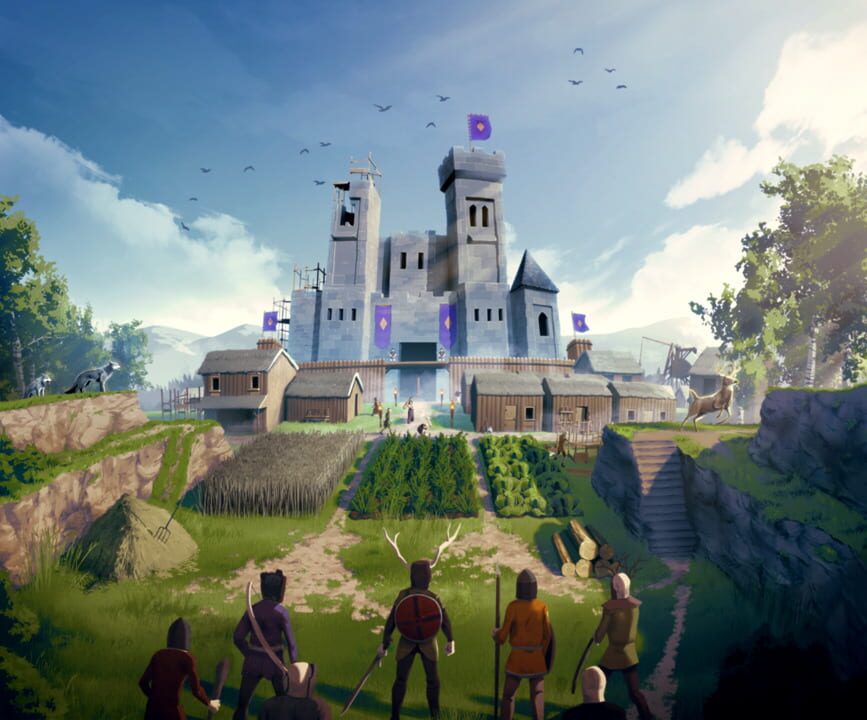
Build and manage your own castle settlement in a land reclaimed by wilderness. With detailed management, survival strategy, and a moddable sandbox world, Going Medieval challenges you to build the mightiest colony this side of the apocalypse.
THE GAMEQ VERDICT10,000 reviews analyzed
What players are actually saying
1. Summary
Going Medieval is a colony sim where a handful of settlers survive medieval winters, raids and hunger while you build a settlement in full 3D, digging cellars down and raising stone keeps up. 88% of the reviews recommend it. Most of the praise goes to the building: shaping terrain, stacking floors, carving cold cellars and watching a wooden hut grow into a walled castle. Others describe the loop as relaxing and hard to put down, and some credit the developers, a team they describe as small, for updating the game through a long Early Access. A third of the longer reviews measure it against RimWorld. Fans mean it as praise (a 3D medieval RimWorld), while critics call it a thinner copy.
Settlers ignore job priorities, take absurd routes and wall themselves into holes. Bugs and crashes followed the game into 1.0, which some long-time players felt was declared too early, and once the castle stands, reviewers say there is little left to do. Performance on large settlements, a slow default pace, heavy micromanagement and the absence of families or children make up the rest of the complaints. Reviews written after the 1.0 release were less positive than the Early Access ones, and they raise the same problems.
2. What keeps coming up
What players praise
Building in three dimensions: castles, cellars and terrainHigh
31% of the longer reviews talk about castles, z-levels, layers, verticality or digging underground, and 10% explicitly praise the building as fun, satisfying or creative. Players enjoy terraforming the map, digging cellars to keep food cold, raising multi-storey keeps and adding walls, moats and drawbridges. One summed it up as "Building multi-story mountain fortresses and underground cellars is super satisfying". Another put the appeal more simply: "This game made me feel like a child building his first lego castle again."
The same building system draws complaints about stability rules, roofs and beams (see the frustrations below), and a few players say the castles in the trailers are hard to reach with the settlers and stone a normal game gives you. Some negative reviews still single the building out, like the one that opens "Good as a builder game Bad as a survival game".
A relaxing loop that eats hoursHigh
11% of the longer reviews describe the game as relaxing, cozy, chill or addictive. Players talk about losing track of time, staying up late and treating it as a game to run alongside a podcast: "A great game to play slowly, podcasts on, grow your province." These players value the slower, lower-stakes pace that frustrates others (see below). A few call it a good first colony sim before RimWorld, and others mention a peaceful mode that lets them build and get through winters without raids.
A small team that kept updatingMedium
7% of the longer reviews praise the developers' updates and communication, mostly from players who bought in Early Access and watched the game grow. They mention regular patches, a public roadmap, weekly dev posts and quick bug fixes: "I sent a bug report and less than a week later the dev had fixed the issue." Another long-time follower describes a "very steady and transparent development cycle". Critics accuse the same team of slow progress, of adding features before fixing old problems, and of ignoring long-standing requests.
Where players are split
The RimWorld comparisonHigh
RimWorld comes up in 34% of the longer reviews, positive and negative alike. For fans the comparison is the selling point: RimWorld's job priorities, traits and raids, but in 3D, set in the Middle Ages and with real verticality. "It's genuinely a 3 dimensional medieval Rimworld. Different enough to not be wanting to just play Rimworld instead, but familiar enough to be an easy learning curve." Some players who disliked RimWorld's 2D art say this is the version that finally clicked for them.
8% of the negative reviews call it a clone, a rip-off or a worse RimWorld, or tell readers to play RimWorld instead, and they point to borrowed menus and mechanics with less depth, fewer events and a far smaller modding scene. "I really cant find a good reason to play this over Rimworld or Dwarf Fortress." Negative reviewers who stopped within a few hours make this dismissal far more often than those with long playtimes.
Combat and raidsMedium
Some players enjoy defending their walls: shooting crossbows from the battlements, flooding moats and watching siege engines break an attack. Others, 8% of the negative reviews, find combat clunky or exploitable. Their complaints are specific: settlers drop the "hold ground" order and charge out, archers stop firing, and enemies stack on one tile, so "an unlimited number of pawns can occupy a single voxel meaning chokepoints are pointless". Players disagree on difficulty too. Some say raids are trivial once you have high ground and archers ("Game is too easy, even on hardest settings"), while others describe raids that heavily outnumber their settlers. One reviewer noticed that raiders who win a fight leave without taking the loot.
Mods and Workshop supportMedium
8% of the longer reviews bring up mods. Supporters welcome Workshop support and expect mods to fill the gaps in content; even one negative reviewer wrote "Workshop is going to be the saving grace for this game". Critics, often comparing with RimWorld, say the modding scene is too small to rescue a thin base game, and some older reviews ask for script mods that can change core systems.
Temperature, food spoilage and cellarsLow
4% of the longer reviews discuss the temperature and spoilage systems. Fans like that food storage pushes you underground and that seasons, shade and heat matter: "The temperature system is really cool and intuitive and the best part of this game that sets it apart for sure." Critics find the same system opaque or punishing, with food rotting fast and cold rooms that will not stay cold; one described "a cellar whose temperature is impossible to debug". A handful also report maps flooding after digging into water, with no way to drain it.
What frustrates players
Bugs, crashes and a 1.0 that felt unfinishedHigh
18% of the longer reviews mention bugs, glitches or crashes, including 22% of the negative ones. Some of this is mild, with positive reviews noting small bugs that a reload fixes. The negative reviews describe heavier problems: settlers stuck in walls or teleporting underground, rooms losing their status, production stopping despite full stockpiles, saves that hang while loading, crashes to desktop, and updates that broke features that used to work. After 1.0, some players who had waited through Early Access said the full release still felt like a beta: "Just another early access game that released version 1.0, except it's still an unpolished and buggy beta." A smaller group says the opposite, that 1.0 fixed their old frustrations.
Settler AI, pathfinding and job prioritiesHigh
12% of the longer reviews complain about settler AI, pathing or priorities, rising to 24% of the negative reviews and 15% of reviews written after 1.0. The same examples turn up again and again: settlers skip priority 1 work for low-priority chores, haul a fraction of what they can carry, walk to the furthest resource, build the last wall of a tower from the inside, dig themselves into pits, or remove the ladder they are standing on. "Settlers will ignore priority 1 tasks that have available resources to run off and do priority 5 tasks instead." Another reviewer called pathing "completely broken and has been since day one". Negative reviewers with long playtimes raise it far more often than those who quit within a few hours. A few positive reviews counter that the AI improved over Early Access or that its quirks are normal for the genre.
A thin late gameMedium
9% of the longer reviews call the game shallow, repetitive, boring or short on endgame, including 19% of the negative ones. Players describe a strong first stretch followed by a plateau: food is solved by a cellar, raids are handled by walls and archers, research runs out, and few events arrive to disrupt things. "build a castle and your done. thats the game." Even fans raise it as a caveat: "Once you've build your castle and surrounding walls, you have your economy optimised and everything is researched, it's just a chore to get it to the end."
Slow pace and heavy micromanagementMedium
6% of the longer reviews complain about the pace, saying the top game speed is too slow and much of the game is spent waiting for settlers to finish tasks: "Gametime is way too slow. Needs a 20x or 50x button." 5% complain about micromanagement: manually changing seasonal clothes, toggling fields, marking each animal to hunt, re-prioritising jobs one tile at a time, and no task queue. "When your population becomes high the game becomes a micro-management nightmare."
Performance on bigger settlementsMedium
6% of the longer reviews raise performance, including 10% of the negative ones. These players say a game with simple graphics drives the GPU or CPU hard, runs hot on laptops, and slows to low frame rates once a settlement grows large or a big raid arrives. "just starting a settlement turns my video card into a jet engine." A few report system shutdowns or black screens, and one Linux player says graphics problems began after engine changes at the end of Early Access. A smaller number say it runs fine on modest machines.
Camera, layers, controls and a short tutorialMedium
5% of the longer reviews criticise the camera, controls or interface, and 4% the tutorial. Players struggle to see inside multi-level buildings, describe the camera jumping up or down a level as the cursor moves over uneven ground, and accidentally deconstruct things with a right click. "The tutorial starts off well and guides you through the basics, but it lasts less than five minutes." Negative reviewers who quit within a few hours raise the tutorial, camera, controls or general confusion far more often than those with long playtimes.
No families or childrenMedium
4% of the longer reviews raise the lack of marriage, children or lineages, and the share roughly doubles in reviews written after 1.0 (7%). Players argue that a medieval settlement without households feels like a temporary shelter, and that new settlers only arriving through random events removes any sense of legacy: "NEEDS a family mechanic. This is a massive, fundamental flaw." A couple of reviewers point out that animals can breed while humans cannot, and some reviews claim the developers prioritised features like cannibalism instead. Some positive reviews mention it only as a wish, and one argued that its absence "does however make it more realistic".
Building rules: stability, roofs and beamsLow
4% of the longer reviews complain about the structural rules. Players hit roofs that will not place, floors that fail stability checks over solid stone, a height limit that cramps tall builds, and no visual overlay to see how support works: "Stability overlay please. Hard to believe the game launched with this mechanic and no way to visualize it".
Settlers without personality, slow population growth and mood spiralsLow
4% of the longer reviews say settlers feel like stat blocks with little personality or relationship depth: "The characters don't feel like anything more than stat blocks". 2% complain that population grows too slowly because recruits only arrive through events, often followed by an attack. A small group (1%) describes mood spirals in which settlers turn rebellious after a siege and stop eating or sleeping properly.
Price for the contentLow
3% of the longer reviews say the game is overpriced for what it offers, often suggesting it is worth buying on sale: "If it was half the price then I'd say its worth it for the satisfying building".
3. The player conversation
Through Early Access the reviews ran around 89% positive, and some read like progress reports, with dated edits added over several years as players returned after updates. Reviews written in the first four weeks after 1.0 were 77% positive and stayed near that level (76%) through June 2026. Some long-time owners wrote that they had expected a finished game, and a few changed old recommendations to negative over AI, bugs and missing features. Reviews written from July 2026 onward were 85% positive.
Players who stopped early talk about onboarding: the short tutorial, the camera and layer controls, the look of the game, and a quick verdict that it is a RimWorld clone. Players with long histories write the detailed critiques of settler pathing, job priorities, combat exploits and the empty late game, often alongside real affection for the building. Much of the disagreement comes down to what reviewers want from a colony sim. Those who wanted a calm castle builder tend to be happy, while those who wanted a hard, story-driven survival sim call it too safe and too thin.
4. What the developers could do
- Fix settler job logic and pathfinding. Settlers ignoring priorities, hauling partial loads, walking to distant resources and trapping themselves come up in 24% of the negative reviews, more often from long-time players than from early quitters.
- Put stability ahead of new features. Reviews written after 1.0 describe crashes, stuck settlers, broken rooms and update regressions, and some veterans say patches fixed one thing and broke another.
- Give the late game more to do. Players say food, defence and research are solved once the castle stands, and ask for more events, goals and threats that disrupt an established settlement.
- Improve performance for large settlements and big raids. Frame rate drops, GPU load and overheating are raised in 10% of the negative reviews, some of them by players on recent graphics cards.
- Tighten combat rules. Players ask for a "hold ground" order that sticks, archers that keep firing, limits on enemies stacking on one tile, and raid balance that rewards building real defences instead of a single exploit.
- Reduce busywork and speed up the clock. Requests repeat for a faster game speed, a task queue, bulk orders and automatic seasonal clothing.
- Make onboarding and building rules visible. A longer tutorial, a stability overlay, clearer layer and camera behaviour, and safer deconstruct controls address what early quitters complain about.
- Offer a way to grow the population naturally. The lack of families and children is a rising request after 1.0, and players also ask for more frequent settler arrivals.