PlateUp!
It’s happening · Management, Roguelite
Overview
Cook and serve your dishes, design and decorate your restaurants, and expand your culinary kingdom with new unlocks, abilities and dishes in procedurally-generated locations. Classic cooking action with permanent roguelite progression. Hire your friends - or do it all yourself!
Read moreShow less
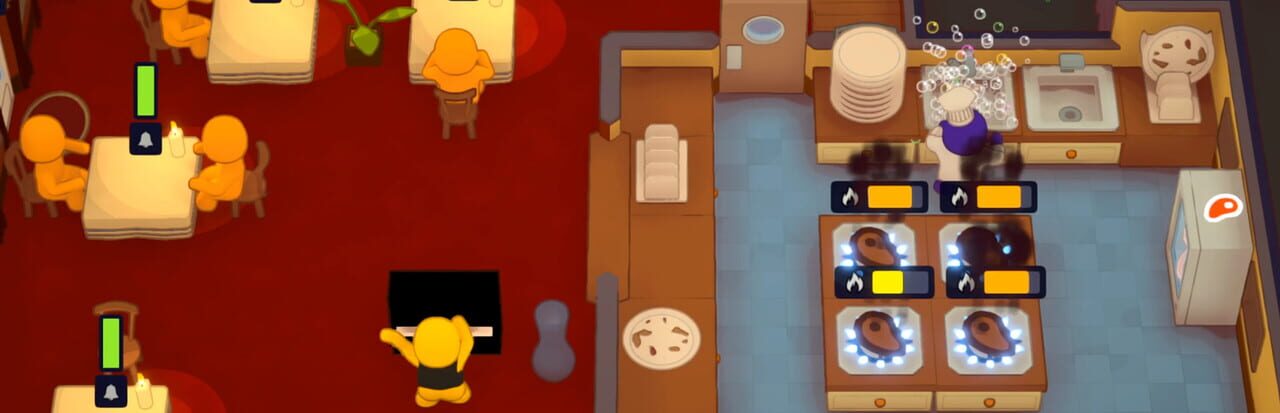
Up to four players build and run a restaurant from scratch, choosing dishes, buying and placing appliances – some of which can be daisy-chained together to create ambitious automatic kitchens – cooking food and serving customers.
Players have free rein to design their restaurant which will expand and develop between shifts – with additional content and challenges unlocked through progression.
Can you cook, serve and manage your way through 15 hectic days in your restaurant and unlock a brand-new franchise?
Classic co-op cooking action, with a wide selection of mains, sides, sauces, toppings, desserts, and starters.
Choose your equipment, lay out your kitchen, curate your menu and plate up your dishes.
From bubbling soups to sublime salads, tender steaks to hearty pies, there's something for everyone.
Look after front-of-house: seating customers, delivering orders, and managing patience.
Equip your restaurant to handle the most fickle of customers and deliver them what they need, right when they need it.
Co-operate with your team like a well-olive-oiled machine or build a name for yourself going it alone.
Exceed your goals and take your franchise to greater heights at a new location, bringing with you new unlocks and upgrade
Upgrade and rearrange your restaurant to your personal taste: when the restaurant closes for the day, the planning begins!
Decide what new equipment to purchase, and place it wherever you want.
Want to go high-tech? Install the turbo-ovens, crank up the conveyors, and make way for the robo-kitchen of the future.
Fancy something a little more... fancy? Curate your art collection, fix up that wallpaper, enlist a friend as a maître d' and get ready to provide the culinary experience of a lifetime.
Exceed your goals and start over at your next location, bringing with you new unlocks and upgrades.
Tailor your brand towards gourmet dining, or fine-tune your fast food franchise.
Every restaurant is procedurally-generated with its own climate, customers and conditions.
Return to your franchise HQ to view your achievements, customise your characters and upgrade your kit, ready for your next adventure!
From the game's Steam store page.
THE GAMEQ VERDICT9,999 reviews analyzed
What players are actually saying
1. Summary
PlateUp! is a co-op restaurant roguelite, and players love the noise it creates around a table or on a voice call. Two-thirds of the longer reviews talk about playing with friends, partners or family, often with a joke about yelling at whoever forgot to wash the plates. Behind the shouting there is a planning game: between shifts you rearrange the kitchen, buy and upgrade equipment, and eventually chain conveyors and grabbers until the restaurant runs itself. A quarter of the longer reviews compare it with Overcooked, and the favourable ones say the pressure here comes from your own layout and choices rather than from the map. A smaller group credits free updates that have kept arriving for years, holiday events and Steam Workshop mods for bringing them back long after launch.
Online co-op and the controls each come up in about a fifth of the longer negative reviews. The online complaints are lag for whoever isn't hosting, failed lobby joins and kicks, which hurts in a game built around playing together; the control complaints are odd default keys and an interaction system that grabs the wrong thing. Mechanics the game never explains are a close third. Players are split on whether solo play holds up, whether one unhappy customer should end an entire run, and how much the random blueprints and challenge cards decide a run.
2. What keeps coming up
What players praise
Co-op chaos with friends, partners and familyHigh
Co-op is the theme the longer reviews raise most: 65% of them mention playing with others, usually with a kind of affectionate frustration. Couples discover they can't share a kitchen, friend groups lose runs to an unwashed plate, and parents play with their kids every evening. Players like that roles sort themselves out (one cooks, one serves, one washes) and that each role feels like its own job. One reviewer put it as "if you spend all your time in the kitchen, you are playing a fundamentally different game than the person running orders to customers". Local and online play can be mixed in one session, and several reviewers mention using Steam Remote Play so a group can share one copy. Some add that the group matters: with players who panic easily or take it too seriously, the yelling stops being funny.
A different game from OvercookedHigh
Overcooked comes up in 26% of the longer reviews, and the comparisons lean favourable. About one in five of them calls PlateUp! better, more strategic or a different kind of game, because you pick the dish and floor plan, rearrange everything between days, and lose because of your own decisions. "The difficulty doesn't come from ridiculous kitchen set ups and annoying mechanics, it comes from an ever-increasing demand for optimizing and efficiency," one player wrote, and another summed it up as "In overcooked you struggle because the maps are working against you, in plateup you struggle because you're an idiot and you overcooked the steak." Several admit they dismissed it as a clone before playing. A handful still prefer Overcooked and find PlateUp! slower, less polished and less fun; one negative review called it "overcooked with the fun parts removed."
Kitchen automationMedium
Players describe a run that starts with hand-chopping lettuce and ends with a production line, and 18% of the longer reviews talk about automation, conveyors or comparisons to Factorio and Satisfactory. Watching the line work is a recurring high point; "Late game kitchens can run themselves if you play your cards right," as one put it. Solo players especially rely on it, since it is how one person keeps up with a growing crowd. The criticism is about access and fit. Getting the parts depends on random blueprints and on research and copy desks that some players call unintuitive, and some co-op groups note that a fully automated kitchen leaves people with nothing to do: "some can even leave the game without making a difference."
Variety and replay valueMedium
Replay value comes up directly in 10% of the longer reviews, and others describe how differently the recipes play. A coffee shop, a dumpling kitchen and a turkey roast each need a different layout and different upgrades, and the challenge cards that arrive every few days push a run somewhere new. Players also mention franchising a restaurant that reaches day 15, overtime days for long runs, Turbo mode, weekly speedrun seeds and seasonal maps. Long-time players are the ones who note the limits: once every recipe is unlocked and the overtime achievements are done, a few say the loop goes stale.
Free updates, seasonal events and modsMedium
"I paid about £8 for this game and I'm still playing it regularly 4 years later with brand new updates," one player wrote. Updates come up in 8% of the longer reviews, and players praise that the game kept getting content without paid DLC: new dishes, new modes, holiday maps, and quality-of-life changes such as save slots, an advanced build mode and the option to pick any recipe. A small group says outright that the updates are free or are still arriving years after launch. Workshop mods get mentioned about as often (10% of the longer reviews), mostly for bigger kitchens, door-less dining rooms, extra recipes and more than four players. Updates also sometimes broke mods or multiplayer, which shows up in clusters of negative reviews after big patches, and a minority in 2023 and 2024 felt new content arrived too slowly.
Where players are split
Playing soloHigh
Solo play comes up in 26% of the longer reviews, and they disagree. One group says solo works once you plan for it, pointing to automation, simpler recipes like coffee, and the extra money the game gives smaller crews: "you can still play solo, thanks to income scaling to the number of players." Several players say most of their hours are solo. The other group finds it exhausting or dull, complaining that one person can't cook, serve and clean fast enough. Even a positive review that calls solo doable and still fun says it is "a degraded experience compared to playing with a party." Negative reviews from people without a group say plainly that they bought it to play alone and it didn't work for them.
One unhappy customer ends the whole runMedium
The rule that a single customer losing patience closes the restaurant comes up in 5% of the longer reviews and in 9% of the longer negative ones. Critics find it harsh, especially after an hour of building: "It would make more sense to start the day over instead of the whole run," one wrote, and another asked for "a three-strikes rule, or a bar that fills up as you miss orders." Supporters see it as the core tension and like that failures feel earned: "you can mostly pinpoint why you're failing on that day and can't blame the system because it's totally your own fault." Several players note that failing still unlocks items and recipes, and some admit to quitting to the menu before the loss registers.
Random blueprints and challenge cardsMedium
About 6% of the longer reviews talk about RNG, luck or rerolls, and a similar share discuss the challenge cards. Some of them enjoy the gamble and compare the card picks to a deckbuilder, while the critics describe runs decided before they start: no mop for a greasy steak menu, no research desk, no conveyor, or a card that forces an unrelated main dish onto a coffee shop. "Could be a good game but the cards every 3-5 days ruin the game," one negative review says, while a fan concedes that "if you are unlucky you can be forced into a choice between two run ending cards." Requests for card rerolls or a way to buy specific items recur.
Unlock pace and long-term progressionMedium
Progression, unlocks and franchises come up in 14% of the longer reviews. Fans like that losing still earns experience toward new recipes and floor plans. Others find the early levels slow, particularly duos and casual players: "Unlocks were so slow, after a couple of hours I had to beg my partner to play another couple of games, yet we didn't unlock any new recipes." Players also mention waiting a long time for larger kitchens, and a few wish successful franchises were kept permanently instead of being lost with the next failure.
PriceMedium
Happy sale buyers outnumber the critics. Price or sales come up in 9% of the longer reviews: 5% mention a sale or call the game worth the money, while under 1% call it overpriced. The critics think the full price is too high for how simple the game looks, and some recommend waiting: "i don't personally think its worth $20, but it goes for 75% off fairly often, totaly worth $5." A reviewer in Brazil also flagged regional pricing as steep.
Looks and soundMedium
The visuals come up in 8% of the longer reviews. Fans find the blob-like chefs and customers charming and easy to read in a busy kitchen ("Don't let the programmer type art fool you, There is depth here!"). Critics call the art bland or say it has "the look of something slapped together with generic off-the-shelf 3D assets," and a few dislike the identical hand-waving animation for every action. Music splits players the same way: some find the soundtrack relaxing and catchy, others mute it, and the creaking door sound gets singled out.
What frustrates players
Clunky controls and imprecise item pickupMedium
The complaints about controls are specific: odd default keyboard bindings, movement keys that some players couldn't remap, bindings that reset, and an interaction system that grabs the wrong item or the wrong tile, especially in corners and on diagonals. Controls come up in 8% of the longer reviews and in 19% of the longer negative ones. One detailed review described how "you often get stuck having to waste time undoing an unintended action." Players also want to swap an item in hand with one on a counter, set things on the floor, and stack dirty plates. Several recommend playing on a controller instead.
Mechanics the game doesn't explainMedium
The game leaves too much unexplained, say 6% of the longer reviews and 16% of the longer negative ones: what blueprints and upgrades do, how the research and copy desks work, how to automate, and how some recipes are meant to be made. Players describe sending new friends to the wiki or YouTube before a run, and one put it as "I feel forced to browse the wiki and youtube videos to prep for a run which makes it start to feel like homework." Fans tend to treat this as part of the learning curve; newcomers in negative reviews sometimes quit over it in their first hours.
Online multiplayer lag and lobby failuresMedium
Connection problems appear in 4% of the longer reviews overall but in 19% of the longer negative ones, and reviews from every year since 2023 raise them. Players describe input delay for everyone except the host, friends who can't join or get kicked after a few minutes, black or blue loading screens, and lag between continents. "The game can work fine one day and the next day act like one of you is on the moon," wrote one launch-month reviewer in a detailed breakdown of the netcode. Another said "half of my playtime might as well just be in the lobby finicking with it trying to get all 4 of us into the lobby." Some groups fell back on Steam Remote Play or local co-op. Complaints cluster after large updates: in the week starting 30 December 2024 the positive share fell to 87%, and several of that week's negative reviews say multiplayer had stopped working.
Messy floors, doors and cramped layoutsLow
Grease, spills and slow mopping are a running joke in the reviews and a real complaint in some of them, mainly for steak and other messy menus when no mop appears in the shop. Swinging doors that block a busy path and customers who trap players in corners are smaller, recurring gripes. A few players dislike the random floor plans, calling layouts tiny or nonsensical and asking for bigger kitchens earlier or a built-in layout editor; some use the Kitchen Designer mod or shared seeds instead.
Recipe rules that don't make senseLow
A handful of specific rules draw mostly good-humoured complaints: draining pasta water into the trash instead of the sink ("Developers, please, there are other places than the trash to put your spaghetti water"), buffet-style sandwiches and sundaes that customers take one component at a time, coffee that pays very little, and card and recipe combinations that players consider badly balanced.
No crossplay, Mac version or matchmakingLow
A small but steady group wants to play with friends on PlayStation, Xbox or Mac, and solo players without a group ask for public lobbies or matchmaking. "Matchmaking would make this one of the most popular games on steam," one wrote. Some point to the official Discord as the workaround for finding players.
Crashes and launch bugsLow
A minority report crashes, a game that hangs on the loading screen (sometimes traced to Workshop mods), achievements that don't unlock for non-hosts, and lost progress. The reports are scattered across different problems, and some reviewers later edited to say the problem was fixed.
3. The player conversation
The conversation is warm and jokey: short reviews riff on "yes chef", burning the kitchen down, ruined friendships and divorce jokes. The longer reviews are mostly enthusiastic (90% recommend the game) and tend to focus on how it differs from Overcooked, on automation, and on how roles split across a crew. The negative reviews fall into a few camps: people whose online co-op wouldn't connect or lagged badly, players who found the controls and unexplained systems too frustrating in their first hours, solo players who found it punishing alone, and a smaller group who prefer Overcooked or dislike roguelites that end runs on one mistake. Veterans raise different issues from newcomers: they talk about card balance, layouts that limit overtime runs, research-desk tricks, mod breakage after updates, and wanting more recipes.
Across the timeline, reviewers describe the game changing a lot after launch. Early reviews ask for save slots, a tutorial and more content; later ones praise the coffee shop and bakery additions, holiday maps, and a 2024 update that players credit with an advanced build mode, free recipe choice and tacos. A December 2025 update that added buffet-style dishes drew both praise and complaints about broken mods and odd serving rules. Multiplayer complaints recur throughout. Reviews written in October 2026 read much like the rest: chaotic fun with friends, with a few early quitters citing controls or online lag, and a handful of buyers who paid about two dollars on sale and mostly still felt it wasn't worth it.
4. What the developers could do
- Fix online co-op for non-host players. About a fifth of the longer negative reviews describe input delay, failed joins, kicks and lag that make online play unusable, in a game built around playing together.
- Make movement fully rebindable and item targeting more forgiving. Players describe losing runs to grabbing the wrong item or tile, struggle with the default keyboard layout, and ask to swap held items with counters, drop items on the floor, and stack dirty plates.
- Explain blueprints, desks and automation inside the game. Players say they had to use the wiki or YouTube to understand upgrades, the research and copy desks, and conveyor setups, and newcomers cite this when they quit early.
- Offer an optional softer failure rule. Requests for restarting a failed day, a strikes system or a penalty bar recur among players who otherwise enjoy the game, alongside asks for a sandbox or creative mode to test automation.
- Give players more control over randomness. Card rerolls, a way to buy essentials like a mop or research desk, and fewer forced off-theme dishes would answer the complaints about runs decided by bad draws.
- Offer bigger and more sensible floor plans sooner, or a built-in layout editor. Players describe cramped or awkward layouts and rely on mods and shared seeds to get usable kitchens for long runs.
- Clean up recipe rules that players find illogical. Letting pasta water go down the sink and letting buffet sandwiches and sundaes be served as finished dishes are the recurring requests.
- Add crossplay, matchmaking and a Mac build. Players with friends on consoles or Macs, and solo players without a group, ask for ways to play together that the game doesn't offer.