Blue Prince
Dogubomb · Puzzle, Indie, Roguelite
Overview
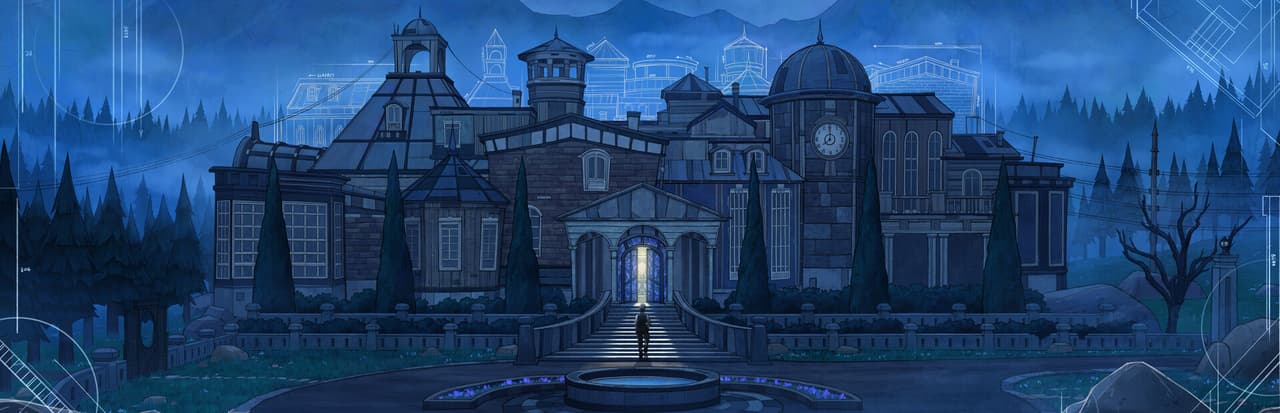
Welcome to Mt. Holly, where every dawn unveils a new mystery. Navigate through shifting corridors and ever-changing chambers in this genre-defying strategy puzzle adventure. But will your unpredictable path lead you to the rumored Room 46?
Read moreShow less
Welcome to Mt. Holly, the mysterious manor with shifting rooms. In Blue Prince, you embark on a genre-defying experience, filled with a unique mix of mystery, strategy, and puzzles that weave together to create an unpredictable journey. Will your explorative steps lead you to the rumored Room 46?
Upon reaching a closed door in Mt. Holly, you decide what room appears behind it and each decision shapes your path as you navigate through the manor. Every door can reveal new and exciting chambers that contain their own unique challenges and secrets. But be careful how you draft, for each day the manor’s floor plan resets and the rooms you saw today may not be the same rooms you see tomorrow.
Your progress each day is shaped by the rooms you select to draft and the tools you find within them. Items in the game can be used in a number of creative ways to fuel your exploration deeper into the house, allowing you to adopt unique strategies to combat the challenges that each day brings. Yet, tread wisely – the house resets each dawn, erasing all but the permanent upgrades to your estate blueprint. That is, if you were clever enough to find one!
As the heir of Mt. Holly, you have been tasked to explore its shifting halls in search of Room 46. Yet as your journey takes you further into the mansion’s depths, you start to discover that there is more lurking under the surface than a missing room. Investigate a past woven with the threads of blackmail, political intrigue, and the mysterious disappearance of a local children’s book author. The deeper you venture, the more you realize that the past is closer than it appears.
From the game's Steam store page.
THE GAMEQ VERDICT9,930 reviews analyzed
What players are actually saying
1. Summary
Players describe Blue Prince as a puzzle game unlike anything they have played: a manor you draft room by room each day, with puzzles layered so deep that reaching the advertised goal feels like finishing the tutorial. They praise that depth, a room drafting loop that keeps pulling them back for one more day, keeping a real notebook of clues, and a quiet, eerie art and music style. Myst, Outer Wilds and The Witness are the comparisons reviewers reach for, and 3% of reviews (328) call it the "best puzzle game" or one of the best puzzle games.
The randomness of the draft is the complaint that turns up in both critical and positive reviews. 57% of negative reviews use words like RNG, random or luck, and so do 15% of positive ones. Players describe solving a puzzle in their head and then spending hours of runs waiting for the rooms and items that let them try the answer. They say this gets worse after the credits, where puzzles turn more obscure and rewards thinner, and that slow repeated animations, no way to save in the middle of a run, and crashes that can wipe a long day add to it. Some reviewers on both sides give the same advice: stop when it stops being fun.
2. What keeps coming up
What players praise
Puzzles layered inside puzzles, far past the creditsHigh
Hundreds of reviews talk about layers, rabbit holes, the credits being "the tutorial", or finding far more after the stated goal. One player put it as "When you first think you've beaten the game, you've actually only just completed the tutorial." Another wrote "The reward for puzzles is more puzzles and boy does this game have puzzles." Reviewers say paintings, notes, furniture and room layouts keep turning out to matter, and that most early and mid-game puzzles have several clues pointing at them, so missing one rarely leaves you stuck. 8% of reviews compare it to Myst, Riven, Outer Wilds, The Witness, Return of the Obra Dinn, Tunic or the board game Betrayal at House on the Hill, and several say this is the first game since Outer Wilds to give them that feeling. The same endless depth is what wears some players down later on (see the split section).
A world and story you assemble yourselfHigh
Players enjoy piecing together a family history and a whole fictional world from letters, books, newspapers and pictures, with no exposition handed over. One reviewer wrote "This game has no business having such rich world building", and several say reaching the ending made them cry. A smaller group finds the writing dry or the history too fragmented to care about, and the endings are contested (see below).
Keeping your own detective's notebookHigh
14% of reviews mention notes, notebooks, journals or screenshots. Players describe pages of handwritten notes, spreadsheets, note-taking apps, red-string boards and hundreds of screenshots, and they treat this as part of the fun: a detail jotted down on day three suddenly unlocks something on day forty. One player summed up the experience as "I filled up over 10 pages of notes and took hundreds of screenshots to try and make sense of it all". Reviewers pass on the game's early advice to take notes. A minority wishes the game kept some of this record itself (see frustrations).
A drafting loop that hooks you for one more dayHigh
Words like addictive, hooked, obsessed or "one more run" turn up in hundreds of reviews, and fans describe the room drafting as a solo board game with its own strategy: managing steps, keys, gems and coins, learning which rooms work together, and slowly unlocking permanent upgrades. Several players say the first few hours felt slow or confusing and then something clicked. Fans who juggle several open leads say almost every run teaches them something, even when the draw goes badly.
Atmosphere, art and musicMedium
The painterly, comic-book look gets praise, along with a melancholy score that swells when something important happens and a mood that is eerie without being horror. A few find the long silences dull or the art plain.
A puzzle game to shareLow
About 1% of reviews describe playing with a partner, family or friends: one person drives while another takes notes, or friends play separately and compare discoveries. "Great couch co-op" was one player's whole review. Several couples describe it as a nightly ritual.
Where players are split
How far past the credits to goMedium
Reviews that reach the late game split into two camps. One says the post-credits layers are the real game and the most rewarding part. The other says the further you go, the more obscure, red-herring-heavy and luck-dependent the puzzles get, while the rewards shrink to another clue or a scrap of lore. A long review that opens with "The first 20 hours of this game is one of the best experiences I've ever had with a puzzle game" goes on to call the next 60 hours a slog. Players on both sides admit looking up one or two late puzzles they consider unreasonable in guides or wikis, and a smaller group explicitly advises picking your own stopping point, often the credits. One player's version: "If you feel like it's stopped being fun, stop playing."
Whether the endings pay offMedium
The ending, payoff or closure comes up more often in negative reviews than in positive ones. Some players found the first ending moving and the later ones satisfying. Others were deflated: reaching the goal ends the day at once, even in the middle of a strong run, and the deeper endings arrive with little fanfare. "There's basically no real sense of closure" is how one player who still recommends the game put it, and several long-haul reviewers say they would have stopped earlier had they known how thin the final payoff is.
Is it worth the priceLow
Price comes up in a small share of reviews. Some say the hours easily justify full price, or that reaching the credits alone is worth it. Others call it overpriced for what they got or suggest buying on sale, sometimes in reviews that recommend the game anyway.
What frustrates players
Luck decides when you can use what you have figured outHigh
RNG, randomness, luck and dice come up in recommending reviews as well as critical ones, often as a caveat, and since recommenders far outnumber detractors, more of them raise it in total. The complaint is specific: you solve a puzzle on paper, then need certain rooms, items or room pairings to show up in the same run, and the draft hands you dead ends, too few keys or gems, or never offers the one rare room. "I've spent 2% of my time solving puzzles, and 98% of my time rolling dice," wrote one player. A recommending player described it as "there is no frustration quite like knowing the solution to a puzzle and waiting for the damn house to give you the right bits". Another summed up the clash as "There are 2 good games here and they are strangling each other." A smaller group of defenders, some of whom call it a skill issue, say permanent upgrades and drafting knowledge bend the luck in your favor and that keeping many leads open avoids wasted days. Reviewers on both sides say it bites hardest late in the game, when fewer leads remain, and some players installed mods for extra rerolls or resources to get through it.
Slow, repetitive runs that waste players' timeHigh
21% of negative reviews use words like tedious, grind, slog or repetitive, and some say outright that the game wastes or does not respect their time. The specifics repeat: slow walking and running, the same item description popping up on every pickup, an unskippable start-of-day sequence, slow computer terminals and other repeated animations, puzzles that make you wait real minutes for an in-game time, and the same small daily puzzles solved again and again. Some players who otherwise love the game list this as their main complaint, and several recommend speed mods.
No way to save in the middle of a runMedium
Save and Quit ends the day, and reviewers describe runs of an hour or more, some up to three hours. Players who can't commit to long sessions describe abandoning their best runs or leaving the PC on overnight, and a few refunded early on for this reason alone. "Save on quit is an accessibility feature for many of us," wrote one player who refunded. A few fans accept it as a guard against save scumming, but the request in these reviews is for at least a suspend save, and several positive reviews call it their only real complaint.
Crashes and lost progressMedium
Because the game only saves at the end of a day, a crash costs the whole run, and 6% of negative reviews mention crashes, bugs, glitches or lost saves. Reports include falling through the floor, softlocks in a few rooms, cutscenes playing as white screens, stutter on Steam Deck, and save files wiped after updates. A couple of later reviews say a save corruption bug was fixed.
Wordplay that assumes fluent EnglishLow
A small group of reviews raise the language barrier, mostly from non-native speakers who otherwise like the game. They say many puzzles rest on puns, homophones and vocabulary, and one player wrote "the word-based puzzles can be significantly more difficult than intended". Another notes "Some puzzles require you to be fluent in the English language but are NOT necessary for completing the game."
Accessibility and settings gapsLow
Colour-blind players say colour-coded clues and some math puzzles become unsolvable, and several left negative reviews over it; a few later reviews mention a colour-blind setting arriving after launch. Others report motion sickness that settings could not fix, and there are steady requests for key rebinding, ultrawide and 1440p fullscreen support, a separate music volume, and a more visible cursor.
No in-game record of what you have readLow
A small number of reviews ask for an in-game journal or an archive of documents already found, including fans managing hundreds of screenshots. Others defend the paper notebook as part of the charm.
Irreversible choices with no warningLow
A few players lost progress to choices the game does not confirm: starting a New Game over an existing save, answers that lock in on a late-game challenge, and a room whose placement becomes permanent without that being clear.
3. The player conversation
Positive reviews range from one-word verdicts ("peak", "GOTY", "does it never end?") to long love letters about notebooks and late-night breakthroughs. Negative reviews tend to be long and specific, and some come from players who enjoyed the first stretch: several thumbs-down reviewers say they wished Steam offered a neutral option, and others say they loved the early and mid game before the late game wore them down. Where the two sides argue, it is over whether the game's randomness and pacing respect the player's time.
What people raise depends on how far they got. Players who stopped within the first few hours talk about dead-end runs, slow movement, finding few visible puzzles, no mid-run save, motion sickness, and the sense that it was not the puzzle game they expected. Players with dozens or hundreds of hours shift to the late game: obscure clues, chains of luck needed to test one idea, thin rewards and the endings. Long-haul positive reviews raise the same points and still recommend it, some with advice to stop at a point of your choosing.
Over time the picture is steady. Monthly positive shares in the slice sit between 78% and 88%, apart from a spike in November 2025 (1,487 reviews, 94% positive) driven by short Steam Awards nomination reviews, and in that burst noticeably fewer reviews talk about luck. March 2026 (79%) and September 2026 (78%) are the lowest months, and their complaints are the same ones raised at launch. Later reviews add Mac players and people who first played on Game Pass or PlayStation and bought it again on Steam. A couple credit a patch with fixing a save corruption bug, and complaints about randomness and saving continue through 2026.
4. What the developers could do
- Give players more control over the draft once they know what they need. Luck is the complaint negative reviews raise most often, and players suggest larger drafts, a guaranteed pick or gradually rising odds for rooms they keep failing to see after the credits.
- Add a suspend save so a run can be paused and resumed. Players describe refunding over runs of an hour or more with no way to stop, or leaving the PC on overnight, and some call a mid-run save an accessibility feature.
- Cut the repeat friction with faster movement and skips for known item pop-ups, the day intro, terminals and other repeated animations. 21% of negative reviews describe the game as tedious or grindy, and they name the same slow actions.
- Make crashes survivable with autosave checkpoints and safer save files. Without mid-run saves a crash costs the whole day, and players report lost runs and wiped saves.
- Signpost the late game and give its endings a bigger payoff. Long-haul players say late puzzles bury real leads among red herrings and lead to thin rewards, and the endings come up more often in negative reviews than in positive ones.
- Offer an optional in-game archive of documents and clues already seen. Players juggling hundreds of screenshots ask for it, and it would help those returning after a break.
- Ship colour-blind support, key rebinding, ultrawide resolutions, motion-comfort options and a separate music volume. Colour-blind and motion-sensitive players report puzzles they cannot solve and sessions they cannot finish.
- Confirm irreversible choices. Players lost progress to an unconfirmed New Game, answers that lock in, and a room placement that turned out to be permanent.