Sandustry
Survival, Simulation, Sandbox
Overview
Explore and mine fully destructible worlds. Automate increasingly complex production chains. Delve deep to uncover an ancient civilization’s powerful secrets and learn to love the sand in this factory game where every pixel is a valuable resource.
Read moreShow less
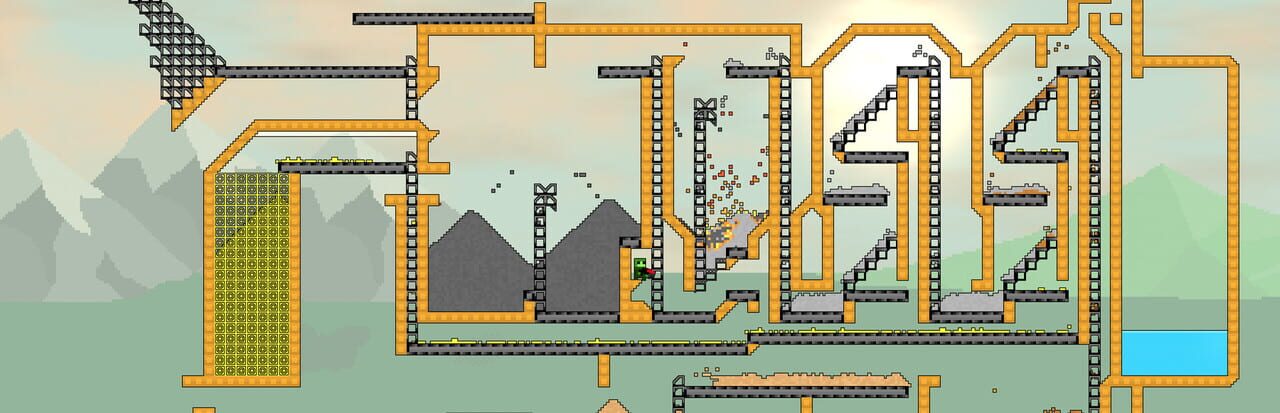
Sandustry is a factory automation game where every pixel is a resource waiting to be mined, mixed, processed, or destroyed. Explore a vast and fully-destructible open world as you seek out powerful artifacts left behind by an ancient civilization.
You’ve arrived on a vast unexplored planet filled with diverse biomes and beautiful landscapes – time to bring the fires of industry! From humble beginnings sifting gold from sand, you will quickly build a growing factory, unlocking powerful new technologies and production chains as you assess the viability of the planet for further industrialization. Countless options lie before you – will you focus on developing more advanced processing and logistical capabilities across your rapidly-expanding factory? Will you take advantage of local wildlife to aid with your mission? Or will you prioritize the hunt for artifacts, spending valuable resources to unlock access to their boons? And hey, there’s no faster way to mine than with the help of a rocket launcher, right? Build a beacon of industry and automation starting with nothing more than the trusty conveyor belt, incorporating filters, drones, pipes, pumps, and a myriad of other parts as you harness nature itself to do your bidding.
From individual grains of sand and flakes of snow to seeds, spores, and chips of ice, every pixel in Sandustry is a physical entity with its own properties. Discover countless chemical and physical reactions and exploit them to develop your production chains, building a pixel-perfect factory to optimize every step, or embracing chaotic webworks of conveyor belts and lifts as long as they get the job done – but be warned, sand is coarse, rough, and it gets everywhere, which introduces a new layer of complexity. The resources in Sandustry react to each other and the world around them – ice melts into water when heated, which turns to steam and rises if brought to a boil (only to come back down as rain if you let it reach the skies). Sand absorbs water around it, slowly depleting limited reservoirs to provide the wet sand that can be sifted for gold, while watered seeds bloom into flowers that can be ignited with fire to produce vital resources.
Deep beneath the planet’s surface lie countless mysteries for you to explore. Find clever ways to overcome the challenges left behind by an ancient civilization to uncover vaults of great knowledge and power. Nothing punches through a thick wall of ice like a freshly purchased flamethrower, but perhaps you can find a way to redirect some lava instead?
Built with modding in mind, Sandustry lets you explore everything from visual tweaks and hand-crafted maps to entirely new buildings and processes that you can integrate into your production chains. Dedicated modding tools make it easy to customize your experience, share your ideas with the world, and even overhaul the whole game!
As you delve deeper into the planets of Sandustry and expand your industrial capabilities, the challenges will grow, but so too will your ways to overcome them. With fully destructible worlds where every pixel is a resource to be harnessed, your options are limitless.
From the game's Steam store page.
THE GAMEQ VERDICT3,167 reviews analyzed
What players are actually saying
1. Summary
Players love that Sandustry takes the falling-sand toy (Powder Game, Noita) and gives it a purpose: every pixel of dirt, water, lava and gas is a physical resource that you route, filter, burn and shake into gold. Reviewers often describe it as some mix of Factorio, Terraria and Noita ("Factorio meets Terraria", "Factorio meets Noita"), and many say they lost hours to it. They also praise how forgiving it is: buildings cost nothing, there are no enemies, you can't die, and tearing a line down to rebuild it costs you nothing. Many also call it unusually polished for Early Access and a big step up from the long-running demo, at a price they see as a bargain.
The complaints are about how much game there is. The Early Access content ends after roughly 8 to 20 hours, and the production chain is a single line where each step turns one byproduct into the next. For an "automation" game it also leaves a lot of manual work: digging dirt, refilling heat and water, cleaning up runaway flowers. Late in the game, gold piles up with nothing to spend it on and the 1 million gold achievement turns into a slog. Few of the reviews that raise these points vote the game down; many call it a great foundation and ask for much more.
2. What keeps coming up
What players praise
Pixel physics turned into a factory gameHigh
About 16% of all reviews talk about the physics, pixels, particles or falling-sand lineage directly, and many more do so indirectly. Players love that nothing is an abstract item in a box: sand sinks in water, wet seeds float, petals drift on fans, gases rise, steam rains back down, and a single stray pixel of lava can boil a reservoir. As one review puts it, "your factory isn't just moving items on belts", because every material behaves in its own way. Many nostalgic reviewers say it's the game they wished those old browser sand toys could have been. A minority push back that the simulation looks more open-ended than it is (see the depth section), though even some negative reviews praise the sand mechanics.
A dangerously addictive "one more tweak" loopHigh
Reviewers describe sitting down for an hour and looking up at 3 or 4 a.m., forgetting to eat, first sessions of 6, 8 or 12 hours, and seeing sand when they close their eyes. A few borrow Factorio's "Cracktorio" nickname. Players at every stage report it, from people 2 hours in to 150-hour players, and they frame it as praise: spotting a bottleneck, fixing it, and immediately finding the next one is what they came for.
Chill, forgiving design: free buildings, no enemies, no deathHigh
Players single out design choices that take friction away. Unlocked structures cost nothing to place, so you can build huge, experiment, delete and rebuild without grinding materials. There is no combat, no health and no timer, and hover mode lets you fly through your own builds. Cut, copy, paste and blueprints are available from the start. Many call it relaxing or "cozy", and one calls it a Factorio that "respects your time". Newcomers say it's a gentle way into the genre, and a few parents play it with their kids. (A vocal minority sees the same choices as the game's weakness; that debate is covered in the split section below.)
It easily passes for Factorio, Terraria and friendsHigh
About 15% of reviews name at least one of Factorio, Terraria, Satisfactory, Oxygen Not Included or Shapez, nearly always as a compliment ("scratches my factorio itch", "Terraria with automation"). Many add that it feels like its own thing rather than a clone. The comparison usually comes with a caveat: it is much simpler and smaller than those games, which experienced players either welcome as a break or hold against it.
Polished, stable, and a huge step up from the demoMedium
The demo is mentioned in about 10% of reviews, mostly by people who played it for dozens (sometimes hundreds) of hours and bought on day one. Those who compare the two say the Early Access build is far better: faster movement, a map, multiple hotbars, zoom, remappable keys, a better tutorial and much more content. A few say they almost skipped the game because the older demo felt clunky and urge others not to judge it by the demo. Many also say the game hardly feels like Early Access: few bugs, no crashes for them, and smooth performance even on old laptops, Macs and Linux.
A solo developer who listens and ships fixesMedium
Reviewers credit the developer (Lantto) for patching reported bugs within a day, the in-game F2 feedback tool, Workshop mod support from launch, and years of letting the community mod the demo. Some cite the modding scene (a multiplayer mod, a distributor/splitter mod, extra maps) as a reason the short content isn't a dealbreaker.
Exploration and puzzle chambers break up the buildingMedium
Many enjoy digging down to find artifacts, upgrade materials, critters that make water or power, and small environmental puzzles as a change of pace from the factory. Players like that new tools (flamethrower, rocket launcher, laser) open up areas you couldn't reach before. Some find the exploration thinner than the building: a few say the underground feels samey or the puzzles are unexplained (see frustrations).
Satisfying sound, music and "juice"Low
A smaller group calls out the clinking of gold, the soft water sounds, the soundtrack and the tactile feel of the tools as part of why the game is so soothing to leave running.
Where players are split
Is it worth the price right now?High
Most reviewers who talk about price say it is a steal. Many bought it at the launch discount (around $10, down from $15), and some say they'd have paid more. Because the content runs out quickly, a steady minority advise waiting for more updates or a sale ("Get it on sale", "too expensive for the current state"). Several of those reviewers still voted thumbs up.
Simple and approachable, or too shallow and easy?Medium
The same features draw praise from one group and criticism from another. Newcomers, casual players and Factorio veterans looking for a break love that there are no ratio calculations, no build costs and no fail states. A smaller group of experienced automation players find it too easy, with nothing at stake and no reason to design well; one says they "didn't have any incentive for clean solutions". Several compare free building to playing in "creative mode", which is the appeal for some and takes the stakes away for others. A few ask for an optional survival or build-cost mode, hazards, or some risk to make the underground feel dangerous.
How well the game teaches its later systemsMedium
Many reviewers praise the short tutorial, the animated GIF examples in tooltips, and the joy of figuring things out yourself. Others, including several thumbs-down reviews, say the later tiers are poorly explained: how the kinetic press works, how to wet seeds, what to do with flowers, how aura or the Tier 6 machine works, how to move lava, what Florinol soil is. They had to turn to YouTube, the wiki or Discord, and several ask for an in-game encyclopedia of materials and interactions.
Performance: light on old PCs, slow in the late gameMedium
Players generally report smooth early and midgame performance. The complaints are about large late-game factories: once builds grow big, huge piles of liquid gold slosh around, or the map is mostly dug out, simulation speed (UPS) drops, sometimes to single digits, and saving and reloading temporarily fixes it. Some report heavy CPU load and hot laptops, audio cutting out when Florinol batteries recharge, and conveyors that stop working after very large build sessions until restart. A couple found fullscreen mode maxed out their CPU while windowed mode ran fine.
What frustrates players
The Early Access content ends too soonHigh
This is the most common criticism, and most people raise it with affection ("My only complaint is that it's a bit short"). Players report reaching the end of the current tech tree in anywhere from about 5 to 20 hours, often in one or two sittings, and then hitting an abrupt "end of Early Access" message just as things were getting interesting. Longer playtimes mostly come from optimizing, restarting, or grinding the last achievement. Some worry about replayability: the map seems nearly identical between seeds, and there's no new-game-plus to carry unlocks forward. Only a small share of those who raise it vote the game down.
A single, linear production chainMedium
Players who make this critique often measure the game against Factorio or Satisfactory. Each step takes one input and gives gold plus one byproduct that feeds the next step (sand, wet sand, residue, seeds, flowers, petals, Florinol, aura). There are no secondary inputs, alternate recipes or products that come back later, and most machines have exactly one use. One reviewer calls it "a tech tree shaped like a post": the factory becomes a long snake, the only puzzles are throughput, and many logistics tools and logic gates never become necessary. A related complaint is that each tier's byproduct can't be processed until the next tier, so you spend the early game stockpiling petals and residue you can't use yet. Even fans who like the simplicity often ask for branching chains and more interlocking reactions.
An automation game that still needs a lot of babysittingMedium
Many players, including the authors of some of the most upvoted negative reviews, say you can never really let the factory run itself. Dirt and sand must be dug by hand for most of the game (several players call the mining drones unreliable, and they get stuck), heat blocks need topping up with the flamethrower until lava logistics unlock, water keeps getting used up and has to be made from snow or rain, and red sand, void petals and the late-game infinite-sand orb all need manual mining. A stationary drill or mining block is a frequent request. Some players say they fully automated everything and that the upkeep is part of the charm, but for self-described automation fans who vote the game down it is a frequent reason.
Flowers, seeds and vines that wreck factoriesMedium
Negative reviews name the plant tier more often than most other problems. Wet seeds float and clog conveyors, flowers seem to sprout on walls and belts with no planter or water, vines regrow through the refinery and resist even the laser, and one seedling on a belt can stall everything behind it. Several players say it ruined saves or made them quit, and some positive reviewers single it out as a low point too.
A late game of waiting and piles of useless goldMedium
Past the midgame, gold stops mattering: players sit on hundreds of thousands with nothing to spend it on, no way to delete it, and huge vats of it eating map space and CPU. The last achievement (1 million gold) is often called a grind, and some get there by leaving the game idle for hours; some found the map ran out of sand first. The aura and nanobot tier, the Florinol energy target and the 10k aura goal are described as waiting rather than designing. Players ask for a gold sink, infinite research, a way to condense gold, and a faster infinite-sand source.
Indestructible terrain, a small map and cramped building spaceMedium
Given the "every pixel is a resource" pitch, players are irked by indestructible veins, sandstone that blocks large areas, and regenerating dune or sun sand that is a nuisance to clear. A number of reviewers say the world feels small or samey, that most building ends up in the sky, and that they want a larger, more varied or procedurally generated map. One reviewer reported that procedural generation placed a required artifact out of reach and softlocked the save.
Crashes and white or black screens for some playersLow
A small cluster, mostly people who stopped within two hours, couldn't play: white or black screens, freezes within minutes (one traced it to the tooltip preview videos), "failed to start" errors, or a black screen after a mid-August patch. A few fixed it by turning off G-Sync or V-Sync or using windowed mode. It's rare, but it accounts for a noticeable share of the thumbs-down reviews from people under two hours.
Tool and upgrade balanceLow
Veterans say many tools are made redundant almost immediately: the upgraded rocket launcher outclasses the shovel, pistol, drill and void gun, the laser burns energy too fast and can't be upgraded, and the grapple hook is forgotten once you can hover. Upgrade currency is scarce, so some upgrades feel like a waste.
Hotbar, filters and controlsLow
Common small asks: too many tools for five hotbars (and no labels), fiddly filter settings, no upgrade planner for belts, no way to cross pipes, sideways launchers, a zoom hotkey, click-to-move or proper controller and Steam Deck support, and getting snagged on single leftover pixels while moving.
Water is a constant bottleneckLow
Players note that water is consumed rather than recycled, surface water runs out, pipes move it slowly, and the water-making critters aren't fast enough for late-game scale.
Multiplayer wantedLow
A small but steady group asks for co-op so they can dig and build with friends.
Worries that the interface looks AI-madeLow
A handful of reviewers say parts of the UI and text look AI-generated, and it bothered them.
3. The player conversation
The tone is overwhelmingly warm and often giddy. Hundreds of reviews are one-liners ("sand", "peak", "the factory must grow", Anakin's "I don't like sand" joke), and the longer ones read like enthusiastic bug reports from people who want the game to succeed. The 84 negative reviews rarely attack the core idea; a few open with "I really wanted to like this", and some promise to revisit the game when it has more depth.
Playtime shapes who raises what. The few reviews under two hours that are negative mostly report crashes, confusion about the mechanics, or a first impression that it's too simple or too slow to dig. Players in the 10 to 25 hour range, roughly when the current content runs out, raise most of the depth debate: linear chains, manual upkeep, flowers and the abrupt ending. Players with the most hours raise much of the late-game grind, gold storage and slowdown complaints.
Sentiment barely moved over time. More than 60% of the reviews arrived in the first two weeks after launch, with 97 to 98% positive, and the positive share stayed in the mid-90s as volume tailed off in the following weeks. Demo veterans are more prominent in the launch-week reviews than in later ones.
4. What the developers could do
- Add branching production chains and reasons to reuse materials. Players criticize the one-input, one-output chain, which one calls "a tech tree shaped like a post": most machines have one use and logistics tools go unneeded.
- Automate the sand supply with a stationary drill or miner, and fix the drones. Manual digging, unreliable drones and hand-refilled heat and water are a frequent reason automation fans give for voting the game down.
- Tame the plant tier. Floating wet seeds, flowers that sprout from nowhere and vines that regrow through the factory come up in more negative reviews than most other problems, and some players quit over them.
- Keep content coming and publish a roadmap. Players who reach the end want more tiers ("please add more"), and a few ask for a public roadmap.
- Give gold a purpose and shorten the endgame waits. Players are drowning in gold they can't spend, store or delete, and the 1 million gold and aura goals feel like idling.
- Explain the later systems in the game. An in-game encyclopedia of materials and interactions and clearer hints for the press, seeds, lava transport and aura would stop players having to rely on YouTube and Discord.
- Optimize large late-game factories and fix the crash reports. Slowdown with big builds and liquid gold, audio dropouts, and early white or black screen crashes hit the players who invest the most and the players who never get started.
- Update the demo to the current build. A few buyers say the old demo nearly put them off, and players who compare the two call the Early Access build far better.