Space Engineers
Keen Software House · Survival, Simulation, Sandbox
Overview
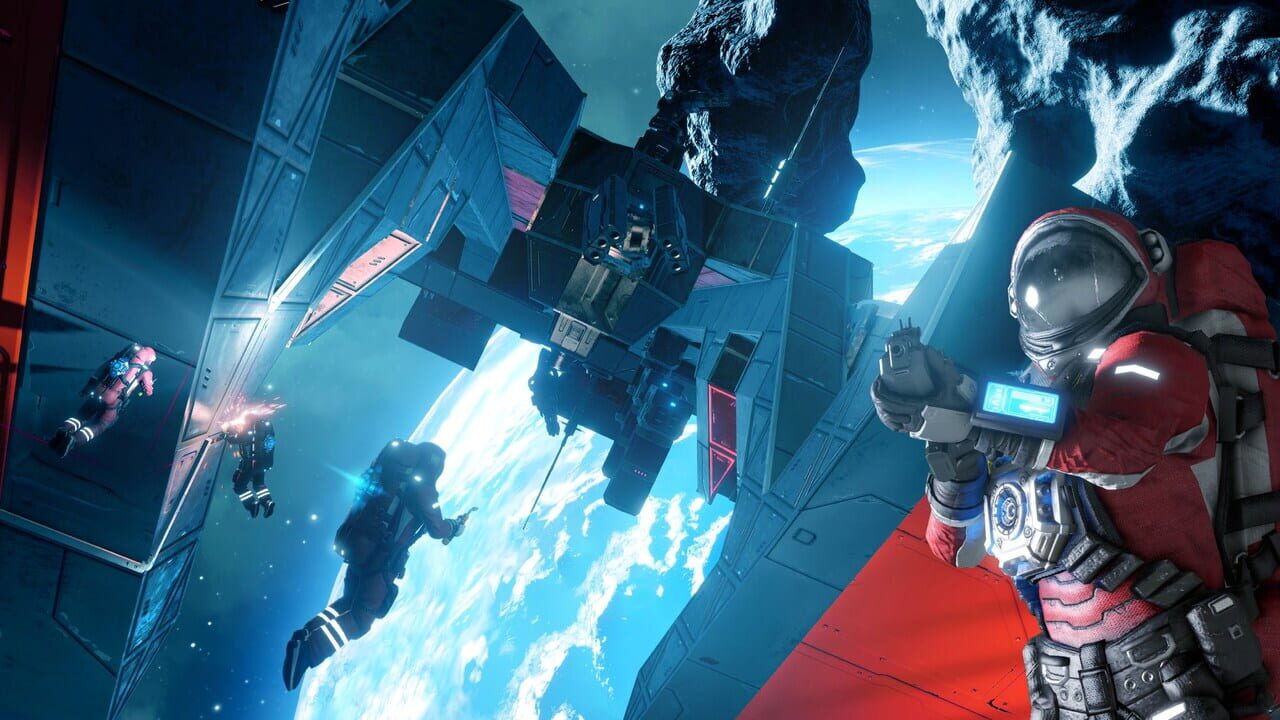
Space Engineers is a sandbox engineering game where you design and build ships, stations, and planetary bases in a fully destructible environment. Explore planets and space, mine resources, survive hazards, and engage in combat alone or with friends in Creative or Survival modes.
Read moreShow less
Space Engineers is an open world sandbox game about designing, building and testing your own space machines. Construct ships, stations and planetary bases in a fully destructible environment, then explore planets and space, mine resources, survive hazards and engage in combat alone or with friends in Creative or Survival modes.
Play solo or in multiplayer, from small co-op outposts to huge community servers. Start with a simple lander, grow into a mining and industrial empire, or focus on warships and planetary fortresses – the game gives you the tools and physics, you decide what to build.
Space Engineers uses a volumetric physics engine: every block and voxel has mass, inertia and damage. Ships break apart, stations crumble and terrain can be drilled, carved and reshaped, so your engineering choices really matter.
Space Engineers is grounded in real engineering and hard science fiction, driven by realism and plausible near-future technology. Think modern space programs extrapolated into the future: realistic ships, stations, tools and systems where everything is built and simulated block by block. It’s about the machinery you build, not about magic or scripted set-pieces.
Why play Space Engineers (SE1) now?
10+ years of active development with many free updates every year – and still ongoing
Huge Steam Workshop with thousands of ships, bases, mods, scripts and scenarios
Stable, feature-rich sandbox ideal for long-term saves and big community servers
All DLC is cosmetic-only – everyone plays with the same gameplay
Active player base, dedicated servers and modding community
Build anything
Design and pilot small and large ships, asteroid stations and planetary bases
Over 200 functional blocks: thrusters, rotors, pistons, turrets, conveyors, production blocks and more
First- and third-person building, symmetry tools and blueprints for fast large-scale construction
Manual building in Survival: weld to assemble blocks, grind to disassemble and reuse components
Fully destructible world
Voxel planets, moons and asteroids with atmospheres, gravity and climate zones
Drill, cut and blast terrain; carve tunnels, craters and underground bases
Ships and structures take block-by-block damage and can break into pieces
Deformable and destructible objects with real mass, storage capacity and integrity
Play your way
Creative – unlimited resources, instant building, no death
Survival – manual assembly, resource and power management, death/respawn
Singleplayer or multiplayer (co-op or competitive) with privacy settings and dedicated servers
Scenarios, Workshop worlds and custom worlds so you can start in exactly the kind of universe you want
Endless replayability
Super-large worlds with procedural asteroids and exploration encounters
Exploration systems that add ships and stations to discover, capture and conquer
Visual Script Editor to create your own missions, game modes and campaigns
Cargo ships, factions and AI-controlled threats to interact with – or defend against
Modding & scripting
Deep Steam Workshop integration for worlds, blueprints, mods and scripts
Modding API in C# to change game behaviour and add new systems
Programmable block for in-game automation and custom logic
Support for custom textures, models and many other mod types
Systems & survival
Electricity, power grids and generators powering your entire base or ship
Oxygen and hydrogen for life support and thrusters
Weapons and combat blocks for ship-to-ship battles and base defense
GPS, remote control, voxel hands, controller support and more quality-of-life tools
Extensive language support with official and community localizations
From the game's Steam store page.
THE GAMEQ VERDICT9,999 reviews analyzed
What players are actually saying
1. Summary
Players love Space Engineers for its building. You can make almost anything, from a mining rover to a capital ship, out of blocks that actually work, and then the physics tests it. Reviewers compare it to Lego and to Minecraft in space, and describe long stretches of designing, crashing and rebuilding. The Steam Workshop, mods and in-game scripting keep adding to the sandbox, and playing with friends is the setup reviewers recommend most often.
New players hit a learning cliff, and the tutorial tells them what to do without explaining how, so they go to YouTube for help. Long-time players object to the amount of paid DLC and to un-owned DLC blocks filling the build menu. Both groups describe bugs, "Clang" physics explosions, crashes and multiplayer lag that have lasted through years of updates. Players disagree on whether a sandbox with few built-in goals counts as a full game, and on what Space Engineers 2 means for this one.
2. What keeps coming up
What players praise
Mods, scripts and the WorkshopHigh
Mods and the Workshop come up in 23% of longer reviews. Players praise the sheer volume of community ships, scripts and gameplay mods, and the in-game programmable block lets technically minded players automate drones, missiles and factories. Some reviewers use mods to fill gaps in the base game, adding more NPC life, hiding DLC blocks or fixing loud audio.
That reliance also draws criticism. Some players call the game "carried entirely by the workshop community," and others say large mod lists make worlds slow to load or unstable, and that updates break mods. A few objected to the mod.io account sign-up that, they say, the game now requires for some blueprint and mod features.
Build anything, and it actually worksHigh
Building and creative freedom come up in 20% of longer reviews. Players like that every thruster, conveyor, rotor and reactor has to be placed and powered, so getting a ship to fly means solving an engineering problem. 8% of longer reviews compare it to Lego or Minecraft: "Legos on steroids, with a little jank. Great fun and addicting." and "Litterally minecraft in space + cool physics". Players who want to design without the survival grind often settle in creative mode.
What to do once the building is done is a separate argument, covered under the split topics.
Physics that make engineering matterMedium
Physics, destruction and terrain deformation come up in 10% of longer reviews. Players enjoy that mass, momentum and damage are simulated, so a bad design fails in a way you can see and learn from. A player who quit, came back a year later and stayed put it this way: "every failure taught me something the game never bothered to say out loud." The community's name for physics going wrong, "Clang", appears in 5% of longer reviews, often as a joke ("Beware of clank, always. It's a great game, just buy it.").
Rovers flipping on small slopes and ships tearing themselves apart come from the same physics, and they show up again in the bug complaints.
Long-running updatesLow
A smaller group of positive reviews credits the game for still getting updates years after release. Reviewers mention survival, economy and NPC encounter updates that arrived while the sequel was in development. "Over 10 years running and this game is JUST GETTING STARTED."
Where players are split
Multiplayer: the best way to play, when it connectsHigh
Friends come up in 14% of longer reviews and multiplayer or servers in another 14% (23% mention one or the other). Players say the game is far more fun with a group sharing the mining and building on a private or dedicated server ("it's a great game, but it is much better with friends.").
Getting into a session and staying in it is where the trouble starts. Players describe friends failing to connect or getting stuck loading, lag and rubber-banding on servers, poor sim speed with large builds, spawning many kilometres apart in the same world, and losing items or dying when a non-host player disconnects: "Who thought it was a good idea for you to lose your entire inventory when you log off of a server?" Reviews of official servers mention griefing, rollbacks and downtime. Solo players are divided. Some enjoy a quiet single-player build, and others say the universe feels empty without other people.
Space Engineers 2 and what it means for this gameMedium
The sequel comes up in 12% of longer reviews, and veterans raise it more often (16% of longer reviews from players with 300+ hours overall) than newcomers do. One camp tells buyers to pick the original because it has far more features and multiplayer: "If you're debating buying this or the sequel, buy this one." Another is excited about the sequel's new engine and plans to move once it matures. A third feels the original was left unfinished, with core bugs unfixed as work moved to the sequel: "Half a game. Abandoned to make half a game v2." Some positive reviews point out that updates and DLC for the original kept coming during the sequel's development.
Is there a game in the sandbox?Medium
Complaints about an empty world, no goals or nothing to do come up in 9% of longer reviews, and in 18% of longer negative reviews. Critics say survival amounts to mining rocks to build tools that mine rocks faster, that planets and space feel lifeless, and that once a ship reaches orbit there is little reason to use it: "Space Engineers is as wide as an ocean and as deep as a puddle." Some call it a tech demo or a design tool.
Other players describe the same open structure and like it. They set their own projects and want tools from the game, with the objectives left to them: "There are a thousand different things you can do. Pick one, build a speeder. and have an adventure from there." Several positive reviews still wish for an endgame goal, more NPCs or meaningful PvE.
The survival overhauls: food, radiation and weatherLow
The survival additions reviewers describe (hunger and farming, sun radiation, hazardous weather, starting with a rover) come up in 2.5% of longer reviews. Some players welcome the extra challenge and the updated encounters ("Food update is pretty nice adds buffs for surviving."). Others feel the additions turned an engineering game into a chore of constant eating and deaths to radiation and storms: "Now you spend half your time sitting around waiting for the weather to clear". Some ask for simple toggles in the options.
Linux, Steam Deck and controllersLow
Few reviews raise platform support, and they disagree. Some players report the game running fine through Proton ("works well on Linux through Proton"), while others describe crashes, missing audio, failed multiplayer and no official Steam Deck or Linux server support. Controller reports split the same way: some say it plays like the console version, others that gamepads stopped working or never mapped flight and drilling properly ("Controller support is an outright lie.").
What frustrates players
Bugs, Clang and performanceHigh
Bugs, crashes, physics glitches and lag come up in 23% of longer reviews and in 30% of longer negative reviews. The same problems recur from review to review: rotors, hinges, pistons and subgrids that break or fling builds into space; rooms that will not pressurize; ships exploding after a light touch or a docking; rovers flipping over; thrusters failing; crashes on recent graphics cards or after updates; "scene too complex" warnings; and sim speed dropping as builds grow. "A game about physics, in which using the physics causes the game to cease functioning." Veterans raise stability more than newcomers (27% of longer reviews from players with 300+ hours overall, against 15% under 10 hours), and some describe the same bugs persisting across years of updates.
Performance reports vary. A smaller group says the game runs well even on old laptops or low settings, and some players treat Clang as part of the charm.
A learning cliff with a tutorial that does not teachHigh
Complaints about the learning curve, confusion and the tutorial come up in 19% of longer reviews, in 25% of longer negative reviews, and in 41% of longer reviews from players with under 10 hours overall. The tutorial and Quick Start give checklist tasks (one says to "refill your oxygen", others to repair a broken panel) without showing how, they can soft-lock or fail to register progress, and much of the real help is a set of links to old YouTube videos. "The tutorial consists of a series of nonspecific text boxes" and "I spent more time watching YT tutorials than playing." Dozens of reviews name Splitsie's YouTube series as the tutorial that actually taught them.
Many positive reviews carry the same warning: once systems like conveyors and power make sense, they say, the depth pays off. A few suggest learning alongside a friend who already knows the game.
DLC volume and the greyed-out build menuHigh
DLC comes up in 18% of longer reviews and in 29% of longer negative reviews, rising to 23% of longer reviews from players with 300+ hours overall. The complaints target pricing and presentation. Players object to the number of small block packs and to their combined price next to the base game, and some say new blocks arrive as DLC instead of in free updates. One concrete complaint is that un-owned DLC blocks stay in the build menu, greyed out and impossible to hide: "upon very first opening of the build menu you see that 90% of it is permanently grayed out, because it's all DLC content." Players also describe Workshop blueprints and derelict or NPC ships that use DLC blocks they cannot place or repair, and a minority argue some DLC blocks are more compact or efficient than their vanilla equivalents.
Other players defend the packs as cheap, mostly cosmetic and optional, and some buy them to support development: "DLC are cheap and 100% optional. Not greedy scheme."
Clunky interface and controlsMedium
The UI, menus, hotbar and controls come up in 9% of longer reviews and in 20% of longer negative reviews. Players describe a monochrome interface that is hard to read, block rotation spread across odd keys, inventory screens without simple drag-and-drop, and a toolbar setup that forces you through a list of every item: "As a new player, when I want to put something from my inventory onto the toolbar (a simple and normal task), I shouldn't have to search a list of every item in the game to find it." Several players also miss basic readouts, such as total cargo capacity or power use across a base.
A slow, grindy survival startMedium
Grind and tedium come up in 6% of longer reviews. Players describe hours of hand-drilling stone for small amounts of ingots, slow survival-kit crafting and long waits for refining before anything interesting can be built: "1h 45mins to make a small square in the middle of a field." Some note that default survival settings already multiply resource yields, and recommend creative mode or a friend's established base to skip the start.
Lost work: despawns, trash removal and broken savesLow
Under 2% of longer reviews describe losing hours of work: unpowered grids removed by the trash-removal cleanup, ships despawning when players fly away, autosaves overwriting quicksaves, cloud saves that only covered blueprints, and corrupted worlds. Players say the game never explains the cleanup rules.
The 100 m/s speed capLow
About 1% of longer reviews complain about the fixed maximum speed. It makes travel between planets and asteroid fields slow, and every ship design tops out at the same speed.
3. The player conversation
Plenty of positive reviews come with a warning attached about the learning curve, the DLC or the bugs, and some negative reviews still praise the building and the physics. A small share of reviews carry visible edits or dated updates, mostly from players with 300+ hours overall, who revisited an old review, sometimes several times over the years, to record what changed. Several flipped from positive to negative over DLC or unfixed bugs, while a few flipped the other way after survival and economy updates.
Who raises what depends on how deep players got. Players with under 10 hours overall concentrate on the first session: the tutorial, Quick Start, not knowing how to refuel or power an assembler, and dying to wolves or spiders before learning to fight back. Reviewers who received the game free, some during a free weekend by their own account, are far more likely than reviewers overall to have played under 10 hours. Players with hundreds or thousands of hours talk about DLC, bugs that have survived years of updates, multiplayer sync, sim speed and what the sequel means for the original.
Critics and fans alike describe the building system and physics as unusual and absorbing. They disagree about how much friction, grind and paid content a player should have to accept to enjoy them.
4. What the developers could do
- Rebuild the first hours as a real tutorial. 41% of longer reviews from players with under 10 hours overall raised the learning curve or the tutorial. They asked for steps that explain how to refuel, power machines and build a first ship, in place of checklist prompts and links to old videos.
- Let players hide or filter DLC blocks they do not own. Players without the packs say the greyed-out blocks clutter the build menu; a few asked for a way to hide them, and some already use a mod for it.
- Fix long-standing physics and subgrid bugs before adding new content. Veterans described rotors, pistons, pressurization and docking failures that destroyed builds, and some said the same bugs persisted for years.
- Make co-op joining and disconnects reliable. Players described friends failing to connect, spawning far apart and losing their inventory when a non-host disconnects, which made the recommended way to play a chore.
- Give blueprints and NPC ships a vanilla fallback for DLC blocks. Players without the packs said Workshop creations and derelicts arrive broken or unrepairable, which undercuts the Workshop they otherwise praise.
- Overhaul inventory, hotbar and readouts. Reviewers asked for drag-and-drop between inventory and toolbar, clearer block info, and totals for cargo and power across a grid.
- Explain and soften trash removal and save handling. Players lost bases and ships to cleanup rules they never saw explained and to autosaves overwriting quicksaves.
- Add more goals and life to survival, with optional toggles for the newer hazards. Players who found the world empty asked for NPC activity and reasons to travel, while those annoyed by radiation, weather and hunger asked for clear switches in the options.