Shapez 2: Factory
tobspr Games · Strategy, Simulation, Puzzle
RELEASE MILESTONES
Dates from IGDB release data
Overview
Dive into a factory-building game with the focus on just that – building huge space factories! Design sprawling multi-level factories and satisfying production lines without limits. Tackle progressively challenging automation goals at your own pace, without the threat of enemies.
Read moreShow less
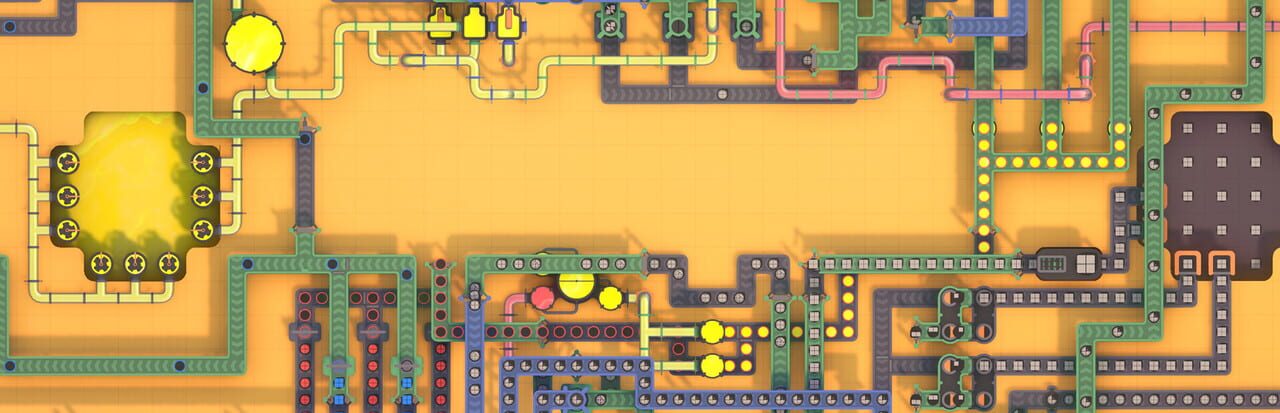
Shapez 2 is a 3D factory-building game where you automate the extraction, production and delivery of geometric shapes. Each shape is its own set of building blocks that your factories can take apart, stack, paint and put back together in near-infinite different ways.
Deliver specific shapes to unlock new technologies, expanding your factory’s capabilities and scale to make even more unique shapes. Grow a single conveyor belt into a massive multi-station space factory across three interconnected layers. Keep it efficient and optimise every platform, or expand into the infinity of space and connect a million buildings by space train – you decide how you engineer your factory.
Shapez 2 is the purest factory simulation game imaginable: all buildings are free, resources never run out and there are no enemies or time limits. Effortlessly delete, redesign and rebuild your spaghetti belts as much as you want, without penalties. You’re in complete control of this sandbox, so you can focus on how to craft the next shape.
Whether you’re new to the genre, a casual or an automation veteran, shapez 2 is for everyone. Pick between three difficulty levels with completely unique logistic puzzles each or take on the experimental Hexagonal mode. There are many reasons to play shapez 2 again and again.
If you’re looking for a list of what shapez 2 has to offer, these are the features you should know about:
Multi-Layer 3D Factories: Design and optimize your factories across three building layers for both buildings and platforms. Connect everything by space belt or train!
Multiple Difficulty Levels: One main game mode with multiple difficulty levels for both new and veteran players, as well as the experimental Hexagonal mode if you’re up for the challenge
Challenging Shape Mechanics: Discover shapes types with unique properties and logic
Open Production Buildings: Build stunning space factories with animated open buildings, so you can always see exactly what’s going on or going wrong
Research System: Unlock new buildings, mechanics & upgrades that open up new ways to build your factory
Blueprint Library: Save, load, export and share factory design blueprints with anyone
Easy controls: Effortlessly cut, copy & paste parts of your factory and undo & redo up to 50 operations with intuitive keyboard controls
From the game's Steam store page.
THE GAMEQ VERDICT9,600 reviews analyzed
What players are actually saying
1. Summary
shapez 2 strips the factory game down to the building. You extract simple shapes, cut, rotate, paint and stack them across three floors and a field of space platforms, and feed the results into a central vortex, with no enemies, no resource costs and free demolition. 97.1% of the reviews recommend it, and what they praise is how building feels. Belts merge and split on their own, copy, paste, undo and blueprints arrive early, and each machine tells you how many copies fill a belt. Fans of the first shapez who compare the two mostly call the sequel an upgrade. Reviewers describe it as calming and hard to stop playing at the same time, and Early Access buyers called it polished from launch day.
More than a third of the negative reviews fault the core loop: once you have blueprints for the basic operations, each new shape means pasting modules, waiting out a quota and deleting the factory, and the shapes themselves vanish into the vortex. Players who came for Factorio-style growth call it more puzzle than factory. The 1.0 launch added Manufacture mode, which some say fixed the throwaway factories and others say changed little. Reviews written after 1.0 are cooler than the Early Access ones (93.0% positive against 97.7%), report lag in very large factories more often, and include players who lost their saves to the update. Some negative reviewers still call the game polished, well made or good-looking. What they doubt is that a factory game without scarcity or lasting goals can hold attention for dozens of hours.
2. What keeps coming up
What players praise
A sequel that outgrew the first shapezHigh
More than 400 reviews say outright that shapez 2 is better than the first game or a big upgrade on it. They point to the three building floors that let belts and machines stack, the space platforms and space belts, trains, fluids, painters that chain, and a research system that lets you choose what to unlock. "This game makes the first game look like a concept sketch," one wrote in the first days of Early Access. Several players who found the first game too flat or abstract say the 3D sequel is what hooked them.
The comparison came up far more during Early Access than after 1.0. A small minority of longtime fans prefer the first game: they miss its open, unlimited map and simpler rules (see the space platforms entry under Where players are split).
Building tools that remove the busyworkHigh
Hundreds of reviews praise the interface and controls, and they name the same tools: belts that snap in the intended direction and merge or split without splitter buildings, anchors for routing, flipping as well as rotating, undo and redo, copy and paste that cost nothing on Normal, blueprints unlocked early, a preview of what a line will output before the first shape arrives, and a tooltip stating how many machines fill a belt. "Each machine tells you how many you need to saturate/utilize a full belt," a Factorio fan wrote, and another put it as "Ever experienced a game where you have to fight the interface to make the game do what you want? This is the opposite." After 1.0 the praise continued in the same terms: "it feels more like using a very competent software instead of playing a game."
Before blueprints unlock, though, moving a building one tile means rebuilding it, and an Early Access reviewer in February 2026 objected that "the ability to cut and paste is locked behind game progression." Others found the floor switching and camera work clumsy, starting on Early Access launch day with "Very awkward controls."
Hard to put downHigh
"was only going to play for a couple hours tonight and now I have work in 3 hours and I haven't slept," wrote one player at Early Access launch; another said "every time i blink while playing this game 30 minutes have passed". Hundreds of reviews call the game addictive, and many tell some version of that lost night: sitting down for an hour and looking up at dawn, or putting 13 hours in on the first day. Players credit the chain of milestone shapes, side jobs that pay out research points while a milestone fills, and the urge to shrink a working design into less space. A few negative reviewers say they enjoyed the first hours before the pull faded (see the first entry under What frustrates players).
Calm building with no enemies or resource costsHigh
No enemies, infinite resource nodes, no building costs on Normal, no fail state and no penalty for tearing a factory down: these are the reasons hundreds of reviewers give for calling the game relaxing, chill or zen. "Turns out that removing combat and resource limits and crafting from a factory game works out very nicely," one wrote, and another said "Even if you are rebuilding and redesigning large chunks it doesn't feel like wasted effort." One parent recommends it as a game you can play for half an hour and put down. The same choices are behind the loop complaint below, where players say the lack of friction leaves nothing to push against.
Animations, art and soundtrackMedium
Every machine visibly does its job, with pistons pushing shapes and mining lasers at work, and players enjoy watching it: "I LOOOVE how the animations actually DO what the machine is supposed to do." Zooming out from a single cutter to the whole network of platforms impresses them too. The ambient electronic soundtrack has its own fans; owning the first game unlocks its music as well, and the Supporter Edition adds more tracks. A few found the music repetitive over long sessions ("it lacks variety and becomes grating after 10 hours or so"; "Sound is good, though it does get a bit repetitious after awhile") and turned it off.
Early Access that already felt finishedMedium
In the launch weeks of August 2024 alone, hundreds of reviews called the game polished or bug-free, and several said they would not have guessed it was Early Access: "This feels in no way like an Early Access title and I have yet to encounter a single bug." Reviewers credit the long public alpha and demo, and the developers' surveys and feedback rounds. Early Access reviewers also listed what was missing, including Steam achievements; post-1.0 reviewers write about completing them.
A gentle way into factory gamesLow
Newcomers and players who bounced off Factorio or Satisfactory say this is the one that worked for them, thanks to the tutorial, the absence of failure and the ratio tooltips. Genre veterans recommend it on the same grounds: "I recommend this game for anyone who's normally intimidated by this genre." Some negative reviewers agree on this point while saying the game is too light for them ("this would be an excellent introduction to automation games if you've never played one"). Not every newcomer got through, though: a few quit inside the tutorial, confused by floor elevators or by actions blocked with no explanation.
Good value for the hoursLow
When reviewers bring up the price, they mostly call it fair for the hours, especially at the launch discount: "A true no-brainer purchase and a great value proposition at its current pricing." A handful disagree, from "Feels more like a $5-10 game" at Early Access launch to "I think it is a little overpriced, so best to wait until it's on sale." in January 2026.
Where players are split
Puzzle game or factory gameMedium
Calling shapez 2 a puzzle game is praise from some players and a complaint from others. Fans of SpaceChem, Opus Magnum and Infinifactory say it scratches the same itch at a larger scale, and positive reviews often describe the core as working out how to cut and recombine a shape, then fitting the solution into less space. Players who came for the growth of Factorio or Satisfactory are let down, and dozens of negative reviews call it a puzzle game or measure it against Factorio, Satisfactory or Dyson Sphere Program. One player recommended it anyway while writing "This is a puzzle game with belts and I can't help but feel a bit disappointed." A negative reviewer put the difference as "The factory always feels like a worthless sketch." Reviewers on both sides advise going in expecting a puzzle game.
How much challenge there isMedium
Normal mode is gentle by design, and veterans call it easy until the later layers: Hard and Insane scenarios, hexagon shapes, crystals and pins, and the Make Anything Machine (MAM) built with wires and logic gates. Long-time players say those layers give them real problems to solve, as in "the insane difficulty scenario frequently required me to pull out paper". Critics answer that the challenge stops once you have a blueprint for each basic operation: "the challenge pretty much disappears." Others report the opposite problem, a jump into the MAM and its wiring with little teaching; one player wrote that "the difficulty spike is unreasonable and too sudden". Moving on to a harder difficulty also means unlocking every technology again, which one veteran found "more tedious than challenging".
TrainsMedium
Trains drew excited mentions at Early Access launch, and players enjoy building rail networks to move shapes across the map. Even a negative post-1.0 review grants that "Trains are finally simple and useful, not just an alternative to conveyor belts." Critics take issue with how they scale. The color-coded route system caps how many routes share a line ("colour coded routes is not a smart idea."), trains are slow over long distances, and they stop the output preview from working, so players build blind until shapes arrive. A longtime player who still recommends the game wrote that "the whole train system is underbaked" and wants better routing and traffic control.
Space platforms and the open map of the first gameMedium
shapez 2 has you build on fixed-size platforms with set connection points, linked by space belts, instead of on one open field. Supporters like the push toward modular designs: "At first I thought the limited space would be annoying, but the space limits are pretty generous as long as you bear them in mind when you build." A post-1.0 reviewer credits the platform limit with stopping the game from becoming pure duplication. Platforms are a recurring target in the negative reviews, where critics find them cramped, dislike the fixed input and output slots, and want the old open canvas back: "I'd much prefer just an open map like the original Shapez had." The point also splits recommenders, as in "I prefer shapez 1 due to the more open spaces to build the factories." The three floors divide players in a similar way: many like stacking machines, while a minority find moving between floors fiddly.
Manufacture mode, added at 1.0Low
During Early Access, throwaway factories were a core part of the loop complaint, and 1.0 added Manufacture mode, where earlier production feeds trade stations and keeps running. Some players say it changed the game for them: "honestly the 1.0 manufacture mode saved this game," and "Post 1.0 i lost all my progress and was a little pissed, BUT manufacturing mode is lit af." Others found rough spots. Trade stations count each lane as its own input ("the trade station inputs are NOT intuitive."), the endless phase after the last milestone asks only for simple shapes ("So much hope on the 1.0, so bitter disappointment."), and some critics of the core loop say the mode still comes down to pasting modules and waiting. One player who bought the game for Manufacture mode enjoyed the original Vortex mode so much they never got to it.
Steam Deck, Mac and accessibilityLow
Reports depend on the setup. On Steam Deck the game is playable with community controller layouts ("Played mostly on Steam Deck, using the top community controller config") and poor without them ("Seems like a great game but the Steam Deck experience is quite poor."); a player who can't play games without a controller says they can't play this one. Apple Silicon Macs range from "Runs great on m1 mac" to "Totally unplayable on an M1 Mac", one owner notes the Mac version runs through Rosetta 2 and asks for an Arm build, and Intel MacBooks with AMD graphics had display problems ("Game has major graphics issues on Intel MacBook Pro."). Linux players praise the native build. The colorblind mode, which adds patterns to colors, drew "The way colorblind assist was done in this game is by far the best I have ever seen." from one player, while a severely colorblind player wrote "This game isn't colourblind friendly." after mixing up yellow and green.
What frustrates players
A repetitive loop with little lasting purposeMedium
More than a third of the 278 negative reviews take issue with the core loop, at about the same rate during Early Access and after 1.0. Milestones ask for thousands of one shape; you build a line, paste copies of it, wait for the quota, and delete it, because later shapes rarely reuse earlier lines. "Get task to make a shape, build factory to make said shape, delete factory once shape is not needed." Without costs or scarcity, they add, there is no reason to build efficiently: "But for me the lack of constraints causes the experience to lose meaning." Once the basic operations are blueprinted, the work turns into assembling modules: "Building a compact system to build a shape is interesting and fun. Copy-pasting it dozens of times to meet a quota isn't." A post-1.0 review that praises the UI, music and trains ends on "A beautiful, pointless sandbox." The same doubts appear in some positive reviews ("oh, your shapes dont serve any purpose btw."), and a 551-hour player says there is "no real replay value" once a MAM that handles hexagons is built. Reviewers who like the game see the same features as freedom: nothing is wasted, so experimenting costs nothing.
Lag, freezes and crashes in big factoriesMedium
Technical problems take up a larger share of the negative reviews after 1.0 than during Early Access, and reports of lag, stutter or frame drops are more than twice as common in post-1.0 reviews. The trouble centers on scale: "the game is beautiful and fun until u get to about 1.4 million machines where the game starts running at 5 fps." Another player says "if you want any kind of throughput you have to copy-paste spam and then your fps tanks to 20" while the PC sits at 10% usage, and others describe multi-second freezes on save and load and slow startups. After 1.0, players reported frequent crashes, one of them bad enough to need a full system shutdown, and in August 2026 one wrote "Until the constant crashes are fixed, I can't recommend this." Early Access had its own problems: full GPU load until a player switched to the Vulkan renderer, freezes when zooming out on low-end Macs, and crashes on some Linux setups. One player also reports screen flicker and a misaligned cursor far from the map center, a bug they say the developers have marked as won't fix. Other players say the game runs well on old laptops and the Steam Deck, so the complaints cluster around very large factories and particular hardware.
Hard steps the game doesn't explainLow
Dozens of reviews praise the tutorial, but specific steps leave people searching outside the game. On Hard, the pins milestone needs a stacking trick the Codex mentions once, hours earlier: "It was a great game until the point where we had to start making pins." Players also cite the trade station lanes in Manufacture mode, the wiring needed for the MAM, and tutorial steps that block an action without saying why. Returning players resent the mandatory tutorial, from "Too rigid in forcing tutorials on the player." on Early Access launch day to "Please give us an option to skip the tutorial" after 1.0, and the skip button comes on a timer: "The game make you wait 30 or so seconds before the game let you skip the tutorials."
Waiting on quotas with no fast-forwardLow
Negative reviews describe a lot of waiting and idling: quotas in the thousands, a cap on how many belts can feed the vortex until train delivery unlocks, and long travel times on space belts. Players alt-tab, watch videos or leave the game running overnight. "This is basically an idle game, set up for the shape needed and then just alt tab to something else." and "The inability to speed up the game (a 2x button, for example) absolutely kills the game for me." Defenders say the lack of a speed-up is deliberate, since the intended answer to a slow quota is a bigger, faster factory, and that side jobs fill the gaps.
Updates that broke save filesLow
Early Access patches and then the 1.0 launch made older saves unusable, and players lost worlds they had put dozens of hours into, sometimes with the tutorial to redo. "Saves are not compatible with 1.0 release, which is so lazy it's unreal." Even a positive review on 1.0 launch day opened with "I just lost my saved game with 20+ hours in it." Several players turned their reviews negative over it.
Paid cosmetic DLCLow
Some launch buyers bought the Supporter Edition, with its extra music and train loop pieces, as a way to back the developers, but cosmetic DLC cost goodwill from Early Access launch day on. "A paid DLC is okay if it adds new content, but a paid skin DLC is a hard no." and "It is not a free-to-play game, so these types of cosmetic purchases have no place in it." Another player objected that the Rail Loop and Rail Twister sit behind "a 40% price bump" for the Supporter Edition.
Missing options players ask forLow
Co-op or multiplayer is the most repeated wish, raised in both eras; one player notes it is possible through a Workshop mod, and another says co-op was floated early on and later shelved. Builders want vertical T connections for pipes and wires ("The game is incomplete without vertical T connections."), a fuller production statistics screen ("And the statistics screen is frustratingly limited and simplistic."), and graphics options such as upscaling and HDR ("Doesn't support DLSS/FSR/XeSS").
3. The player conversation
The conversation is warm and mostly brief, often a running joke ("The factory must grow", "Feed the vortex") or a single line of thanks. 42% of all the reviews were written in the first 17 days of Early Access, August 15 to 31, 2024, and 98.7% of those recommend the game; many came from shapez 1 fans, and some from demo players and Patreon alpha testers who had followed development. That first wave set the tone: polish, controls and the step up from the first game.
The 1,283 post-1.0 reviews are cooler but still strongly positive at 93.0%. The 1.0 launch week (from April 20, 2026) brought 230 reviews at 95.7%, and later weeks ranged from 85% to 100% positive. In the lowest, the week of September 7, 2026 (85.2% across 61 reviews), most of the negative reviews said the loop was too simple or that this was not their kind of factory game. Post-1.0 reviewers talk less about shapez 1 and more about Manufacture mode, performance in big factories and saves lost to the update.
Negative reviews written in under 2 hours most often object to the premise, the loop or the puzzle framing, or to the tutorial and missing explanations. The problems that only appear at scale come from players with dozens of hours or more: lag in very large factories, lost saves, the pins milestone, trade stations and the end of the MAM chase. Some negative reviewers say the game simply isn't for them, and several wish Steam offered a neutral option.
4. What the developers could do
- Give finished factories a job after their milestone. More than a third of the negative reviews fault the core loop, saying lines are deleted once a quota is met and shapes vanish into the vortex, and reviewers suggest shapes that feed later goals, production-rate targets, or an endless phase for Manufacture mode that keeps building on itself.
- Fix late-game performance and the post-1.0 crashes. Lag reports were more than twice as common after 1.0, with frame rates collapsing past a million machines, freezes on save and load, and crashes that lock up the PC.
- Teach the hard steps inside the game and let veterans skip the tutorial. The Hard-mode pins milestone, trade station lanes and MAM wiring send players to search engines, and returning players object to a mandatory tutorial with a timed skip button.
- Add a fast-forward or trim quota sizes. Negative reviews describe waiting on quotas with nothing to do, alt-tabbing away or leaving the game running overnight.
- Carry saves across major updates. Players lost worlds with dozens of hours in them at 1.0 and in earlier patches, and several turned their reviews negative over it.
- Rework train routing. Players call the color-coded routes limiting and the trains slow over long distances, and ask for proper routing and traffic control.
- Improve Steam Deck, Mac and graphics support. Official controller layouts, an Arm build for Apple Silicon, fixes for Intel Mac graphics, and DLSS or FSR support are what players on those setups ask for.
- Keep paid extras to new content. Cosmetic DLC and train pieces tied to the Supporter Edition drew objections from players who otherwise like the game.