Teardown
Tuxedo Labs · Indie, Sandbox
Overview
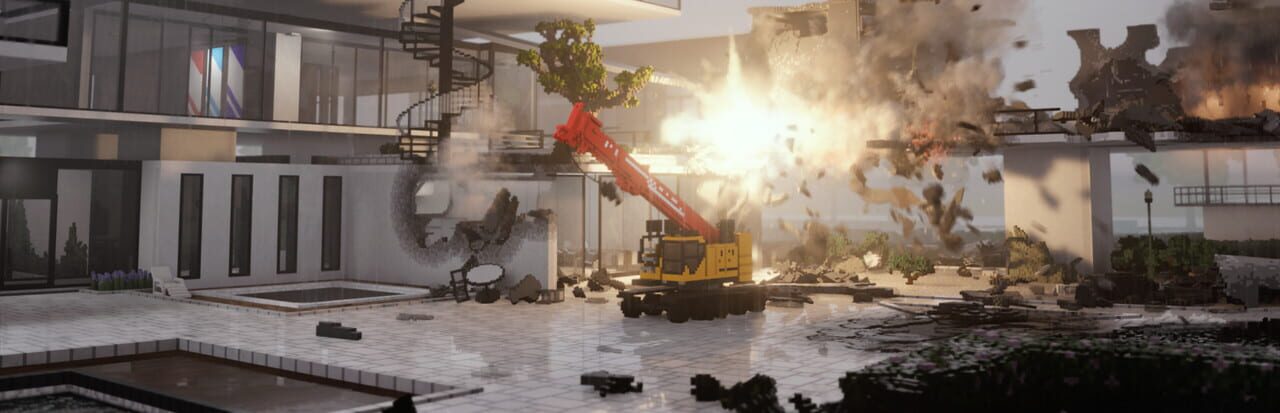
Prepare the perfect heist in a fully destructible, simulated voxel world. Tear down walls with vehicles or use explosives to create your own shortcuts. Shape the environment to your advantage in the most creative ways you can imagine. Play solo or with up to 12 players in multiplayer.
Read moreShow less
Plan and execute the perfect heist in a fully destructible world. In Teardown, anything can be broken, moved, or turned into a shortcut. Take your time and use creative problem-solving, brute force, and everything around you to create an efficient path through the level.
Run, jump, drive, slingshot. Do whatever you need to collect targets, avoid robots, or steal whatever your clients ask for, alone or together with friends in multiplayer. And whatever you do… don’t get caught.
Fully destructible voxel environments
Realistic physics, fire, smoke, water, debris, and vehicles
Huge arsenal of tools and explosives
Story-driven campaign with 40 missions, fun in single player, a blast in multiplayer.
Sandbox mode for unlimited resources and destruction, alone or together with friends
Thousands of community made mods to enjoy!
Campaign
After accepting a shady offer in hopes of saving your demolition business, you’re pulled into a murky soup of revenge, betrayal, and insurance fraud. You soon find yourself stealing cars, demolishing buildings, blowing up safes, avoiding trigger-happy robots and more.
Upgrade your expanding arsenal of tools by searching for hidden valuables scattered around the environment.
Modding
Use the same editor the developers use to create custom maps, tools, vehicles, and game modes. Complete with built-in mod support, Lua scripting, and Steam Workshop integration. Teardown includes detailed example mods you can learn from or build upon, making it easy for aspiring modders to get started. Or just dive in and enjoy the wide range of community-created mods.
Multiplayer
Up to 12 people can play together in an online multiplayer session. Set up a private session for you and your friends or join a public lobby. You can play the campaign, have fun in sandbox mode, or play mods created by the community.
Sandbox
Create chaos in sandbox mode with unlimited resources and total freedom. Experiment, destroy, spawn objects, and play by your own rules.
Art Vandals
A free mini campaign expansion for Teardown featuring five new heist missions set in the quiet village of Tilläggaryd. Introducing new tools like the Paperboy Gun and Jackhammer. Created as a mod, Art Vandals also serves as an introduction to Teardown’s powerful modding systems.
From the game's Steam store page.
THE GAMEQ VERDICT9,997 reviews analyzed
What players are actually saying
1. Summary
Teardown is a first-person game set in worlds built from destructible voxels: you can smash, burn, cut or blow up almost anything, then drive a truck through what's left. That destruction is what players write about most. 47% of longer reviews talk about the physics, the voxels or tearing things apart, and short reviews often say little more than "fun" or "boom". Mods come next: 42% of longer reviews mention them, and some players treat the in-game mod browser, the sandbox and community maps as the main reason they keep playing. Multiplayer, which reviewers describe arriving as a free update in March 2026 after an experimental beta, comes up in 29% of longer reviews, mostly as praise for the co-op campaign and chaotic sessions with friends.
The arguments are about two things. The campaign is less about demolition than the name suggests: most missions are heists where grabbing the first alarmed item starts a 60-second timer, and 15% of longer reviews discuss that structure. Some players call it a clever puzzle game, others a stressful speedrun they never wanted. Performance is the other. 18% of longer reviews talk about it, more often to complain about lag and frame drops during big explosions, fires or heavy mod use than to praise it, though some say it runs surprisingly well on modest hardware. Smaller groups report launch crashes, stutter that some trace to the multiplayer update, expansions that don't work in co-op and buildings that stay up on a single voxel.
2. What keeps coming up
What players praise
Destruction physics and the voxel worldHigh
Players describe cutting through walls with a blowtorch, collapsing towers with propane tanks, burning houses down and watching fire, smoke and water behave convincingly. 47% of longer reviews talk about destruction, physics or voxels, and short reviews are full of it too. Technically minded players single out how the engine keeps up with every change: "it's pretty amazing how it's able to keep track of every voxel I've displaced," one wrote about the quick save. Vehicles get praise as demolition tools, and another reviewer said the game "feels like playing inside a CGI render". The main criticism of the physics itself is structural (see the frustrations below): buildings can stay standing on a sliver of support.
Workshop mods, the sandbox and community mapsHigh
Players list tank and military vehicle packs, tornado and storm-chasing mods, physics guns, planes, nukes and huge community maps such as malls and whole cities, all installed through the in-game mod browser. 42% of longer reviews mention mods or the Workshop, and 21% bring up the sandbox. "Mod support is what actually saves this game from getting stale after twenty hours," one reviewer wrote, and a line that turns up in short reviews is that the game is good alone and better with mods. Modders praise the Lua API and the map editor. On the other side, some feel the base game leans too hard on community content ("99% mods 1% game" was one short positive review), and players with large mod lists report long load times, lag and crashes.
Co-op and multiplayer with friendsHigh
Multiplayer or co-op comes up in 29% of longer reviews, and most of what those reviewers say about it is praise. They describe playing the whole campaign in co-op, splitting objectives among friends and laughing through failed heists, plus prop hunt, deathmatch, car sumo and other community modes. A couple were impressed by how well the physics stays in sync online, and one wrote: "With the multiplayer update, Teardown has finally become what it was always supposed to be." One reviewer noticed that the alarm time drops for each extra player, so missions became impossible with too many friends but were fun with a smaller group. The problems players raise with multiplayer (lag, crashes, griefers, missing DLC support) are covered in the frustrations below.
Looks, lighting and fireMedium
14% of longer reviews praise the graphics, lighting or visuals. Players are surprised by how good a blocky world looks with ray-traced lighting, reflections, rain, smoke and fire, and several note that it runs that lighting without RTX hardware. "A game with voxel physics and ray tracing as its main lighting system that's supported on non rtx cards? I'm SOLD," one wrote. A few reviewers find the mandatory TAA blurry in motion (see the frustrations below).
A digital rage roomMedium
"Rage room of my dreams," one short review read. Others in the same vein call Teardown stress relief, a way to take out their anger or something to unwind with after school or work, and a few parents mention playing it with their children.
Where players are split
The timed heist campaignHigh
In most missions you prepare a route at leisure, cutting holes, parking vehicles and building ramps, then trip an alarm and have 60 seconds to grab everything and escape. 15% of longer reviews discuss the alarm timer or heist structure. Fans call this the heart of the game: "Came for the destruction, stayed for the challenge," one wrote, and another described a puzzle game where "the solution to the puzzle is a hammer and pipe bomb". They praise how maps change between missions, the tool upgrades and the story told through emails and TV news. Critics say the name and trailer promised demolition and found theft runs instead; one suggested calling it "60 seconds!!! The Stress Simulator". They object to fire alarms that punish using the blowtorch, unkillable helicopters and robots, cut power lines that don't switch off alarms, difficulty spikes on some later missions, and movement that makes precise runs a gamble. The negative reviews that make this complaint often come from players only a few hours into the campaign. A few reviewers point out the assist settings and the option to unlock every tool and map without playing the campaign, and at least one said the game felt much more fun after learning about it.
Price, editions and DLCMedium
Plenty of reviewers say the base game is worth the roughly $30 they paid, and others point to frequent sales at around $15 as the time to buy. Others call it overpriced for an indie game, object to Deluxe and Ultimate editions and a season pass they say costs more than the game, and want DLC tools usable in the sandbox without buying the pack. Opinions on the expansions themselves vary: Greenwash Gambit and the free Art Vandals mini-campaign get praise from some, Folkrace's racing divides people, and several players say the DLC adds little that the Workshop doesn't already offer for free. The complaint co-op players raise about the DLC, that expansions don't work in multiplayer, is covered in the multiplayer frustrations below.
Replay value once the campaign endsMedium
Some players report hundreds or thousands of hours and say the game never gets old thanks to mods. Others find that blowing things up wears thin once the campaign is done: "there is only so much fun to be had destroying stuff," one wrote in an otherwise positive review, and a handful call it a tech demo more than a game. Reviewers who got bored often add that friends or mods brought them back.
What frustrates players
Lag and frame drops in big destructionHigh
Reviewers who complain about performance mostly describe the same pattern: the game runs well until a building collapses, a fire spreads or a heavy mod goes off, and then frame rates fall to single digits. Performance comes up in 18% of longer reviews, and short reviews add more complaints ("frame drop simulator", "lag, lag, lag and lag"). "performance is great until it just snaps and suddenly you're at 14FPS," one player wrote. A few technically minded reviewers say the physics runs on a single CPU core, so even top hardware chokes; one with a Ryzen 9800X3D and an RTX 5080 reported "1fps or less with 0% gpu usage". Baseline performance divides people. Some players run it on integrated graphics, old laptops, Linux or the Steam Deck, while others with recent PCs call it unplayable. Players share workarounds: lower settings, switching to OpenGL, and performance or debris-cleanup mods from the Workshop.
Crashes, launch failures and update regressionsMedium
Crash reports run through both short and long reviews: games that hang on the loading screen, black screens, crash-dump loops, crashes when loading maps or running many mods, and PCs that freeze or reboot. Some come from players on low-end laptops, and a few buyers say they refunded. A separate group of long-time players says specific updates broke things: a rhythmic stutter after the multiplayer update that a few tie to AMD X3D CPUs and that some fixed only by switching back to the prev_build 1.7 branch, mods broken by the same update, and quick-loading near a vehicle crashing the game and, in one report, resetting all progress. "As of the multiplayer update, the game now has a consistent repeating framerate hitch, this causes dizziness," one wrote. A few players report audio that stopped working altogether or a cursor that vanishes in menus.
Multiplayer gaps: expansions, player models, mods and griefersMedium
Players who came for co-op list what multiplayer leaves out. The paid expansions are single-player only ("ALL of the expansions are single player only," one group found after finishing the campaign together). Custom player models from the Workshop can't be used online while paid DLC characters can, many mods lack multiplayer support, achievements and campaign progress count only for the host, and there is no built-in text or voice chat. Public lobbies draw complaints about lag, rubber-banding, crashes for non-hosts and griefers: "multiplayer is rampant with griefers," one wrote, and others describe hackers with slur names crashing hosts with no way to block or ban them. A few reviewers asked for crossplay with PlayStation and Xbox friends.
Controls, controller and Steam DeckLow
Controller players describe menus that need a cursor steered with the thumbstick, mod menus that can't be used without a mouse, and custom bindings overwritten by updates. Some Steam Deck owners report input breaking after changing the layout ("Modifying layout is impossible without breaking controls"), while others say it runs well on the Deck. Keyboard players want full rebinding, including interactions on mouse buttons and the numpad.
Buildings held up by a single voxelLow
Some players miss structural integrity: a building stays up as long as any voxel connects it to the ground, so towers hang on one brick or sink straight down instead of toppling. "a single voxel in a far corner of a building is enough to keep it intact," one reviewer wrote. Several recommend structural-integrity mods, though one says those mods can't run fast enough.
Motion sickness, blur and flashing lightsLow
A small group can't play for long because of motion sickness despite the head-bob and blur settings, and others find the TAA blurry or smeary. One player asked for an option to tone down the flashing alarm lights after they triggered a seizure.
Terms of useLow
A few negative reviews object to a new EULA that players were asked to accept after buying the game, quoting clauses that let the publisher end access to the game and require arbitration.
3. The player conversation
The tone is loud, young and often joking. A large part of the short reviews are one-word ratings, keyboard mashes, copypasta or jokes about real-world disasters, and some players say they found the game through YouTubers. The longer reviews are more thoughtful, and some of the critical ones open by praising the engine before turning on the campaign or performance. A couple of negative reviewers say they would have picked a neutral rating if Steam offered one.
Expectations drive much of the split. Players who came to tear buildings down, often only a few hours into the campaign, write the heist and timer complaints, while players who settle in describe a puzzle or immersive-sim game and some finish it with every optional objective. Long-time players with large mod libraries write about mods broken by updates, the move toward paid DLC and editions, and stutter after the multiplayer update. Sentiment held steady through 2026: every week from mid-January to early October 2026 recommended the game at between 91% and 98%, and reviews written around the March 2026 multiplayer release mix co-op praise with early reports of crashes, lag and griefers in public lobbies.
4. What the developers could do
- Spread physics work across CPU cores and soften the big-destruction slowdown. The most detailed performance complaints describe single-digit frame rates with an idle GPU when large structures collapse, even on top hardware.
- Fix the post-multiplayer-update stutter and the launch crashes. Players report a rhythmic hitch that some tie to AMD X3D CPUs and fix only by rolling back to the 1.7 build, plus games that hang on loading or loop on crash dumps.
- Make the campaign's flexibility visible up front. Some timer critics didn't know about the assist settings or that tools and maps can be unlocked in the options, and at least one reviewer enjoyed the game much more after finding out.
- Add more pure demolition jobs and let creative answers to alarms work. Critics ask for missions where tearing a building down is the goal, and expect cutting the power or carrying the alarmed object away to beat an alarm.
- Bring the expansions, custom player models and more mods to multiplayer. Co-op buyers were surprised the paid expansions are single-player only, and they object that Workshop player models are blocked while paid DLC characters are allowed.
- Give hosts moderation tools and built-in chat. Public-lobby players describe griefers and hackers with slur names crashing servers with no way to block or ban them, and ask for text or voice chat.
- Finish controller, Steam Deck and rebinding support. Controller and Deck players describe cursor-driven menus, layouts that break input and bindings reset by updates, and keyboard players want every action rebindable.
- Offer an optional structural-integrity mode. Players want buildings to topple when their supports are cut instead of hanging on a single voxel.