Timberborn
Mechanistry · Simulation, Survival, City Builder
RELEASE MILESTONES
Dates from IGDB release data
Overview
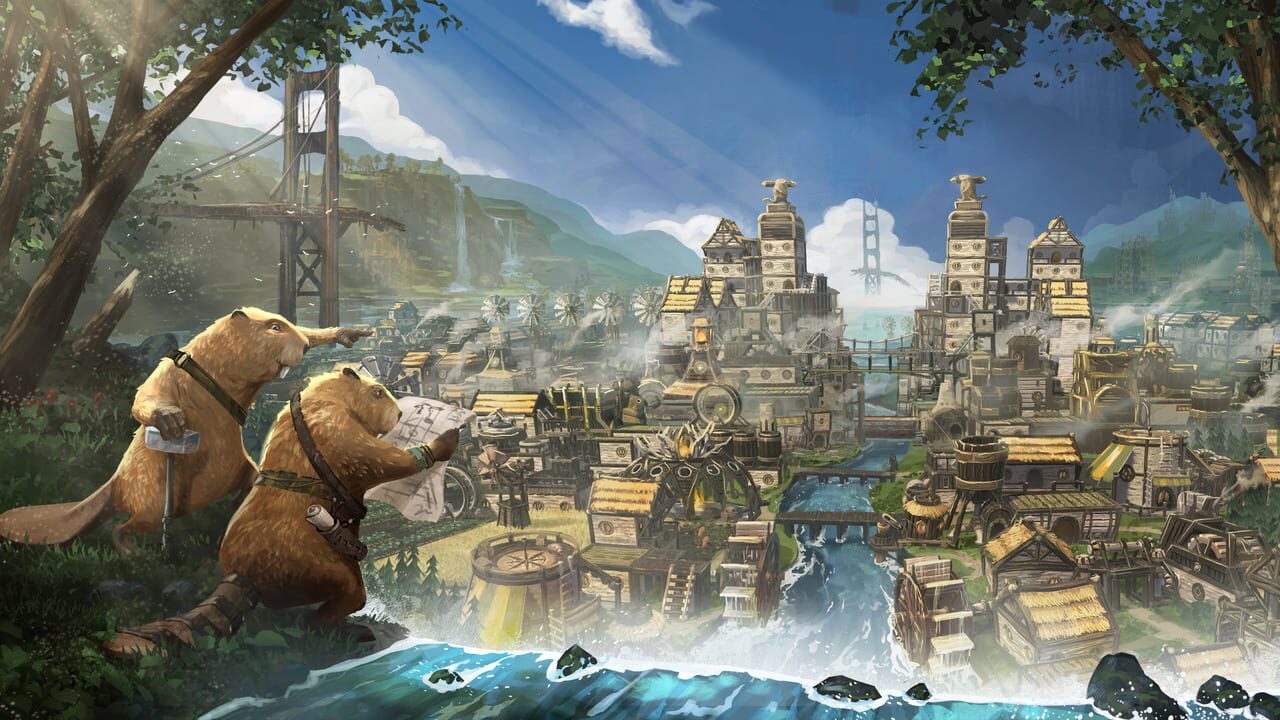
Humans are long gone. In a world struck by droughts and toxic waste, will your lumberpunk beavers do any better? A sandbox city-building game featuring ingenious animals, vertical architecture, water physics, and terraforming. Contains high amounts of wood.
Read moreShow less
Mankind turned Earth into a dry wasteland and perished, but some species adapted and evolved. Pick one of the beaver factions and see how long your colony can last.
Beaver societies
Control one of two beaver factions: the nature-friendly Folktails or the industrious Iron Teeth. Each faction has unique buildings, technology, and gameplay traits. Choose what fits your playstyle!
Wet, dry, and toxic seasons
Prepare your settlement for recurring droughts and waves of toxic waste. Stockpile food and keep fields and forests alive even after rivers dry up. Rely on both natural water sources and artificial irrigation to keep the land arable and your beavers safe.
Water physics and terraforming
Beavers’ engineering skills are legendary. With Timberborn’s 3D water physics and terraforming, so can be yours. Put up dams and floodgates, erect massive aqueducts, dig canals and tunnels with explosives, and reshape the terrain to your liking.
Vertical architecture
Harness the game’s unique vertical architecture system. Space is limited, so stack lodges and workshops on top of each other. Construct platforms and bridges, set up an elaborate power grid, and let your beavers speed around on ziplines or through tubeways.
Lumberpunk
Turn timber into sophisticated machinery – from water wheels and lumber mills to engines and mechanized pumps. Wood is the core resource in Timberborn, but the most advanced structures require metal. To find it, send your scavengers to the ruins of the old world.
Automation
Automate tasks across your settlement by creating an intricate system of sensors, relays, counters, and other tools for advanced engineers. Self-controlling dams and factories are just the beginning.
Bots
Supercharge your colony with mechanized beavers. Power them up, maintain them, and you'll get extra-efficient workers for almost any job. They operate 24/7, and you can send them to the most hazardous areas.
Well-being
Build a sprawling city with efficient production chains and follow the lives of its inhabitants day and night. As the population grows, satisfy your evolved rodents with a balanced diet, entertainment, decorations, and end-game monuments that help restore the Earth.
Map editor and mods
Play on one of the included maps or create your own and share it with the community. On top of the built-in map editor, Timberborn features official mod support. Tons of extra player-made content and quality-of-life additions are available, with more coming each day.
From the game's Steam store page.
THE GAMEQ VERDICT10,000 reviews analyzed
What players are actually saying
1. Summary
Players are close to unanimous about Timberborn: 96.2% of these reviews recommend it. What they describe is a city builder organised around water. You dam rivers, build reservoirs to last through droughts, route toxic badwater off the map, and later blast tunnels and stack whole districts on top of each other, all with beavers players find hard not to care about. Droughts and badtides give the early hours real stakes, difficulty settings let each player pick a cozy build or a punishing survival run, and some reviewers describe losing whole evenings to it. Long-time players credit years of early-access updates with deepening the game; by their account those brought 3D water and aqueducts, then ziplines and tubeways, then automation tools at the 1.0 release in March 2026.
The main reservation is about what comes after the water is under control. Once a colony has a big enough reservoir and a way to divert badtides, some players say the danger fades and the game turns into an open sandbox with no campaign and few goals beyond each faction's wonder. Thumbs-down reviews give this reason more often than any other, and some positive reviews mention it as their one caveat. Newcomers add a tutorial that stops before dams and badwater, a slow early pace, and big colonies that stutter.
2. What keeps coming up
What players praise
Water physics, dams and terraformingHigh
The water simulation, and the dams, reservoirs, levees and floodgates it drives, come up in 24% of longer reviews, more than any other topic. Players describe the core puzzle with obvious relish: keep a river's water on the map through the dry season, spread it to turn barren ground green, and use its flow to turn water wheels for power. One sums it up as "This is a logistics and fluid dynamics game for true sickos." Dynamite, tunnels and aqueducts push the puzzle further, and another reviewer writes "I'd go as far as to say that this game only truly starts once you've unlocked explosives." Several compare it to damming streams as a child. The criticism here is mild: a minority find the flow hard to predict, with reservoirs that slosh or overflow after a small change upstream.
Droughts and badtides give it stakesHigh
Droughts and badtides, raised in 15% of longer reviews, are mostly described as the source of the game's tension. Players enjoy racing to finish a dam before the dry season and watching whether their stores hold: "The best moments come when a bad tide is approaching and suddenly everything becomes a race against time." Stories of colonies collapsing to a handful of beavers after a long drought are told fondly, as lessons that make the next settlement better. The late-game complaint starts here too (see below): once a reservoir and a diversion are built, these events stop threatening anything.
Chill or punishing, your choiceHigh
Reviewers call the game relaxing, cozy or chill in 12% of longer reviews, and some praise how far the difficulty can be tuned, from drought and badtide length to consumption rates, down to switching hazards off entirely. One puts it as "it can be as intense or chill as you want", and a reviewer comparing it with other colony sims notes "You won't really get any of the crazy doom spirals you get in other colony sims." Some name the absence of combat as a draw. Several warn that the jump from normal to hard is large, with hard mode demanding near-perfect early planning.
Beavers with personalityHigh
The beavers themselves are called cute, adorable or charming in 12% of longer reviews. Players point to the small touches: work hats, tail tattoos, ziplining beavers, chatter when clicked, mud baths and dance halls, and the way happier beavers work faster and live longer. Colony deaths sting as a result, and one reviewer writes "This game achieved something previously unimaginable: getting me invested in rodents."
Mods, workshop maps and the map editorHigh
Mods, the Steam Workshop or the map editor come up in 9%. Players value built-in workshop support, community challenge maps, extra factions from modders, and fixes such as ladders, faster speed settings and a co-op mod. The catch, covered under frustrations, is that game updates can break the mods people rely on.
Hard to put downHigh
In 8% of longer reviews the game is called addictive, or the reviewer tells of looking up to find it is 3 a.m. Several tie the "one more cycle" pull to always having a project half-finished before the next drought. One writes "This game eats hours faster than a Langolier", and several say they uninstalled for a while to get their evenings back.
Steady updates through early accessMedium
Praise for the developers, for listening to feedback and for regular, substantial free updates, appears in 7% of longer reviews, and several early buyers edited their reviews at 1.0 to say the game had grown well past what they first played. One calls it "A model for how EA should be." A small group of early buyers argues the opposite, that years of updates added buildings and systems while leaving the core loop unchanged.
Building upwardMedium
Vertical building gets its own praise in 6%: stacking houses, warehouses and workshops, platforms and overhangs, and later ziplines between levels. Players enjoy packing a district into a small patch of irrigated land, and one writes that "the grid feels more like a tetris board". The friction points are stairs that take up space and a camera that makes deep stacks hard to work in.
Where players are split
The 1.0 automation tools and the sluiceMedium
Automation (sensors, relays and levers that can open floodgates or pause buildings on conditions) comes up in 6% of longer reviews, and most of that talk is approving. Players say it removes the chore of flipping floodgates every season: "Automation is a super nice add-on to this". A smaller, vocal group of veterans objects. Reviewers report the simple sluice gate was pulled shortly before 1.0, briefly restored after pushback, and later removed for good, and some say its replacement demands logic they never wanted: "completely removing the Sluice artificially raises the game's complexity floor". Another admits "the logic gate automation made me uninstall the game". Mods that restore the sluice exist, though some note they broke with later updates.
Two factions, and calls for moreMedium
Requests for more factions appear in 4% of longer reviews, usually in reviews that otherwise praise the game. On whether the existing Folktails and Iron Teeth play differently, more reviewers say yes than no, pointing to Iron Teeth breeding pods, tubeways and industrial power: "the two factions are far more unique from one another than I would have imagined". Others disagree: "I tried the 2nd faction and they play essentially the same." A few add that newer map features suit one faction better than the other.
Is it worth the price?Medium
Value comes up directly in about 3% of longer reviews, and more of those call the game worth the money than not; "33.99€ is a steal" is one example. Reviewers note the price went up to $35 during early access, and a minority think that is too much for a sandbox with this much waiting, as in "Interesting Idea, but not worth $35." Buying on sale is the usual compromise suggested.
Badwater and the harder edgeLow
Badwater is usually discussed as the challenge that keeps maps interesting. A handful of long-time players say its arrival during early access changed the mood they came for: "badwater changes this game from a casual city builder to something I no longer like". Several of them note that badtides can now be switched off in custom settings.
Mac, Linux and Steam DeckLow
Players on Mac and on Linux through Proton mostly report the game running well. The exceptions are scattered: a late-2025 update that broke mouse dragging under Proton until a fix landed, mods not loading on some Macs, and Steam Deck play that works best with a custom control layout.
What frustrates players
Little to do once the water is solvedMedium
Thumbs-down reviewers give this reason more than any other: 29% of the longer ones say the challenge disappears or the game lacks goals, and some positive reviewers raise it as their one caveat. The pattern they describe is consistent. Build one large reservoir, divert the badwater source, stockpile food, and nothing can threaten the colony again: "once you solve the water issue, you have nothing else to do". Wonders read to them as long resource sinks, and there is no campaign or scenario structure. One reviewer writes "The game optimizes itself out of being fun." Players ask for floods, storms, random events or map-specific objectives, and some say harder challenge maps with late threats help. Fans counter that setting your own goals is the point of a sandbox.
Thin tutorial and a steep startMedium
Complaints that the game leaves too much unexplained appear in 4% of longer reviews, and players send each other to YouTube and the wiki. The tutorial covers food, water and housing, then stops: "The tutorial stops before many mechanics are taught." Dams, badwater, districts and automation are the gaps named most often, and one player calls the tutorial "ABYSMAL" outright. A smaller group likes that it leaves discovery to them. These complaints come mostly from players in their first sessions, some of whom refunded.
Slow pacing and waitingMedium
Waiting is the complaint in 3% of longer reviews and 12% of longer thumbs-down reviews. Trees take days to grow, early science is slow, wonders take hours to build, and reviewers say 3x is the top speed, so players describe idling or leaving the game running overnight: "out of every 10 minutes you will spend 7 minutes staring at the screen waiting for things to happen". Others like the slow rhythm as background play.
Big colonies slow downMedium
Frame drops and stutter as colonies grow show up in 3% of longer reviews, usually from a few hundred beavers upward and even on strong PCs, along with a pause on every autosave: "peaking over 300 population continues to degrade playability". A few players suspect pathfinding that leans on a single CPU core. Several note steady improvement across updates; one long-running review tracks a heavy save going from unplayable to 60 fps by March 2026.
Crashes, lost saves and broken mods after updatesLow
A small group reports crashes when loading saves or in the late game, saves lost after updates, and mod setups wiped out by patches: "last update broke every single mod in this game". The autosave system draws its own complaints for keeping only a few recent slots with no setting for interval: "Autosave is a joke."
Missing building conveniencesLow
Players list tools they expected: hotkeys for buildings, moving a building without demolishing it, deleting paths in bulk, copying settings between buildings, and production and consumption statistics. "No, you can also not relocate buildings." Some of these are covered by mods.
Fixed maps and no random generationLow
Once players know the official maps, they want variety: "we obviously need random maps". The workshop fills part of the gap.
Beavers that strand or starve themselvesLow
Beavers that wall themselves in during construction, wander through badwater, or go hungry next to full storage frustrate a minority, as does a priority system that cannot force workers into a critical job: "I've watched a beaver walk past three food sources, a water pump, and his own house". Some treat it as comic rather than game-breaking.
No built-in co-opLow
A steady trickle of players want official multiplayer to play with a partner or friend; "MAKE MULTIPLAYER PLS." is the plain version. Some already use a community co-op mod and call it workable but rough.
The district systemLow
Running several districts with import and export settings feels like busywork to some: "The district system feels finicky." Some avoid districts entirely, and several say ziplines and tubeways made one large district practical.
A quiet soundscapeLow
A few players miss construction and work sounds, "beaver hammer doesn't go bonk bonk while building", and some find the soundtrack too short. Others single out the music as a highlight.
3. The player conversation
The tone is affectionate and playful. Many short reviews are one-line jokes about beavers, wood and dams, the Polish "bober kurwa" meme keeps turning up, and longer reviews often read as colony diaries about famines survived and dams that flooded the town. Thumbs-down reviews are rare, and much of the criticism sits inside recommendations as a single caveat about the late game, the tutorial or performance.
Complaints about the tutorial, the lack of direction and the slow start come mostly from people in their first sessions who expected a goal-driven builder. Players with long early-access histories focus on specific design changes (the removal of the sluice, the arrival of badwater, mods breaking between versions) and on performance once their colonies grow large. About 8% of longer reviews compare Timberborn with another game, most often Factorio, Banished and Cities: Skylines. Fans frame it as Banished with water engineering or a gentler Factorio, while detractors point to Factorio, Oxygen Not Included or Against the Storm as deeper. Some reviewers credit the YouTuber RealCivilEngineer with introducing them to the game.
Sentiment barely moved across the 1.0 release: reviews written during early access ran 96.6% positive and those written afterwards 95.6%. After 1.0, complaints about missing goals took a slightly larger share of longer reviews (2.5%, against 1.7% during early access), and the automation changes became a new argument among veterans.
4. What the developers could do
- Add pressure and goals after the first reservoir. The reason thumbs-down reviews give most often is that the game stops threatening the colony once water is stored and badwater diverted, and players ask for floods, storms, random events, scenario maps or objectives that keep later cycles tense.
- Teach the water systems in the game itself. New players say the tutorial ends before dams, badwater diversion, districts and automation, and they end up learning the core mechanics from YouTube and the wiki.
- Cut the dead time. Reviewers describe idling at 3x speed while trees grow, science accumulates and wonders build, and several ask for a faster speed tier or quicker late-game construction.
- Keep large colonies smooth. Players report stutter and falling frame rates past a few hundred beavers, plus a hitch on every autosave, even on high-end PCs.
- Protect saves and mods across updates. A smaller number of reviews report lost saves, crashes when loading, and mods broken by patches, and players want more autosave slots and a configurable interval.
- Fill in the building tools. Players want building hotkeys, moving a building without demolishing it, bulk path removal, copying settings, and production and consumption statistics.
- Give veterans a new faction. Requests for a third faction come from players who love the game and feel they have seen what the two current factions offer.
- Keep a simple water-control option next to automation. The veterans upset about the sluice's removal want a one-building way to manage badtides that does not require wiring logic.