Wandering Sword
Xiameng Game · RPG, Open World, Adventure
Overview
Wandering Sword is a Chinese martial-arts RPG where you play a young swordsman caught up in a feud and nearly dies. Escaping the event puts you on the path of pursuing the highest form of martial arts and exploring the pugilistic world to become the great hero you are always destined to be.
Read moreShow less
Journey through over 75 breathtaking locations across 5 diverse regions, each echoing the richness and allure of ancient China's tradition and landscape. Explore a world filled with bustling ancient Chinese towns, scenic mountains, picturesque rivers, dangerous lairs, treacherous terrains and more!
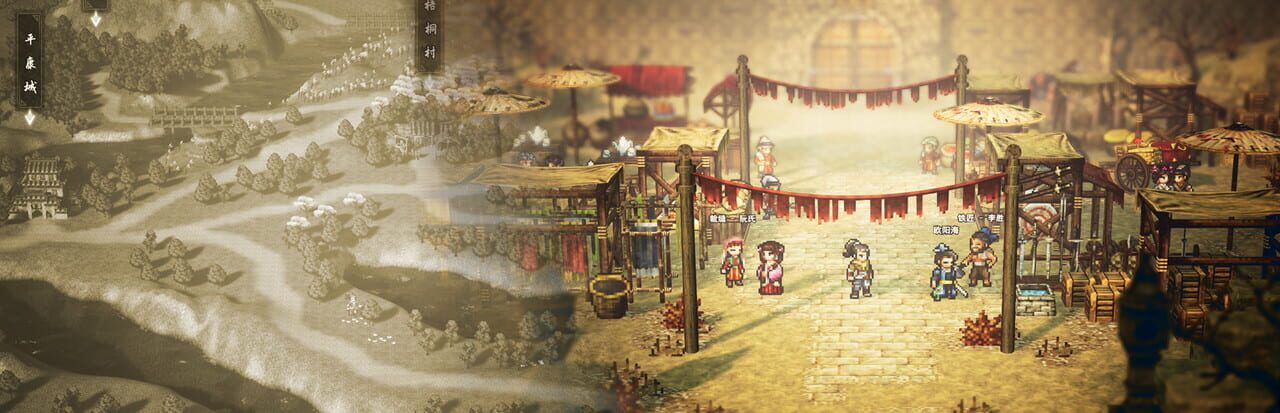
Utilizing Unreal Engine 4, Wandering Sword portrays a captivating blend of traditional pixel art graphics seamlessly layered onto immersive 3D landscapes. Drawing upon the charm of classic pixel-based martial arts games, the game infuses modern visual effects to elevate every moment in its Wuxia world.
Wandering Sword introduces an innovative combat system that operates on a tiled board and offers players the flexibility to switch between turn-based and real-time mode. This dual mode approach caters to both traditional RPG players who prefer a slower pace and those who enjoy real-time action that demands quick reflexes.
Wandering Sword brings to life a diverse array of martial arts moves and weaponry. As you traverse the land, you'll unravel hundreds of martial arts techniques and weapon styles. Cultivate your energy through meridian points, gain expertise in both external and internal forms, and achieve true mastery of martial prowess.
In Wandering Sword(逸剑风云决), building relationships with NPCs is an integral part of your journey. Recruit up to 14 unique martial artists to join you on your adventures, each with their distinctive abilities. Who knows, you may even find love in this intricate world of martial arts!
Delve into an immersive Wuxia adventure with Wandering Sword. Boasting multiple endings shaped by your choices you make and a plethora of side quests that supplement the main storyline, enjoy over 20 hours of engaging gameplay that promises high replayability and a fresh experience with each adventure.
From the game's Steam store page.
THE GAMEQ VERDICT2,525 reviews analyzed
What players are actually saying
1. Summary
Wandering Sword is a wuxia RPG that players treat as the game they had been waiting for: a young man with no martial skills grows into a master, in a pixel-art Ancient China whose look reminds many of Octopath Traveler. 66% of the longer reviews talk about the story and 29% praise it outright, with several singling out the side quests and the recruitable companions. 47% frame the game through wuxia, jianghu, manhua or Jin Yong novels. Progression is the other big draw: players learn techniques by gifting, sparring with and consulting the NPCs who know them, then feed points into cultivation methods and meridians. They also like being able to switch between turn-based and real-time fights, the auto-battle, and how much game the low price buys.
Most of the frustrations appear inside positive reviews. The warning players give most often is about missable content: 16% of longer reviews bring up companions, quest branches or good endings that can be locked out without notice, or tell new players to keep a guide open. Combat divides players. Some love it, while others find that once a build comes together the fights turn into a stat check the game can play on auto. Menus and controller support draw steady complaints, and the English translation gets about as much criticism as praise. Complaints about a rushed ending, no new game plus and no difficulty options are mostly from launch; later reviews credit updates and two expansions, Southern Chronicles and Echoes of Ash and Dust, which reviewers describe as free.
2. What keeps coming up
What players praise
Story, side quests and a large cast of charactersHigh
66% of longer reviews discuss the story, and 29% call it good, great, gripping or rich in so many words. Players describe a classic zero-to-hero wuxia plot with betrayals, old sins and sect politics, and several say it pulled them in after a slow opening. One player admired how late chapters pay off early threads: "At like hour 70 of play stuff comes up that references the first 3 hours of the game." The side content gets as much love as the main line. 6% single out the side quests as a highlight, with the Beggars' Sect, Detective Leng and Nanjiang storylines named in several reviews, and 9% praise the companions as memorable or well written; a few note that optional recruits change how main story scenes play out. Criticism within the theme: the main plot follows familiar genre tropes, the hero is a naive do-gooder (2% call him bland or naive), and some optional companions go quiet after their recruitment quest.
An authentic wuxia and jianghu fantasyHigh
For the 47% of longer reviews that talk about wuxia, xianxia, murim, manhua or Jin Yong, the setting is the reason to buy. They praise the sects (Wudang, Shaolin, the Beggars' Sect), the Taoist and Buddhist philosophy in the dialogue and the feeling of living inside a martial arts novel. One reviewer described it as "just the feeling of playing through a Jin Yong story as if I were the protagonist". Players new to the genre are positive too, though some warn that the terminology and the stream of Chinese names take a few hours to absorb. A couple of reviewers caution that the game is a harder sell for anyone with no interest in wuxia, and one rates it a 6/10 for those players.
Learning martial arts from the people you meetHigh
19% of longer reviews discuss the progression system, mostly with praise. There are no character levels: you earn martial points from fights, spend them on techniques for five weapon types, and gain meridian points by leveling cultivation methods. New techniques come from manuals, story events or NPCs who teach you once their affinity is high enough. Players enjoy the climb from weakling to grandmaster: "You start off as a homeless bum with no skills and by the end of the game you're a kung fu god." The gift-and-spar loop is a running joke, mentioned in 10% of longer reviews: you raise an NPC's affinity with gifts and then win the gifts back in a spar, "until they cough it all back up along with everything else they own." On the downside, players say the system is poorly explained in the opening hours and the meridians take grinding late in the game.
HD-2D pixel art and presentationHigh
26% of longer reviews praise the visuals, and 12% mention Octopath Traveler, mostly to say the art looks like it. Players single out the bamboo forests, snowy mountains, busy towns and the hand-drawn character portraits. One called the locales "some of the best I have seen in any HD-2D game". A minority think the pixel style looks cheap, blurry or unoriginal, and one Chinese-language reviewer found the coarse pixels hard on the eyes.
Turn-based or real-time, with auto-battleHigh
Players are grateful for the combat modes, which come up in 17% of longer reviews. You can fight turn-based for hard battles and switch to real-time auto at 2x speed for trash mobs, which players say takes the sting out of grinding. One wrote that these options "make this game the first turn-based rpg I've enjoyed in awhile". The complaints are that the auto AI is weak, ignoring buffs and wasting area attacks, and that at launch you could not switch modes inside a fight.
Lots of content for the priceMedium
When the 17% of longer reviews that bring up price or value do so, it is to say the game gives more than it costs. Players describe first playthroughs of 50 to 100 hours, and some say they would have paid more: "For the price this game is at, it's almost criminal that it's this good." One reviewer in Malaysia felt the regional price was too high.
Developers who kept improving the gameMedium
11% of longer reviews credit the developers with listening to feedback and patching fast, a share that was highest in the launch months (14% of longer 2023 reviews). Reviewers list auto-battle, 2x speed, fast travel, a world map, new game plus, harder difficulties and achievements as additions after release. "I made a comment asking for auto-battle. The very next update, they added auto-battle," one player wrote. The two story expansions, Southern Chronicles and Echoes of Ash and Dust, are named as having fixed a weak late game, and one player says the content expansions took the game "from a 6/10 to a 9/10".
MusicMedium
14% of longer reviews mention the soundtrack, warmly, especially the boss themes and the quieter traditional pieces. Variety is the catch. 2% say the tracks repeat too often, one noting that after the first stretch "the music repeats way too often", and one found an upbeat theme playing over a dramatic death scene.
Where players are split
Combat depth and difficultyHigh
Combat comes up in 40% of longer reviews. Fans enjoy grid tactics with back and side attacks, five weapon styles and builds that stack passive buffs; one wrote "I will never get sick of dropping Thunderbolt Swordplay on people". The critics make two linked points: some call combat shallow, repetitive or a stat check on flat maps with no terrain, and somewhat more say the game becomes too easy once you collect cultivation methods, leaving later fights to auto-battle. "I think the final boss hit me once," wrote one player. Others report the opposite problem, sudden boss fights or forced 1v1 duels far above their power. A few blame expansion items, especially from Secrets of the Eastern Sea, for breaking the power curve, and one points out that the difficulty can't be changed without starting a new game. Weapon balance draws a smaller set of comments that favor swords: "Sword MC is just plainly better than all the alternatives," wrote one, while hidden weapons and polearms are called underpowered or short of manuals. Players who enjoy feeling unstoppable see that as the point of a cultivation story, and players who want a challenge recommend Hard or Extreme from the start.
Grinding and craftingHigh
17% of longer reviews talk about grinding, and they split. Some enjoy an old-school grind made painless by auto-battle; others resent repeating spars for one item, stamina limits on gathering and consulting, and slow crafting levels. "The combat is also way too slow considering how little exp you get per battle," wrote one critic. Crafting divides players too: some say crafted gear with extra affixes beats anything you find, while a few call cooking, fishing and alchemy pointless busywork.
Replay value and new game plusHigh
15% of longer reviews discuss replaying, new game plus or the inheritance system. Supporters point to the endings (several reviewers count 20), branching quest outcomes and inheritance points that let a second run start stronger on Extreme difficulty. Skeptics say the main story is too linear and too long to replay, and that chasing every ending for the achievements is exhausting. Early reviewers note there was no new game plus at launch, and several listed it as their main request.
The English translationMedium
14% of longer reviews comment on the translation, split about evenly: 5% praise it as good or surprisingly solid for a Chinese game, and 5% call it rough, stiff or awkward. Critics point to modern slang in a historical setting, flat poetry and odd grammar; one joked that "The amount of people who 'hehe' at you is simply disturbing." Defenders say it beats most wuxia translations, with one calling the translation quality "surprisingly well-done". A few early quitters dropped the game over the writing in the first hour.
A linear main story with one sect and set romancesMedium
7% of longer reviews call the main story linear or ask to join a sect other than Wudang, and 4% bring up the romance or harem endings. Some players like the focus, since a fixed, righteous hero lets the writers tell one story well. Others want to play a villain or choose their own path: "I wish the game let you pick your sect, sadly it doesn't." The main romance is criticized as forced ("The game kind of shoves the heroine down your throat," one player wrote), and several wish favorite side characters had their own routes.
What frustrates players
Missable companions, endings and hidden triggersHigh
16% of longer reviews raise missable content or the need for a guide, often as advice to new players rather than as a complaint. The share rose over time, from 9% of longer reviews written in 2023 to 22% of those from 2024 on. Players describe companions who become unrecruitable if you advance the main story, quest steps that never appear in the journal, and region endings that depend on having specific companions or affinity levels. "Quests absolutely require guides because many of them have hidden subquests," wrote one player who still recommends the game, and a negative reviewer put it as "There is quite literally zero margin for error". Players disagree on what to do about it: some say to keep a companion guide open from the start, others insist you should "do your first playthrough completely blind" and treat the misses as reasons to replay. One player adds that good English guides are hard to find.
Clunky menus and controller supportMedium
5% of longer reviews complain about the UI, menus or controller, and these complaints turn up more often in negative reviews than in positive ones. Players describe menus built for mouse and keyboard, awkward controller navigation through meridian and party screens, teaching techniques to companions one by one, a cluttered inventory and tooltips that cover the screen. "The UI is frustrating to navigate, especially with a controller," wrote one player who still recommended it. A few Steam Deck players say the menu text is too small to read comfortably, while others report the game runs well on the Deck.
A rushed ending, mostly at launchLow
4% of longer reviews say the ending felt rushed, abrupt or anticlimactic, a complaint much more common at launch (6% of longer 2023 reviews) than later (2%). Early players wanted epilogues for their companions and a way to keep playing after the final boss. Later reviewers credit Echoes of Ash and Dust with expanding the final arc, though one late-2024 review still found that "the ending felt rushed and a bit disappointing".
Scripted losses and companions who keep leavingLow
A small number of longer reviews object to story fights you are scripted to lose even after winning them, which one player called the "win the fight, lose the cutscene" problem. A related complaint, from a few reviews, is that story companions join and leave the party constantly and are absent from key boss fights, so investing in them feels wasted; one negative review said in about half the boss fights your teammates "just don't even show up".
Too many names to keep track ofLow
2% of longer reviews find the number of Chinese names, sects and places hard to follow. "Personally I found the names of many characters hard to memorize," one player wrote, and a few ask for an in-game glossary or name tooltips.
Scattered technical problemsLow
A small number of reviews report crashes, a game that switched to Chinese after a patch, high GPU or CPU use for a pixel-art game, no ultrawide support and, early on, controllers that did not work at all. One isolated report described the game filling a system drive with log files.
3. The player conversation
93% of the longer reviews recommend the game. A typical long review lists what the writer loved and then a few gripes (missables, menus, balance), and the gripes usually come with advice for new players. Wuxia and manhua readers make up much of the conversation, while a smaller group compares the game with Hero's Adventure: Road to Passion or with classic JRPGs like Suikoden.
Negative reviews are few, and they come from two groups. Players who quit in the first couple of hours cite the UI, controller navigation, the opening's flood of names and terms, or the translation. Negative reviews from players with dozens of hours complain about missed content locking them out of endings, railroaded story beats, scripted losses and combat that stopped mattering once they were overpowered.
Over time the mood shifted slightly. Reviews written in September and early October 2023 were 97% positive, and their requests centered on missing features: new game plus, difficulty settings, fast travel, a map and a longer ending. Later reviewers say most of these arrived in updates through 2023 and 2024, and complaints about the ending became rarer. Reviews written in 2025 were 94% positive and those written in 2026 were 92% positive, with the remaining criticism shifting toward missable content and the UI.
4. What the developers could do
- Flag missable content inside the game. Missable companions and endings are the warning players give most often, and they ask for warnings before points of no return, journal entries for time-limited companion quests and town markers for available side quests.
- Rebuild the menus for controller and small screens. UI and controller complaints appear more often in negative reviews than positive ones, and players ask for direct navigation in meridian and party screens, bulk teaching of techniques, better inventory sorting and larger text on the Steam Deck.
- Retune the power curve and allow difficulty changes mid-run. Critics say fights become trivial once a build comes together or after picking up expansion gear, others hit sudden boss spikes, and one player regrets that the difficulty can't be changed without starting over.
- Let wins in scripted fights count. Players who beat a boss only to lose in the cutscene call it immersion-breaking, and they suggest either real cutscenes or different story outcomes for victories.
- Give non-sword weapons more manuals and late-game power. Several players say the story and rewards push swords, while hidden weapons and polearms lack early manuals and fall behind late.
- Give an editor a pass over the English text. The translation splits readers, and the critics point to specific fixable problems: modern slang, flat poetry and grammar slips.
- Expand the soundtrack and give companions more presence. Players ask for more battle themes and fewer repeated loops, and for epilogues, banter and fewer join-and-leave interruptions for the companions they invested in.