Graveyard Keeper II
Lazy Bear Games · Sandbox, Automation
Overview
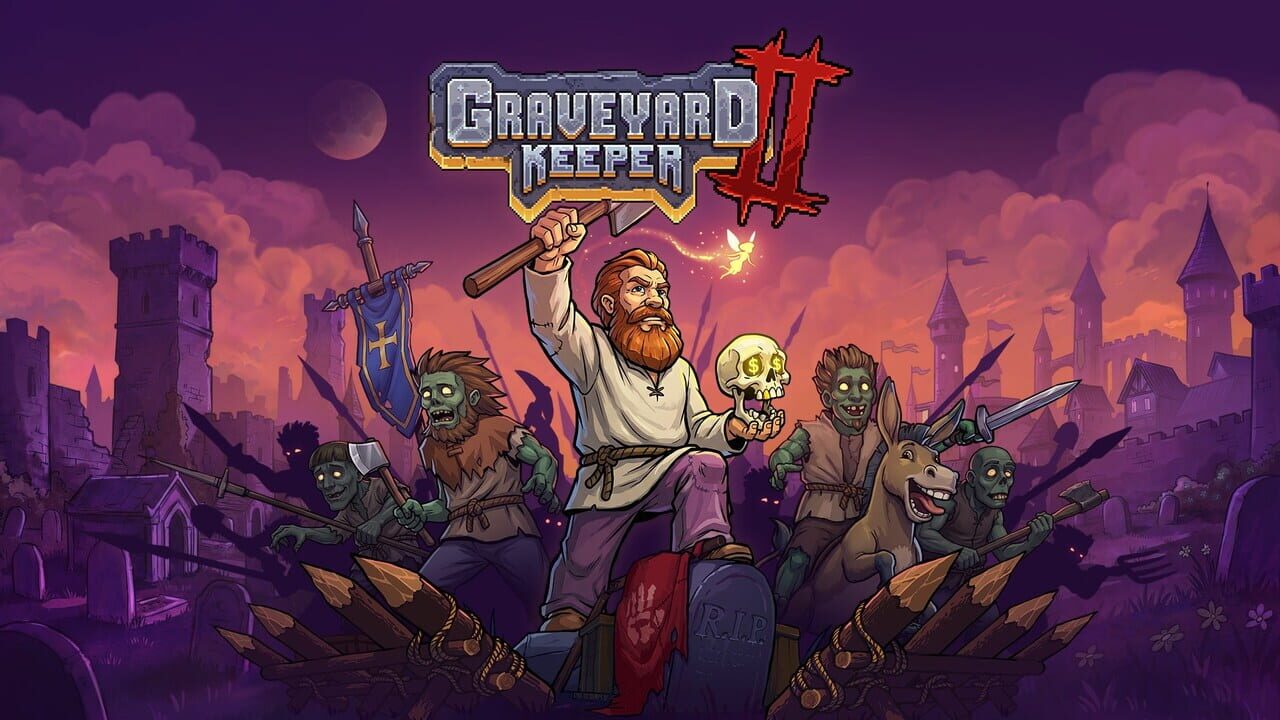
The most inaccurate medieval cemetery sim is back! Restore The Town, manage the graveyard, automate production, lead your undead army into battle and turn the zombie problem into a thriving business! Graveyard Keeper 2 is the grotesque sequel that's deeper than six feet, and more unhinged than ever!
Read moreShow less
You are the Grand Inquisitor now! Restore the Town and lead your undead army into battle to save the realm from a zombie apocalypse. Welcome to Graveyard Keeper 2 - the sequel to the original, unhinged classic!
Automate your production like never before
Lead your zombie army into battle and fortify the Town against the undead
Rebuild The Town and milk its residents for maximum profits
A world full of unhinged humour, grotesque characters and a twisted story
Build and manage your own medieval graveyard. Harvest as much flora, fauna, and human remains as you can to build extraordinary machinery, automate production, and expand your graveyard for pure profit.
Become the Inquisitor and lead your undead army into battle to save the Kingdom from a zombie apocalypse. Build towers and fortifications, craft powerful armour and weapons, arm and train your not-so-smart troops, and slash your way to victory!
Help the townsfolk restore their homes and turn their problems into revenue. Complete quests throughout the city, as your undead workers take care of the heavy lifting behind the scenes. With zombie-based automation and structured systems, you can transform local efforts into a scalable and profitable operation.
From the game's Steam store page.
THE GAMEQ VERDICT3,140 reviews analyzed
What players are actually saying
1. Summary
80% of the reviews recommend Graveyard Keeper II. It keeps the first game's loop of processing corpses, preaching sermons and crafting everything from raw materials, and it removes a lot of what made that loop a chore: fast-travel waypoints with no cooldown, quest characters who stay in town all week, corpses that no longer rot, a perk to carry four logs at once, full voice acting and zombie workers from the first hours. Positive reviews keep coming back to how much of the old friction is gone and how hard the game is to stop playing.
The trouble starts in the second half. Once the game pushes players into the underground factory, reviewers describe conveyor belts that each cost power, buildings that can only be moved by tearing them down, and a zombie-limit penalty (the PR or Panic Reduction system) that cuts the faith a sermon pays out, so players spend faith to protect their faith income. Progression-blocking bugs, no way to pin a recipe, storage chests that only serve their own area, and systems players had to look up online add to it. A group of reviewers, some of whom still recommend the game, say it plays like an early-access release sold as 1.0. Fans and critics often name the same strengths and the same problems and disagree on whether the friction outweighs the loop. That disagreement grew after launch week, when the positive share fell from 85% to 71%.
2. What keeps coming up
What players praise
A sequel that fixes much of the first gameHigh
A common positive judgment is that this is the first game improved. 9% of all reviews say outright that it is better than, or improves on, Graveyard Keeper (293), and 5% tell anyone who liked the first game to buy this one (153). The fixes they list are concrete: waypoints that make the map quick to cross, quest characters no longer tied to one day of the week, corpses that don't decay, farming that returns more seeds than you plant, simpler alchemy, a proper quest log, and zombies arriving early instead of in a later expansion. One reviewer summed up the feeling: "It kind of feels like they looked at GK1, saw what did and didn't work, and made a new game designed from the ground up based on those lessons."
Not everyone sees a big step. A minority call it a half-step sequel or a large expansion for the original, some miss the teleport stone and the meditation spot that let them skip time, and several think the new fishing minigame is worse. Newcomers mostly report they could follow the story without the first game, though some reviewers still advise playing it first.
Full voice acting, with the old mumbling one switch awayHigh
Voice acting is new to the series, and most reviewers who mention it like it: the skull Larry, the nun and the guards come up by name, and several say the voices made them follow a story they would have skipped. Players also like that the first game's gibberish is still available, so anyone who dislikes the voices can turn them off. As one put it, "there's a setting that you can switch the voices to the old noises."
Some find particular voices grating, with the fairy and the skull named, and one otherwise happy reviewer wrote "The voice acting makes me want to die, but you can't have everything!" Others say the new mumbling is less charming than the old.
Art, lighting and atmosphereHigh
Reviewers who comment on the move to 3D lighting under pixel art mostly approve. They mention shadows stretching at sunrise, weather effects, glowing fires and water, and several admit to stopping just to look at the scenery. One wrote that "The graphics have so much charm and detail". The catch, covered under the frustrations below, is that the same visuals stutter on some machines and that the story slides between scenes look out of place next to the in-game art.
Hard to put downMedium
Reviewers describe the loop as compulsive: you go out for stone, come back with berries and three new projects, and look up to find it is three in the morning. Several players with ADHD call it either a dream or a trap. One long-time player's advice was "If I was to make the absolute, most important recommendation, it would be to SLOW DOWN, TAKE YOUR TIME." The same advice appears in reviews that warn the game punishes rushing the quest chain.
Developers who patch fastMedium
Some reviews credit the studio with frequent patches in the first days, crash fixes, and a post ten days after launch listing planned changes that reviewers quote: movable workstations, a reworked PR system, more faith from sermons and a way to cremate zombies. One player wrote that "the devs behind it are so on the ball that the one bug I found was fixed before I could find anywhere to properly complain." Several negative reviews say they will flip once those plans ship.
The goodwill has limits. A group of players stuck on the Central District battles report that patches announced as fixes did not fix their saves, and one complained that "The worst is the patch notes promises a bug fixed then I encounter it in the game".
Plenty of game for the priceMedium
Reviewers who mention price mostly call it a bargain, citing 40 to 100 hours for a price in the $20 to $30 range. One wrote: "Sheer content in this game is worth the price alone." A smaller group would still wait for a sale until the patches land, and a few were annoyed that the sauna building was a pre-order exclusive with no way to earn it in game.
Where players are split
The grindHigh
17% of the reviews mention grind, tedium or chores (522), and they divide sharply. Fans say the interlocking chains are the point: one wrote "Keep the grind." and later "I wanted to make crates. Now I own a mine. This is not a complaint." Critics say much of the grind is padding rather than challenge. 35% of negative reviews raise it, and a typical line is "My main gripe is that the game doesn't respect your time". A frequent middle position is that the early hours feel well paced and the grind grows heavy once town repairs ask for hundreds of the same kits.
Zombie battlesHigh
The capture-the-flag battles that retake the town are the other big addition. Supporters like leading squads, placing barricades and towers, and the change from the first game's dungeon, which one called "FAR better than the dungeon in the first game, a nice change from the grind". Critics list specific problems: your own squads block you in narrow lanes, archers cancel their attacks and spearmen get stuck, battles can only start on one day a week and only if you meet a defense-point threshold, and many missions end with players idling until the timer runs out. One wrote: "Sitting there having already won for 2 minutes because the timer says you have to wait sucks." Because battles gate steel and story progress, players who dislike them cannot skip them, and several ask for that option.
Writing and humorMedium
The dark, dry humor is a draw for many: the alcoholic skull, the nun, the communist donkey and the callbacks to the first game all get mentions, and one reviewer said "the writing actually lands". Others think the jokes are gentler and the characters thinner than in the original, that quest givers keep piling on follow-up requests, and that the story fizzles toward the end. One called the game "a pale imitation with more tedium and worse writing." Complaints about the guards repeating the same banter come up several times.
The weekly calendarMedium
Players agree that quest characters now being available every day fixes one of the first game's worst habits. One reviewer noted that "most quest npcs are available all days of the week, day or night." The calendar comes back later, though: sermons, resurrections, battles, the PR board and warehouse orders each happen on one weekday, so missing one can cost an in-game week. Another wrote that "if you miss envy day good you're probably going to have to skip sloth day as well." Short days make it worse, and several reviewers point out that time keeps running during long voiced dialogue and while laying out the factory.
Energy and insanityMedium
The new insanity meter, which shrinks your maximum energy after corpse work and long shifts, divides players. Critics say it turns the game into constant sleeping, especially since you can only sleep when tired, and one compared it to "the RAD bar in Fallout 4". Others call it a non-issue once you have food and beer: "The insanity mechanic that most people complain about in other comments is pretty much irrelevant."
Steam DeckLow
Handheld players disagree. Most Deck owners who mention it say it runs well, often after dropping to medium or low settings, while others report stutter, heavy battery drain and drops to 30 to 40 frames per second. One unhappy owner wrote "Steamdeck verification really needs to be taken away."
What frustrates players
The factory and zombie automationHigh
A quarter of negative reviews mention the underground factory (155 of 631), and positive reviews raise it often too. The complaints are specific:
- Late-game crates and building kits can only be made in the factory, so players who wanted to craft by hand are forced in. "It makes absolutely no sense that I can craft the Iron Supply in my backyard, but I can't do the same for the Vegetable Supply."
- Every belt tile costs one unit of power, and reviewers report a zombie on the carousel produces only about 7 to 10, so long belts mean many zombies doing nothing but power. Players end up skipping belts: "my setup ended up being lots of chests hooked up to machines with as few belts as possible."
- Building happens from a wall board. Mistakes mean marking pieces for removal, walking over, picking up the dropped materials that block the tile, and walking back. There is no planning mode.
- Production has to be re-queued by hand, there is no option to keep producing an item indefinitely, and chests have no filters, so a mine's porter fills up with coal or stone and starves the line.
- Most stations need a second zombie as supplier or porter, and those helpers gain no experience and sometimes freeze in place.
Several players say the result is the opposite of automation. One who disliked being pushed into it wrote "I want to PLAY the game, not watch it play itself", while another wrote "if I wanted an automation game I would of went for an automation game". A minority of automation fans enjoy it anyway ("New factory game was not expected but absolutely love it"), though even many of them ask for cheaper belts.
Bugs, softlocks and getting stuckHigh
Roughly a third of negative reviews mention bugs, glitches or getting stuck. The progression blockers they name include the Central District battles, where "One of the captureable flags spawns in a courtyard whose door is locked" or the player spawns trapped in green gas, plus a broken crematorium, a choir quest that breaks if you build the choir early, the red-eye ending stalling at 90 of 100 friendship, quest items that fly off-screen after a battle, and the pier and warehouse stairs that trap players behind invisible walls. Zombies freezing in their work animations and porters jamming come up throughout. With no unstuck option and saves only at bedtime, one stuck spot can cost a lot: "imagine 2-4 hours of progress gone because you tried to cross a bridge."
Some players finished the game without hitting anything serious, and several crash reports were edited to say a patch fixed them.
The PR penalty and the faith squeezeHigh
Faith, earned from one sermon a week, now pays for mastery points, research, waypoints, marble carving, zombie collars and PR newspapers, and a sermon only happens if the town has given you enough gratitude that week. On top of that, the PR system cuts sermon faith once you pass a zombie limit (reviewers report 5, or 10 with a perk, before later upgrades), and lifting the penalty costs faith. 20% of negative reviews mention faith (125) and 16.5% mention PR or the zombie penalty (104). One review described a game that "punches you in the face for having too many zombies". Another wrote "So I'm being penalized for using one of the game's primary mechanics, and then asked to spend the same resource to stop being penalized for using it."
The details make it worse in players' accounts: the campaign can expire mid-week before sermon day, the limit is hard to find in the interface, and there is no way to get rid of an extra zombie once it exists. Some positive reviewers say the PR cost becomes trivial once the board is upgraded and the town grows, and some report a perk or a bug removed the debuff entirely.
Basic quality of life that isn't thereHigh
11% of the reviews raise missing quality-of-life features by name (331), and the same three come up most:
- Moving buildings. Stations can't be moved, only demolished, and above ground players report getting back only part of the materials. Workbench add-ons that must sit next to their bench make this hurt more.
- Recipe pinning. There is no shopping list, so players keep notebooks, phone notes or screenshots. One positive review pleads "for the love of God let me make a wishlist for things I need".
- Storage by area. Crafting pulls from chests only in the current zone, so materials have to be carried between the yard, garden, house, morgue and church, and the bag system makes the small inventory harder to manage.
Others list no zombie overview or naming, no infinite crafting toggle, and 99-item stacks. Mods for most of these appeared within days. A negative reviewer who saw players turning to them wrote "if you have to mod a game in order to make it fun, then it's not a good game."
Systems the game never explainsHigh
A few dozen players, newcomers and veterans of the first game among them, say they had to search Reddit, YouTube or wikis. The same gaps keep coming up: zombies need a tool before they can work, most stations need a supplier zombie, gardener zombies need a crop sign, the resurrection table is a separate build, and zombie mining only unlocks after clearing one particular blockage. One wrote: "I spent around three hours trying to work out how to unlock the Logger/Miner/etc. automation before discovering that a particular piece of rubble had to be removed first." The factory gets almost no tutorial. A minority enjoy working it out themselves and compare it to older games that didn't point the way.
A strong first half and a sagging secondMedium
15% of negative reviews single out the mid game, the late game or the second half. They tell a similar story: the first 15 to 30 hours are a delight, then progress stalls behind steel, which arrives only after a long run of battles, and behind quests that ask for things you can't make yet. The mercenary quest is a frequent example, where asking for a discount makes them demand gold-star wine that needs steel tools. One reviewer's tip was "Don't ask the mercenaries for a price discount." Players who finish say the best gear arrives too late to use and the ending feels rushed.
Sold as 1.0, plays like early accessMedium
124 reviews, most of them negative, describe the game as unfinished, rushed, untested or early access. Besides the bugs, they point to things that look cut: zombie fishing perks when zombies can't fish, a third fertilizer slot that never unlocks, a market stall that can't be built, and inspiration tasks that can't be completed. One wrote: "The game is unfortunately an unfinished product that really should have been released as Early Access." Another read the fishing perks as "Get it shipped, fix it later, nobody will notice." Several suspect the gaps are being saved for DLC.
Performance and crashesMedium
Reviewers report stutter when items spill onto the ground or many zombies work at once, slowdowns that build over long sessions until a restart, lag when collecting a big sermon's worth of faith, and GPU use they find high for pixel art. One summed it up as "this game stutters harder than scatman john." Crashes are worse than usual because the game only saves when you sleep. Plenty of players on strong and weak machines alike report smooth play.
Furnaces and ovens that stop after every batchLow
Timed stations now finish one batch and wait to be emptied before starting the next. As one review explained, "you have to collect each batch for the next one to begin". A zombie posted at the station solves it, but each one counts toward the zombie limit.
A graveyard that barely mattersLow
Several reviewers note the irony of the title. After an early quest asks for a modest graveyard score, nothing requires you to keep improving it, and most corpses end up as zombies or ash. One wrote: "Out of everything in the game, your graveyard is the least important one."
Saving only when you sleepLow
The game saves only at bedtime, you can't sleep at full energy, and there is a single save slot that a new game overwrites. One player complained "Theres not even a save button", and a few others lost a playthrough by starting a new game.
Cutscene art and a slow openingLow
Some players find the illustrated story slides jarring next to the in-game pixel art ("The unskippeable cutscenes look horrendous"), and a group of early quitters were put off by a long, scripted opening with dialogue they couldn't skip.
No native ultrawide supportLow
Ultrawide monitor owners note there is no 21:9 option, and several mention a community mod that adds it.
3. The player conversation
Plenty of positive reviews come with a list of complaints, naming the factory, the PR system, recipe pinning, moving buildings or bugs while still recommending the game, and many of the shortest ones are single lines from fans of the first game. A handful of reviewers wish Steam offered a neutral rating. Some reviews were edited in both directions: a few turned positive after a bug fix, others turned negative once the player reached the PR system or the factory.
Playtime mostly shows who reaches which part of the game. Praise for the voice acting and for the sequel improving on the first tends to come from players early in the game. Complaints about the factory, the PR system and the game feeling unfinished come from players a few dozen hours in, and complaints about porter zombies and steel come later still. Complaints about missing ultrawide support and about unskippable cutscenes and the slow opening come in the first hours.
The tone shifted after launch week. 92% of launch-day reviews recommended the game, launch week as a whole was 85% positive and the second week 71%, with a low of 60% nine days after launch. On the day the developers posted their list of planned changes and the day after, the share was 76% and 79%. Some negative reviews promise to change their vote once those changes ship, and a few of the players who don't recommend it advise waiting a few months for patches.
4. What the developers could do
- Rework or remove the PR penalty and cut faith costs elsewhere. Reviewers describe it as a penalty on the zombies the game requires you to build, paid in the very resource it takes away.
- Make factory power and building tolerable. Players ask for free or much cheaper belts, a planning mode, automatic pickup of demolished materials, an option to keep producing indefinitely and chest filters, because these are the frictions they list when explaining why they quit.
- Fix the progression blockers and add an unstuck option. The Central District battles, crematorium, choir and ending bugs stopped players cold, and several lost hours of play to a single stuck spot.
- Let players move buildings with a full refund, pin recipes and share storage across areas. These three requests appear in positive and negative reviews alike, and players have already shown with mods that they can be done.
- Explain zombies and the factory in game. Tooltips for tools, suppliers, crop signs and the zombie limit, plus a real factory tutorial, would address the long list of things players had to search online.
- Allow saving outside of sleep and keep separate save slots. Crashes and stuck characters cost players hours because the only save is at bedtime, and some lost a playthrough to the single slot.
- Let timed stations run a full queue. Reviewers want furnaces, ovens and kilns to keep producing without being emptied after every batch.
- Smooth performance and give the graveyard a purpose. Players want the stutter and long-session slowdown fixed, native ultrawide support, and a reason to keep improving the graveyard the game is named after.