Wanderburg
Randwerk · ARPG, Action Roguelike, Driving
Overview
Drive your Castle on Wheels into battle in this minimalist medieval roguelike of roaming fortresses! Devour entire villages, build your modular arsenal of siege machinery and break the game as you grow with every stronghold you crush.
Read moreShow less
Castles weren’t built to move. Now they do.
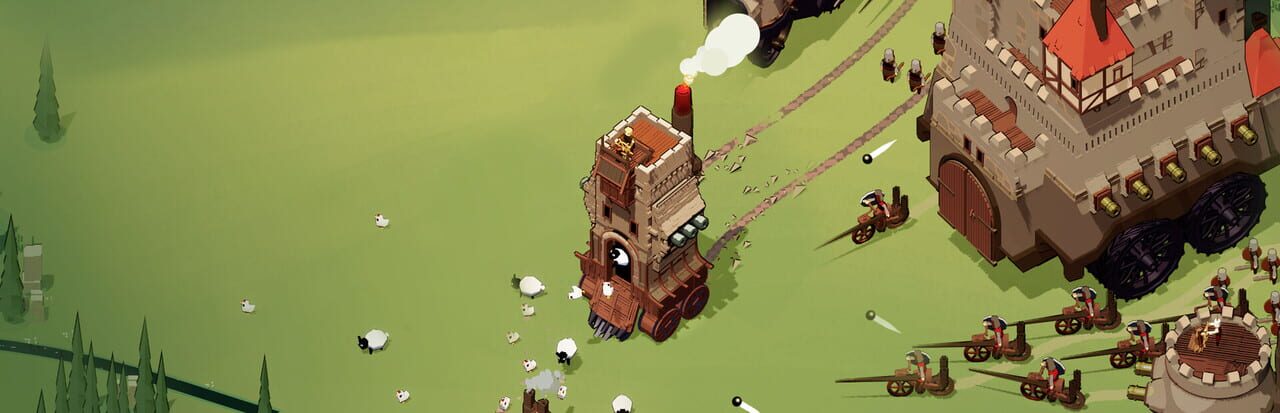
Wanderburg is a fast-paced, minimalist roguelike set in a medieval world of roaming fortresses. Castles hunt, Villages flee. And only the biggest stronghold survives. What begins as a modest moving fortress quickly becomes a growing, devouring war machine that reshapes the battlefield with every run.
Roll forward and consume everything in your path. Fleeing villages, wandering flocks and smaller fortresses all feed your growth. Defeat powerful enemy castles to push your evolution further. Your castle does not just upgrade - it expands.
Steam-powered siege engines roll beside arcane artillery. Knights ride bicycles into battle. Massive strongholds fire broadsides like warships on land. And somewhere beyond the hills, something bigger is already on the move.
Build your modular arsenal piece by piece. Break the game while you're at it. Mount cannons, raise arcane towers staffed with wizards, deploy explosives, and experiment with wildly different builds each run. Between runs, unlock new modules and vehicles that open up fresh strategies and game-breaking combinations.
A modular progression system lets you expand your moving fortress with new siege modules and structures, while unlockable vehicles, artifacts and captains between runs steadily widen your strategic options and build variety.
Fully playable with mouse, keyboard, or controller and highly optimized for almost anything you throw at it.
From the game's Steam store page.
THE GAMEQ VERDICT1,071 reviews analyzed
What players are actually saying
1. Summary
Wanderburg is an Early Access survivors-style roguelite (a "bullet heaven") where you drive a castle on wheels or legs, eat sheep, villages and smaller castles to grow, bolt cannons, archers, mages and battering rams onto its front, sides, back and top, and fight up to four bosses per map before an escalating "Overtime" phase. Most players love the premise and the moment-to-moment feel. Steering a growing fortress, ramming enemies and eating everything on the map is often described as silly, addictive, "one more run" fun, helped by a charming low-poly art style and a soundtrack that reviewers praise often, especially the German-sung theme and the techno-playing captain. Comparisons to Mortal Engines, Howl's Moving Castle, Vampire Survivors and Megabonk come up often, and most reviewers who mention price felt the launch-discount price of around $10 was fair.
The main complaints come from positive and negative reviewers alike. There is no meta progression that makes you stronger between runs (unlocks are sidegrades), and the silver needed to unlock them is a slow grind. Content runs out in roughly five to fifteen hours, and many modules feel useless, which narrows play to a few builds. Difficulty jumps sharply after the first map and at four and five skulls, with fast off-screen rammers and pinpoint-accurate enemies, and Overtime quickly turns into an unwinnable swarm. Launch week also brought crashes (notably on AMD GPUs), a severe slowdown after pausing, a rough menu UI and no key rebinding. Some positive reviews recommend it mainly for what Early Access could make it.
2. What keeps coming up
What players praise
Driving a castle that eats everything is instantly, addictively funHigh
Reviewers describe the core loop as simple, immediate and hard to put down: roll over sheep, peasants and farmhouses for gold, level up modules, beat a boss, grow bigger and zoom out, then start swallowing things that used to threaten you. Ramming builds that send bosses flying, hoovering up flocks of sheep, and watching enemy castles break apart are the moments they mention. Several note that it asks for more active play than Vampire Survivors: you steer, dodge projectiles and time up to four active abilities. Players also like that runs are short enough for quick sessions, a podcast or a video on a second monitor. About 10 negative reviews praise the idea before explaining why they still can't recommend it ("the idea is good, but not the game"), and one positive review puts the same mix more kindly, calling it a bit buggy while "the core is fun."
Charming art style, humor and a standout soundtrackHigh
Players enjoy the minimalist, flat-shaded style, the inventive enemy castle and vehicle designs, the fleeing farmhouses, the Wilhelm scream and the German-flavored humor. The music gets warm praise: the sung "Wanderburg" chorus is called an earworm, and the techno captain who "only knows one song" became a running joke. A few found the music repetitive after many hours, and some critics say the art and premise are carrying thinner systems.
The Mortal Engines fantasy finally made playableMedium
Some reviewers bought the game on the premise alone, citing Mortal Engines ("municipal Darwinism"), Howl's Moving Castle, Katamari Damacy and agar.io. For these players the fantasy of a predatory rolling city is the hook, and they forgive rough edges because nothing else offers it. More critical reviewers counter that the "moving castle" idea is mostly cosmetic: mechanically it plays like any survivors-like, with only three chassis and fixed slot layouts.
Plays well on Steam Deck, handhelds and controllerMedium
Reviewers who play on Steam Deck, Legion Go and ROG Ally mostly report smooth play, and several say controller is the best way to play. Low-end laptops and Linux are also reported to run it. The exceptions are a handful of Deck users who needed to switch to fullscreen to stop crashes, and some controller users who found turning in tight circles awkward or D-pad input unrecognized in menus.
Fair value at the launch discountMedium
Most players who mention price feel the launch-discounted $10 (or roughly €10) was a good deal for ten or more hours of fun. Opinion is more divided at the full $15 price (see the split section).
Active, fast-patching developersLow
Several players note quick hotfixes in launch week, new launch options (DX11, DX12, Vulkan for AMD) that fixed their crashes, and developer replies on reviews and forums that turned a few negative reviews positive. One reviewer says the last couple of updates made more builds viable and late-game damage less punishing.
Where players are split
Is there enough content for the price?High
One camp says it "feels more like Demo + a bit": three biomes, three chassis and four fixed bosses per map, seen in full within five to ten hours, with nothing left to do once you beat the hardest zones. Some who played the demo feel very little was added, and one argues some menus got worse. The other camp says there is plenty for an Early Access game at this price, with 14 captains, around 20 weapons and dozens of artifacts to mix, and that complaining about scope in Early Access misses the point. Price tends to decide it. Reviewers are generally happy at $10 and less sure at $15, and one notes the developers say they are considering raising the price as content is added.
Did the full release improve on the demo?Medium
Players who played the Next Fest demo are split. Some say the release is much better (one calls it "twice as good"): smoother, more polished, more unlocks, better balanced and less punishing. Others feel the opposite: more enemies, more aggression and more bugs than the demo, controls they found worse, and demo progress that did not carry over. Several point out that the demo shows most of what the game has, so anyone unsure can try it first.
Challenge versus unfair difficultyMedium
Some players enjoy the difficulty that others complain about below. They say higher skull levels are meant to be hard, that experimenting until a build clicks feels great, and that a tough Overtime gives the game its replayability. One long-time player argued that the balance nerfs players demanded made the game less compelling. Several reviewers who had struggled later edited their reviews, after realizing they had entered a harder zone by accident or after patches softened late-game damage.
Steering and controlsLow
Some praise the driving as tight, weighty and satisfying, especially on controller. Others find the castle sluggish, prone to sliding or getting stuck on terrain, and too slow to dodge fast enemies. The spider chassis is singled out as awkward to steer.
What frustrates players
No real meta progression, and a slow silver grind to unlock anythingHigh
This complaint comes up more than any other, and about as often in positive reviews as in negative ones. Players expecting a roguelite are surprised that silver buys only new modules, captains, crews, chassis and artifacts. These are sidegrades: as one reviewer puts it, a module's damage ceiling in your first run is the same as in your hundredth, so harder maps give you no raw power to grind toward. The prices make it worse. Many unlocks cost 5,000 to 8,000 silver or more (one artifact 18,000, a cosmetic sheep pet 50,000), while a run pays roughly 1,000, failed runs pay little or nothing, and some quests ask for enemies that don't spawn on the map they're tied to. Some describe replaying the same early maps with the same starter build just to afford one new piece, then finding the piece is weaker than what they had. A few reviewers are fine with the horizontal design, but those who complain want cheaper unlocks, partial silver on failure, or some permanent stat progression.
Steep difficulty spikes and punishing enemy designHigh
Difficulty complaints cluster in two places. The first is the jump from the first map to the second: one reviewer beat the first map easily and then lost three times in a row on the second. The second is the four- and five-skull zones. Players name specific culprits: rams and walking mines that build speed off-screen and one-shot you, enemies that aim where you are going, mortar spam with hard-to-read arcs, bosses buried in dozens of escorts so you can't reach them, enemies faster than your nitro, and very scarce healing. One reviewer sums up the result as "speed is king", since extra health can't offset damage you can't avoid. Some also report that the first minutes of a run are the hardest part, since you start weak with no permanent upgrades to lean on.
Overtime turns into an unwinnable swarmHigh
After the last boss, Overtime lets you keep playing for more silver, and it draws angry feedback. One reviewer says the question becomes "how long can you run away" rather than "how long you can fight for", and others describe swarms of sawblade and spiked units faster than you, kamikaze bombers, and mortar and cannon fire with near-perfect accuracy. It arrives right as a build finally feels powerful, so the power fantasy is cut short. Because it is also the main source of extra silver and leaderboard score, some see it as a grind wall. A minority defends it as the real challenge of the game, and a few ask for a separate endless mode.
Unbalanced modules, weak synergies and few viable buildsHigh
Reviewers who discuss builds say only a few work on hard maps. Archers and arrows are named as reliable picks (though one reviewer finds cannons underpowered), while summons, melee crews, many front weapons, support crews and most captains are called weak or useless. Summoned units get stuck and pick targets poorly, and one reviewer found infantry and archers stop reaching enemies after the castle grows. Upgrades are mostly flat percentage stat boosts, with damage stats split between auto-attacks and abilities so that the wrong picks are wasted. Weapons rarely interact with each other, and one reviewer says "just pick the highest rarity" is often enough. The boss-kill choice between defense and mobility is called an illusion of choice. Reviewers want more distinctive chassis (a few find the tank chassis too slow to be worth using), more module slots and more build-defining upgrades.
Unlocking more makes runs worseMedium
Every weak module or artifact you unlock stays in the level-up pool forever and lowers your odds of seeing the pieces your build needs. Some players say they deliberately avoid unlocking things or restart runs at the four-minute mark when the right upgrades don't appear, and they are annoyed that still-locked items show up as level-up choices. They ask for a way to ban, lock or reroll options.
Crashes, freezes and slowdownsMedium
Crashes are among the most common complaints from players who left a negative review within two hours. Players report crashes at launch, on selecting a map, at level-up screens, after the third or fourth boss and when alt-tabbing. AMD Radeon owners report some of the worst cases, including GPU driver crashes and full system reboots. A bug several players hit drops the game to a few frames per second after it sits paused or on an upgrade screen for a few minutes, which can cost a whole run. Frame rates also sag with heavy on-screen action and in Overtime. Several reviewers confirm that launch-week patches and the DX11/DX12/Vulkan launch options fixed their crashes. An early hotfix left some players stuck on a "Generating world" screen, and one reviewer says the 19 and 21 September hotfixes brought crashes back.
Rough menus, no key rebinding, typos and unexplained statsMedium
The UI is described as placeholder-grade, and one reviewer says the menus feel "like something from an old Flash game". Players list mismatched fonts, blurry elements, Backspace instead of Escape to go back, no mouse cursor in parts of the menu, an in-game bug reporter that softlocks on controller, and V-Sync resetting every launch. The lack of key rebinding is a hard stop for some. The fixed WASD-plus-QERT layout leaves left-handed players stuck, one reviewer's hand hurt within minutes, and another says the developers have known since the demo that players wanted rebinding. Players also flag typos and unclear translations, and descriptions like "boost significantly" with no numbers, which make it hard to know what upgrades or quest targets actually do.
Lost save progress across PCsLow
A small but serious cluster: players who switch between two computers report Steam Cloud overwriting their unlocks with an older save, and a few lost progress for other reasons. For those affected it wiped hours of grinding.
Leaderboards and missing quality-of-life featuresLow
Some find the always-visible leaderboard intrusive and full of impossible scores, and want it filtered by map. Others ask for a mid-run save, an enemy compendium to see which enemies spawn where for quests, a stats view during level-ups and a more detailed end-of-run screen.
3. The player conversation
The tone is warm and forgiving. Many reviews are short and enthusiastic, full of jokes about eating sheep and the theme song, and some positive reviews carry explicit caveats ("It still needs more time in the oven"). Some negative reviews are just as hedged: the game is fun, but not one they can recommend yet, often with a promise to revisit. Reviewers on both sides mostly agree the game is fun and split over whether its progression, balance and polish are worth paying for now.
Who raises what shifts with playtime. Reviewers with under two hours most often mention crashes, a quick sense that the game lacks depth, and menus and controls without rebinding. In the two-to-ten-hour group, by far the largest, the silver grind comes up most, alongside thin content, module balance and difficulty. Players with ten or more hours talk most about module balance and difficulty, including Overtime and the four- and five-skull wall.
Sentiment was steady across the first three weeks: 82% positive in launch week (683 reviews), 83% in week two and 79% in week three. Some week-three reviews report that the mid-September hotfixes brought crashes back, while several earlier negatives were edited to positive after crash fixes and balance patches.
4. What the developers could do
- Add real meta progression and cut unlock costs. The complaint that comes up most, in positive and negative reviews alike, is that unlocks are sidegrades and silver comes in far too slowly, so players grind the same maps without ever getting stronger.
- Rebalance difficulty spikes and rethink Overtime. Players hit a wall on the second map and at four and five skulls, and describe Overtime as an unwinnable swarm of fast, off-screen, pinpoint-accurate enemies that ends runs just as builds come online.
- Bring weak modules, captains and crews up to the arrow and cannon meta, and add cross-weapon synergies. Reviewers say only a handful of builds work on hard maps, summons and many front weapons are useless, and upgrades are bland stat bumps that rarely interact.
- Let players ban, lock or reroll items in the upgrade pool. Players say unlocking more makes runs worse because weak items dilute the pool forever, and still-locked items appearing as choices adds to the frustration.
- Fix crash and slowdown bugs, especially on AMD and after pausing. Crashes are among the most common complaints from players who quit early, and the frame-rate collapse after pausing or idling on an upgrade screen costs whole runs.
- Add key rebinding and overhaul the menu UI. Players call the menus placeholder-grade, dislike Backspace-to-go-back and settings that don't stick, and left-handed players are stuck with a fixed layout.
- Explain upgrades with real numbers and fix typos and quest targets. Vague descriptions, spelling and translation errors, and quests requiring enemies that don't spawn on their map leave players guessing and slow progression further.
- Fix cloud saves across multiple PCs. A small group lost hours of unlocks when Steam Cloud overwrote their progress after switching machines.