We Were Here Too
Total Mayhem Games · Puzzle, Indie, Adventure
Overview
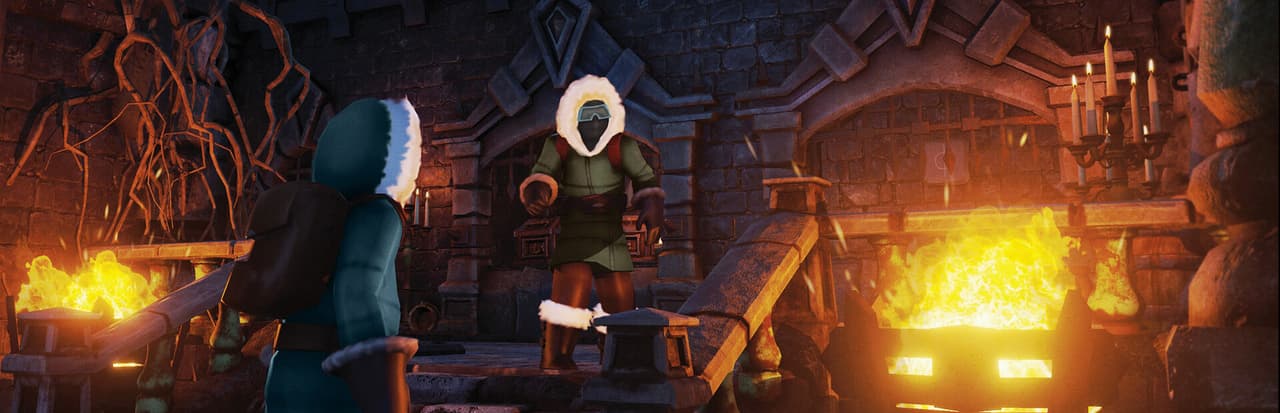
We Were Here Too is an online only, first-person cooperative adventure set in a fictional medieval castle. The survivors find themselves in a drastically different scenario. One is trapped in what seems like a royal court, while the other finds themselves in an abandoned tomb. Once again, all they have is a walkie-talkie, with a familiar voice on the other end. Do you have what it takes to survive the castle… together with your friend?
THE GAMEQ VERDICT4,830 reviews analyzed
What players are actually saying
1. Summary
In the second game of Total Mayhem Games' co-op puzzle series, as reviewers describe it, two players are split up inside a castle and can only talk over a walkie-talkie, so every room depends on describing what the other person cannot see. Most reviewers recommend it, and their praise centres on that setup. Positive reviews often come from couples, siblings and friends who laughed and yelled their way through a few hours. Some also mention the gloomy castle, the music and the option to replay from the other role, and some returning fans call it a clear step up from the free first game.
Bug reports run through every year: softlocks, crashes and falling through the map turn up in 11% of all reviews and 33% of the negative ones, often alongside save and checkpoint failures that send pairs back to the start. Length is the other long-running objection, often with advice to buy on sale. A timed maze near the end is named more often than any other room, and some reviewers dislike the timed puzzles in general. Players disagree about whether this sequel beats or trails the free original, and about whether its puzzles are clever or mostly a matter of describing symbols. The share recommending it stayed between 77% and 83% each year from 2018 through 2024, then fell to 72% of reviews written in 2025 and 59% of those written in 2026, a year whose reviews bring up the maze and the controls far more often.
2. What keeps coming up
What players praise
Talking each other through split puzzlesHigh
Each player holds half of every puzzle, and the fun comes from turning a strange symbol, a sword or a floor plan into words your partner can act on. "Both players have information that the other person doesn't have. Because of that, successfully solving a puzzle really feels like a shared achievement rather than two people simply working on the same puzzle by coincidence," one player wrote. Another said "It really makes you aware of how you're communicating with others and how they're understanding you." Short positive reviews often joke about yelling at a partner, mixing up left and right, or being abandoned at the end, and the jokes are affectionate. Reviewers stress that the experience depends on who you play with, and some advise against playing with strangers.
Atmosphere, music and the castle settingMedium
Praise for the atmosphere often calls it spooky or eerie without being outright horror, and the marionette figure gets nervous, fond mentions. "The atmosphere in this game is simply astounding and the music makes it even better," one reviewer wrote. When the soundtrack comes up it is mostly for how it ramps up tension in the timed rooms, though a few found the loops grating or the timed-room music too loud over a partner's voice. Some reviewers say this entry is less scary than the first game.
Two roles worth playing twiceMedium
Switching between the Lord and the Peasant is a reason to play again, and achievement hunters note that a full completion needs both sides plus the secret ending. Reviewers like that the roles trade off giving and receiving information more than in the first game: "Very good balance with different enough mechanics on either side that you get to enjoy both." Some say the second run is mostly a speedrun once you know how each room works, and that the replay value ends there.
Where players are split
The sequel against the free first gameHigh
The free first We Were Here comes up constantly, and reviews that take a side are split about evenly between calling this one better and calling it worse. One side finds it longer, harder or more polished: "If you liked the first game, then We Were Here Too is just like that, but bigger and better in every way." The other calls it the weakest of the series or the one to skip, and most of those verdicts come from negative reviews. Fans of the first game who disliked this one point to fewer memorable puzzles, a weaker sense of dread and the price tag on a game of similar length. One reviewer who preferred the other entries suggests playing this one last or not at all.
Clever puzzles or just describing symbolsMedium
For one camp the puzzles are fair and satisfying: "They can all be worked out with good communication and by asking the right questions." Others say most rooms come down to one player describing an image while the other finds a match, with long walks between options, and most reviews making that complaint are negative. "It just wasn't interesting enough, plus there was a lot of time spent walking around just looking for the thing that matched," one wrote. A related complaint is that some rooms never explain what they want, which sent some pairs to guides, YouTube or screen sharing. Besides the maze, the rooms named in this debate are the armory with its near-identical weapons, the chess-board room and a late puzzle in a cell with rising lava.
The secret ending and its hidden switchesMedium
Players who found the secret ending liked being rewarded for exploring: "it felt like a nice reward for observing your surroundings." Others only learned at the very end that it depended on items spread through earlier rooms, with nothing pointing them out: "the game does a really poor job of telegraphing that one is only achievable if you collected a load of secrets in the previous levels." That progress is lost when a pair reloads a checkpoint, crashes or stops for the night, so reviewers say the secret ending in practice needs one uninterrupted session. Some also found the payoff underwhelming after the effort.
Story and loreMedium
Fans like the books scattered through the castle and the links to the first game and later entries. Critics find the story vague or disconnected from the puzzles ("I wish there was more context to the games, because they feel like a number of puzzles existing in the void"). A practical complaint that comes up again and again is that the cursive handwriting in the books is hard to read in the dark rooms, and several reviewers call the intro cutscene low quality.
The in-game walkie-talkieLow
Some players insist on the push-to-talk walkie because it forces turn-taking and adds tension: "Only one of you can speak at a time, and you'll spend a lot of your time talking describing the objects and rooms that you'll encounter in order to solve puzzles." Others found it cut out or never transmitted ("There's nothing as frustrating as seeing the little light go on and then... nothing.") and moved to Discord. Only a small number of reviews report it broken, the largest batch of them from 2018.
What frustrates players
Bugs, softlocks and crashesHigh
11% of all reviews and 33% of negative ones report technical problems. They describe doors that stay shut after a solved puzzle (the stairwell comes up more than once), falling through the floor or into lava without dying, weapons or cubes vanishing, and crashes. "It is riddled with bugs that cause softlocks, forcing you to restart the game, but the checkpoints don't work and take you back two rooms," one player wrote. A cluster of reviews traced their crashes to a plugged-in controller and only got stable by switching to keyboard and mouse, and a 2026 review describes the screen stuttering whenever the player looks around with the mouse. The same bugs are reported from 2018 to 2026, and a negative reviewer who works as a software developer wrote "I could not wrap my head around how such egregious flaws can make it to production and still be there 7 years after launch." Positive reviews often mention the same bugs as an annoyance they worked around.
Short for the priceHigh
Reviewers who give a figure quote roughly one and a half to four hours for a first run. Length was the main objection in 2018, the launch year, and the comparison with the free first game sharpened it: "This game has same amount of content than the first one, but the first one was free." Positive reviews make the same point and add that it is worth it on sale ("little short for 10 dollars but really good game, i got it for 2 dollars and would say it is very worth it"). Reviewers also point out that both players need their own copy, and a few asked for a two-pack.
The timed maze and other timed roomsHigh
The maze, where one player guides the other through a shifting circular layout against a clock, is named more often than any other room. The maze or timed puzzles in general come up in 15% of negative reviews. Players describe timings with no room for a single hesitation, latency between players, and a view that does not show the guide the whole layout. "We made it through running and without making any mistakes on our path, and we still weren't able to complete it within the time given," one pair wrote of the timed trials. Others say the timer turns a communication puzzle into memorising a route, and some gave up at that point. A few enjoyed the pressure, and some found the maze far easier after swapping roles. The maze alone came up in 18% of reviews written in 2026, against 2% in 2018.
Saves and checkpoints that do not holdMedium
Players report coming back to a session and finding they must start from the first room, a level select that does not unlock, or a reload that puts them at an earlier checkpoint than the one the game announced. "Game doesn't save progress. You have to start it all again everytime you play," one wrote. A few pairs say they fixed it by editing a config file. Three reviews from September to November 2025 say an update or the developers deleted their saved progress. Most of these complaints come from negative reviews, and they make the secret-ending problem above worse.
Fiddly object handling, especially the cubesMedium
Players complain about the controls for picking up, inspecting and rotating objects, most often in the timed cube room. "Picking up the cube often resulted in immediately dropping the cube," one player wrote, and another said "The cubes spinning all over the place when I'm hitting 1 directional input is just ridiculous." Swapping weapons on the knight statues gets similar complaints. These complaints became much more frequent in 2026.
Getting a session runningMedium
Connection reports describe lobbies that will not form, invites that fail, disconnects every few minutes, and a dropped partner sending both players back to the menu. "We spent more time setting up a lobby than playing the actual game," one pair wrote. A few reviews from 2019 to 2022 also found nobody online to play with, so the game only works if you bring your own partner.
Settings and platform snagsLow
Smaller groups report keybindings that will not remap (a problem for non-QWERTY layouts), no colour-blind or ultrawide support, motion blur that caused dizziness, and a log file that grew to about 8 GB on disk. In 2020 a few Linux players objected that the Linux build was removed after they had bought it for that platform.
3. The player conversation
The tone is warm even when it is critical. Short positive reviews read like inside jokes about a specific friend, partner or sibling, while negative reviews run longer and list the rooms that broke their evening. Fans of the series often compare all its entries, placing Too anywhere from favourite to weakest.
Who raises what depends on how far players got. Reviews from people who stopped within the first hour often describe crashes, disconnects or lobbies that would not form, and none mention the maze, which they never reached. The maze, the armory, the cubes and the chess board come from pairs who played through most of the game, and the secret-ending and replay complaints come from those who finished and tried for full completion.
What players complain about has changed over the years. In 2018 length and price drew more comment than bugs or the maze. Bug reports were more common from 2020 on than at launch and peaked in 2025, the year save complaints also rose and the recommend rate slipped to 72%. In 2026 the recommend rate fell to 59%, and the maze and timed rooms came up in 22% of that year's reviews, more than in any earlier year, alongside complaints about the cubes and object controls. Praise for the communication concept and the atmosphere appears in every year.
4. What the developers could do
- Loosen the maze timing or add an optional relaxed timer. No room is named more often, it came up in 18% of reviews written in 2026, and some pairs who took the right path describe missing by fractions of a second.
- Fix the softlocks, doors that stay shut and fall-throughs. 33% of negative reviews report bugs, and doors that stay shut after a solved puzzle and floors players drop through force full restarts.
- Make checkpoints and the level select save reliably, including secret-ending progress. Players describe restarting from the first room after a break, and losing switch progress on any reload makes the secret ending a one-sitting run.
- Signpost the hidden switches or let players go back for them. Some reviewers only discovered at the final room that the secret ending depended on items in earlier rooms they could no longer reach.
- Smooth out object pickup and cube rotation. Complaints about dropping, spinning and swapping objects became much more frequent in 2026, and they cluster in the timed rooms where a fumble costs a run.
- Fix the controller crash and keybinding menu. Several reviewers only got the game stable by unplugging their controller, and others could not remap keys for non-QWERTY keyboards.
- Stabilise sessions and the walkie-talkie. Failed invites, disconnects that return both players to the menu and a walkie that stops transmitting push players to restart or to Discord.
- Offer a two-pack or bundle price. Both players need a copy of a game reviewers call short, many recommend waiting for a sale, and a few asked for a discounted pair.